
Tax Deductions for Cleaning Businesses: 2026 Tax-Year Guide
Cleaning businesses can deduct vehicle mileage (72.5 cents per mile for 2026), supplies, equipment under Section 179, insurance, software, home office costs, contractor payments, wages, and marketing. Track every expense, keep receipts, and make planned purchases before December 31. This guide is educational, not tax advice, confirm your specifics with a tax professional.
 R Rashdi
·
July 2, 2026
·
12 MIN READ
R Rashdi
·
July 2, 2026
·
12 MIN READ

Quick answer
Cleaning businesses can deduct vehicle mileage (72.5 cents per mile for 2026), supplies, equipment under Section 179, insurance, software, home office costs, contractor payments, wages, and marketing. Track every expense, keep receipts, and make planned purchases before December 31. This guide is educational, not tax advice, confirm your specifics with a tax professional.

Cleaning business tax deductions are the cheapest money you will ever make. Every legitimate write-off you track reduces the income the IRS taxes you on, and cleaning businesses generate deductible expenses constantly: miles between jobs, cases of microfiber, a new vacuum, the software that runs your schedule.
Tracking these write-offs is far easier when expenses are categorized as they happen, see how accounting software for a cleaning business handles it with 21 built-in categories.
Three things changed for the 2026 tax year, and all three matter to cleaners. The IRS standard mileage rate rose to 72.5 cents per mile. The 1099 reporting threshold jumped from $600 to $2,000. And Section 179 expensing limits went up again. This guide covers all of it, plus the moves to make before December 31.
One thing first: this article is education, not tax advice. Tax law has exceptions on its exceptions. Use this to walk into your tax professional’s office with better questions, not to skip the visit.
The 12 Biggest Cleaning Business Tax Deductions for 2026
Here is the full checklist. Each row gets a deeper treatment below.
| # | Deduction | The short version |
|---|---|---|
| 1 | Vehicle and mileage | 72.5 cents per business mile in 2026, or actual expenses |
| 2 | Cleaning supplies and chemicals | Fully deductible, disinfectants, microfiber, trash liners, all of it |
| 3 | Equipment | Vacuums, floor machines, vans, Section 179 or bonus depreciation |
| 4 | Uniforms and protective gear | Branded shirts, gloves, goggles, non-slip shoes |
| 5 | Business insurance | Liability, workers’ comp, commercial auto, bonding |
| 6 | Software subscriptions | Scheduling, invoicing, accounting tools, 100% deductible |
| 7 | Home office | $5 per square foot simplified, up to $1,500 |
| 8 | Phone and internet | Business-use percentage of your bill |
| 9 | Contractor payments | Deductible; 1099-NEC required at $2,000+ for 2026 payments |
| 10 | Wages and payroll taxes | Wages plus employer Social Security, Medicare, FUTA, SUTA |
| 11 | Marketing and advertising | Website, ads, business cards, vehicle wraps |
| 12 | Training, licenses, professional fees | Certifications, business licenses, your CPA’s bill |
Vehicle and Mileage: The 72.5-Cent Question
Your van is probably your biggest deduction. For 2026, the IRS standard mileage rate is 72.5 cents per business mile, up 2.5 cents from 2025 (IRS Notice 2026-10). Drive 12,000 business miles this year and that is an $8,700 deduction, no gas receipts required.
You have two methods, and you can only pick one per vehicle per year:
- Standard mileage: multiply business miles by 72.5 cents. It covers gas, maintenance, insurance, and depreciation in one number. Simple, and usually the right call for older or modest vehicles. If you own the vehicle and want this method, you must use it in the first year the vehicle is in service.
- Actual expenses: total your gas, repairs, insurance, registration, and depreciation or lease payments, then multiply by your business-use percentage. This can win for an expensive van with heavy maintenance, but it demands receipts for everything, all year.
What counts as a business mile matters more than which method you pick. Driving between client jobs counts. Supply runs count. The drive from home to your first job is normally commuting, not deductible, unless your home office qualifies as your principal place of business, in which case those miles count too. That single detail changes the math for a lot of solo cleaners, so raise it with your tax professional.
The IRS expects a contemporaneous log: date, destination, business purpose, miles. “Contemporaneous” means kept as you go, not rebuilt from memory in April. A reconstructed log is one of the easiest things an auditor takes apart. Automatic trackers handle this for you; our roundup of cleaning business apps covers two that keep IRS-ready logs in the background.

Supplies, Equipment, and Section 179
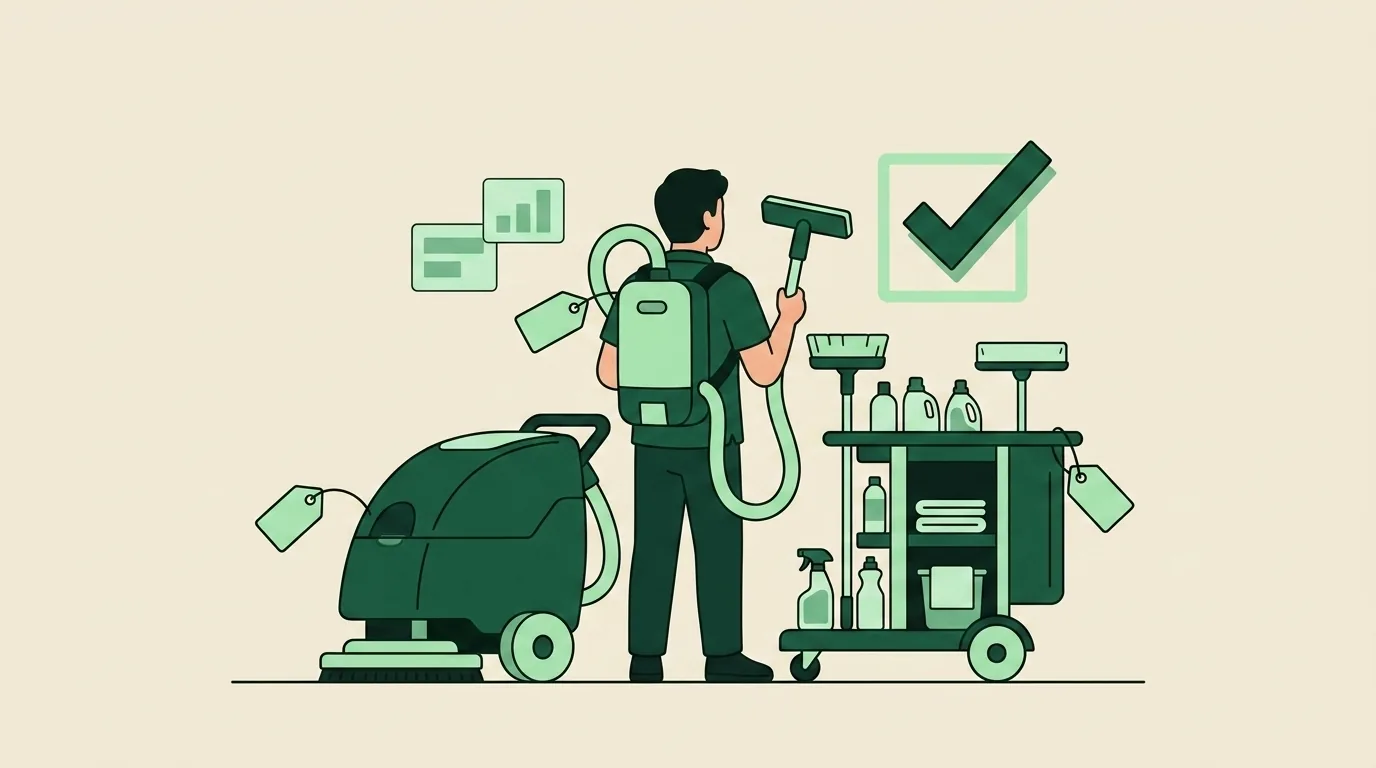
Everything you spray, wipe with, or throw away on a job is deductible: disinfectants, glass cleaner, floor products, microfiber, trash liners, paper goods. Keep business supplies on a business card, separate from your household shopping, and the documentation takes care of itself.
Equipment is where the bigger numbers live, and you have three tools:
- De minimis safe harbor: items costing $2,500 or less per item or invoice can simply be expensed in the year of purchase under the IRS de minimis safe harbor election. That covers most vacuums, buffers under that price, and small tools. (Older guides say $500, that limit went away years ago.)
- Section 179: lets you deduct the full purchase price of qualifying equipment the year you place it in service, rather than depreciating it over years. For tax years beginning in 2026, the limit is $2,560,000, phasing out above $4,090,000 in purchases (IRS Rev. Proc. 2025-32). No small cleaning company gets anywhere near those caps, practically, you can expense the whole floor machine, the trailer, the equipment package for a new crew.
- Bonus depreciation: under the 2025 tax law, 100% bonus depreciation is back on a permanent basis for qualifying property. Whether 179 or bonus is better for you depends on your income and your state (many states don’t follow the federal rules), that is a 10-minute question for your CPA, worth far more than the 10 minutes.
One timing rule to tattoo on your wrist: “placed in service” is what counts, not “ordered.” A scrubber sitting in a warehouse on December 31 deducts next year.
Repairs and maintenance on equipment are always fully deductible in the year you pay them, no depreciation needed.
Home Office, Phone, and Software
If you run scheduling, quoting, and invoicing from a dedicated space at home, the home office deduction is real money, and most cleaning owners qualify and never claim it.
The test is exclusive and regular use. A spare room that is genuinely your office qualifies. The kitchen table does not. Two ways to calculate:
- Simplified method: $5 per square foot, up to 300 square feet, a maximum of $1,500 per year. No expense tracking needed.
- Actual method: the business percentage of rent or mortgage interest, utilities, insurance, and repairs. A 150-square-foot office in a 1,500-square-foot home is 10% of those costs.
The quiet bonus mentioned above: a qualifying home office can convert home-to-first-job drives into deductible business miles. For a cleaner driving to clients every day, that often beats the deduction itself.
Your phone and internet are deductible at their business-use percentage. If 70% of your phone use is dispatching crews, quoting, and texting clients, deduct 70% of the bill.
Software is the easy one: subscriptions used for the business are 100% deductible. Your scheduling and invoicing platform, your accounting software, cloud storage, payment processing fees, all of it. If you run CleanerHQ alongside QuickBooks, both subscriptions are write-offs, and the expense records they hold make every other deduction on this list easier to prove.
Contractor Payments and the New 1099 Rules
Payments to legitimate independent contractors, subcontracted cleans, a carpet specialist, your bookkeeper, are fully deductible. The paperwork around them just changed in a big way.
For payments made in 2026, the 1099-NEC reporting threshold is $2,000, up from the $600 limit that applied through 2025. Congress raised it in the 2025 tax law, and the IRS has confirmed the new threshold applies to payments made after December 31, 2025, with inflation adjustments in later years. So: pay a contractor $2,000 or more for services during 2026, and you file a 1099-NEC.
The mechanics:
- Collect a Form W-9 from every contractor before their first payment, not in January when you are chasing 14 people for tax IDs.
- 1099-NEC forms are due January 31 to both the contractor and the IRS (next business day when the 31st falls on a weekend).
- If you file 10 or more information returns in total, the IRS requires you to e-file them.
A deduction below the threshold is still a deduction, you just don’t file the form. Keep invoices and payment records either way.
The bigger risk in this category is not the form. It is classification. If your “contractors” work your schedule, in your uniforms, with your supplies, under your direction, the IRS may call them employees, and the penalties run 20% and up of unpaid taxes, plus interest, plus state fines. Read our guide to independent contractors vs employees before tax season, not after a letter arrives.
Wages, Insurance, and the Rest of the Checklist
Employee costs. Wages, overtime, and bonuses are fully deductible, and so are the employer taxes stacked on top: Social Security (6.2% of wages up to the annual cap), Medicare (1.45%), federal unemployment (FUTA), and state unemployment (SUTA). Workers’ comp premiums, health benefits, and retirement contributions you make for employees are deductible too.
Insurance. General liability, commercial auto, bonding, and umbrella policies are ordinary business expenses. If you are self-employed, your own health insurance premiums are generally deductible as well, on your personal return rather than the business schedule, which is exactly the kind of detail your tax professional handles in one sentence.
Marketing. Website hosting, Google and Facebook ads, business cards, flyers, and yes, the vehicle wrap on your van is deductible advertising.
Training and professional fees. Certifications, safety training, industry association dues, and conferences count, with travel meals limited to 50%. Your CPA’s bill and any legal fees for the business are deductible, the tax help pays for part of itself.
Retirement. A SEP-IRA lets a self-employed owner contribute up to 25% of net self-employment earnings, capped at an annual IRS limit, one of the largest single deductions available to a profitable owner. Setup deadlines vary by plan type, so ask about it before year-end.
Year-End Moves Before December 31
The 2026 tax year ends in five weeks. Here is the late-November playbook:
- Buy planned equipment now and place it in service. In use by December 31 means deductible in 2026.
- Stock up on supplies you will use anyway. January’s microfiber order, purchased in December, deducts this year.
- Prepay qualifying expenses. Cash-basis businesses can generally deduct prepaid insurance or software covering up to 12 months ahead, the “12-month rule.” Confirm your situation qualifies.
- Settle contractor invoices and chase W-9s before 1099 season starts.
- Consider invoice timing. Cash-basis owners who bill late December may receive payment, and recognize income, in January. Whether deferring helps depends on next year’s outlook; ask before you do it.
- Reconcile the mileage log while you still remember October.
- Book the tax-pro call now. In November they have time to plan with you. In March they can only report what already happened.
Recordkeeping That Survives an Audit
Every deduction above lives or dies on documentation. The system that works for one-to-twenty-person cleaning companies is boring and short:
- Separate accounts. One business bank account, one business card. Mixed personal-and-business statements are the single biggest mess your bookkeeper untangles.
- Capture receipts the day you get them. Photo, app, or folder, pick one and stick to it.
- Categorize as you go. CleanerHQ’s built-in expense tracking sorts spending into 21 categories as it happens, and your invoices, payments, and payroll-ready exports live in the same system, so tax season is an export, not an archaeology dig.
- Keep records at least three years after filing, four for employment tax records, and up to seven in special situations. Cloud storage is cheap; reconstruction is not.
If your current “system” is a glovebox full of receipts, fix that before January. Start a free CleanerHQ trial (card needed to start the trial), and let every job, invoice, and expense land in one place your accountant will actually thank you for.
For the full picture of what these deductions mean for your bottom line, see our guides to cleaning business profit margins and quarterly taxes and 1099 filing, and the software side of the equation in our cleaning business software pillar guide.
Frequently Asked Questions
What is the IRS standard mileage rate for 2026?
The 2026 IRS standard mileage rate for business use is 72.5 cents per mile, up 2.5 cents from the 70-cent rate in 2025 (IRS Notice 2026-10). At 10,000 business miles, that is a $7,250 deduction. Always confirm the current rate at irs.gov before filing.
Do I still send a 1099 to contractors I paid $600?
Not for 2026 payments. The reporting threshold rose from $600 to $2,000 for payments made after December 31, 2025, under the 2025 tax law, with inflation indexing in later years. Payments made during 2025 still used the $600 threshold. Forms 1099-NEC remain due January 31.
How much is the home office deduction for a cleaning business?
The simplified method allows $5 per square foot up to 300 square feet, a maximum of $1,500 per year. The actual-expense method deducts the business percentage of rent or mortgage interest, utilities, and insurance, which can be larger. The space must be used exclusively and regularly for the business.
Should I use standard mileage or actual vehicle expenses?
Standard mileage (72.5 cents per mile in 2026) wins on simplicity and usually on value for modest vehicles. Actual expenses can come out ahead for an expensive van with high running costs. If you own the vehicle, you must choose standard mileage in its first year of service to keep the option later.
Can I deduct supplies I buy in December but use in January?
Generally yes. Cash-basis businesses can typically deduct incidental supplies, the kind you don’t inventory, in the year purchased. That makes a December stock-up on chemicals and consumables a legitimate year-end move. Large bulk purchases spanning years can be treated differently, so confirm with your tax professional.
How long should a cleaning business keep tax records?
Keep tax returns and supporting receipts at least three years from filing, employment tax records at least four years, and up to six or seven years where income was underreported or claims involve bad debts. The practical rule most accountants give small businesses: keep everything seven years, digitally.

Written by
Rashdi has spent 15+ years building and managing enterprise software, and has worked with US cleaning businesses since 2006. He founded CleanerHQ.