
How to Write a Cleaning Quote That Wins (Real Examples)
A winning cleaning quote names the client and property, lists every included task, prices three options (good/better/best), states what is excluded, sets a 30-day expiration, and asks for a decision. Send it within 24 hours of the walkthrough, in cleaning, speed is the cheapest competitive advantage there is.
 R Rashdi
·
July 6, 2026
·
13 MIN READ
R Rashdi
·
July 6, 2026
·
13 MIN READ

Quick answer
A winning cleaning quote names the client and property, lists every included task, prices three options (good/better/best), states what is excluded, sets a 30-day expiration, and asks for a decision. Send it within 24 hours of the walkthrough, in cleaning, speed is the cheapest competitive advantage there is.
You already know how to clean. The quote is where the money is won or lost, and most owners learn how to write a cleaning quote by copying whatever their first competitor sent them. That usually means one number, no scope, no options, and no follow-up.
This guide fixes all four. You’ll see a complete, realistic quote with annotations explaining why each line exists, the three-option pricing structure that quietly raises your average ticket, the exact wording that stops scope creep before it starts, and a follow-up cadence with scripts you can copy today.

Anatomy of a Cleaning Quote That Closes (Annotated Example)
Here is a full quote for a typical residential job, a 3-bed, 2-bath house going onto a biweekly schedule. The structure works the same for commercial work; only the line items change.
Sparkline Cleaning Co., Quote #Q-0147
Prepared for: Dana Whitfield · 412 Alder Court, Maple Grove, MN
Property: 3 bed / 2 bath single-family, approx. 1,900 sq ft, one dog
Walkthrough: July 2, 2026 · Quote valid through: August 1, 2026
Service requested: Initial deep clean, then recurring biweekly cleaning
| Option | Price per visit | What’s included |
|---|---|---|
| 1, Essential Biweekly | $150 | All floors vacuumed and mopped, kitchen counters, sink and appliance exteriors, both bathrooms fully cleaned, reachable-surface dusting, trash out, beds made |
| 2, Standard Biweekly (most popular) | $175 | Everything in Essential, plus microwave interior, cabinet fronts, baseboards on rotation, interior glass doors, pet-hair detail on upholstery |
| 3, Premium Biweekly | $205 | Everything in Standard, plus fridge interior monthly, oven interior quarterly, window sills and tracks, one load of laundry folded |
One-time initial deep clean: $295. Required before recurring service begins. Covers built-up soil, baseboards, vents, and full detail of both bathrooms and the kitchen.
Not included at these prices: interior windows beyond glass doors, walls, garage, exterior areas, post-renovation dust, biohazard cleanup. Each is available by separate quote.
Terms: 50% deposit reserves your deep-clean date; recurring visits are billed to the card on file after each visit. Pricing assumes the condition observed on July 2, if conditions change, we confirm any price adjustment before work begins, never after. Free reschedule with 48 hours’ notice. This quote expires August 1, 2026.
To accept: open your quote link, pick an option, and sign from your phone.
Now the annotations, six choices in that document that do the selling:
- The property line proves you looked. “3 bed / 2 bath, ~1,900 sq ft, one dog” tells Dana this price was built for her house, not pulled from a flyer. Generic quotes invite price-shopping; specific quotes end it.
- Tasks are listed, not summarized. “Both bathrooms fully cleaned” plus a visible task list beats “general cleaning” every time, because the client can see what $175 buys, and so can your crew when scope questions come up later.
- Three options, priced roughly 15-20% apart. More on the psychology below, but notice the middle option is labeled “most popular.” That label alone steers the decision.
- The deep clean is separate and explained. First-time and deep cleans typically run 1.5-2x the recurring rate, a standard operator rule of thumb, because you’re removing months of buildup, not maintaining your own work. Pricing it separately protects your recurring margin and makes the recurring price look smaller.
- The exclusion list is doing quiet, heavy work. Every item on it is a scope-creep dispute that now can’t happen.
- It expires. An open-ended quote is a free option for the client to sit on while your labor costs rise. Thirty days is standard; some operators use 14 for one-time work.
If you want a printable checklist of everything to capture before you write the document, our cleaning service quote checklist covers the full list.
Capture Everything Once: The Walkthrough
A quote is only as good as the walkthrough behind it. The expensive mistake is quoting from a phone description, discovering reality on day one, and then having the awkward “actually it’s more” conversation that kills trust.
Walk the property (in person or on a video call) and record, once:
- Size and layout. Square footage, levels, bedroom and bathroom counts. For commercial, cleanable square footage and fixture counts.
- Condition. Months since last professional clean, pet situation, clutter level, problem areas the client points out.
- Frequency and timing. Weekly, biweekly, monthly, one-time; access notes, alarm codes, parking.
- The client’s actual priority. Ask “what would make this a five-star service for you?” The answer goes in the quote, in their words. It’s the cheapest personalization available.
Time the job honestly while you’re there. If estimating duration is your weak spot, read how to estimate job time accurately, bad time estimates are the root cause of most underpriced quotes.
For the prices themselves, work from your costs up, not from competitors down. A widely used floor rule among veteran operators: price at no less than 2x your loaded labor cost, which keeps labor at or below 50% of revenue. Our house cleaning pricing guide has full rate tables by home size, frequency, and region.
Three-Option Pricing: Good, Better, Best
A single-price quote asks the client a hard question: should I hire this company, yes or no? A three-option quote asks a much easier one: which of these fits me? You’ve moved the decision from “whether” to “which”, and “which” decisions close more often.

Three principles make the structure work:
- The premium option is an anchor, even when nobody buys it. Next to $205, the $175 option reads as sensible rather than expensive. Without the anchor, $175 is the expensive option.
- The middle option is your real offer. Build it as the service you actually want to deliver at the margin you actually want to earn. Essential exists for budget shoppers you’d otherwise lose; Premium exists for the client who always wanted the fridge done and never knew to ask.
- Keep the gaps meaningful but close, roughly 15-20% per step. Too narrow and the options blur together; too wide and the premium tier looks like a different company.
There’s a margin bonus hiding here too: every upgrade from Essential to Standard is revenue with almost no extra acquisition cost. It’s the same mechanic covered in our guide to upselling cleaning services, just moved to the start of the relationship.
One warning: three options only work when each tier’s scope is explicit. “Premium = more thorough” is meaningless. “Premium = Standard + fridge interior monthly + oven quarterly” is a purchase decision.
Wording That Prevents Scope Creep
Scope creep is rarely malicious. The client genuinely believes “cleaning” includes the inside of the oven, and you genuinely never said otherwise. The quote is where you say otherwise. Six sentences to steal:
- The inclusion list. Itemize the tasks. If it’s not on the list, it isn’t in the price, but only if there is a list.
- The exclusion list. “Not included at this price: interior windows, walls, garage, post-renovation dust.” Listing exclusions feels negative; in practice clients read it as professionalism, and it converts “you missed a spot” arguments into “would you like to add that?” conversations.
- The condition clause. “Pricing assumes the condition observed at the walkthrough on July 2.” This is your protection when the empty house you quoted becomes a furnished house with two new puppies.
- The change-order sentence. “If the scope changes, we confirm any price adjustment before work begins, never after.” Clients fear surprise invoices more than they fear higher prices. This sentence removes the fear and protects you in the same breath.
- The expiration date. “This quote is valid through August 1, 2026.” Costs change; so does your schedule capacity.
- The add-on menu. Price the common extras up front (oven $35, fridge $30, interior windows $8 each). Scope creep with a price list attached has a different name: upselling.
Send It Fast: Speed Beats Polish
Here’s the uncomfortable truth about losing quotes: many were lost before the client ever read yours, because a competitor answered first while you were “getting to it Thursday.”
The classic research on this comes from outside the cleaning industry but applies directly. A Harvard Business Review study that audited 1.25 million sales leads found companies that contacted a lead within one hour were nearly seven times more likely to qualify it than those that waited even an hour longer, and more than sixty times more likely than those that waited a day. Cleaning leads behave the same way: a homeowner who fills out three quote forms tonight is hiring whoever makes it easy tomorrow.
The reasoning is simple. Quote requests are made at the moment of maximum motivation. Every hour after that, motivation decays, the tabs close, and your quote arrives as an interruption instead of an answer.
Practical standard: quote the same day, within 24 hours at the absolute worst. If the job needs a walkthrough first, then the same-day move is booking the walkthrough, today, with a real time slot.
This is the part of the job software genuinely fixes. In CleanerHQ, the pricing calculator builds the price from your rates and produces good/better/best tiers automatically, and the quote itself goes out with an e-approval link the client can sign from their phone, walkthrough to sent quote in minutes, not days. If you’re comparing tools for this, our roundup of cleaning quote software covers the field honestly.
Tired of losing jobs to whoever answered first? Start a free CleanerHQ trial (card needed to start the trial), and send your next quote the same day you walk the job.
The Follow-Up Cadence (Word-for-Word Scripts)
Most owners send the quote and wait. Silence isn’t rejection, it’s a busy person with a full inbox. A five-touch cadence over three weeks recovers a meaningful share of “lost” quotes, and none of it requires being pushy.
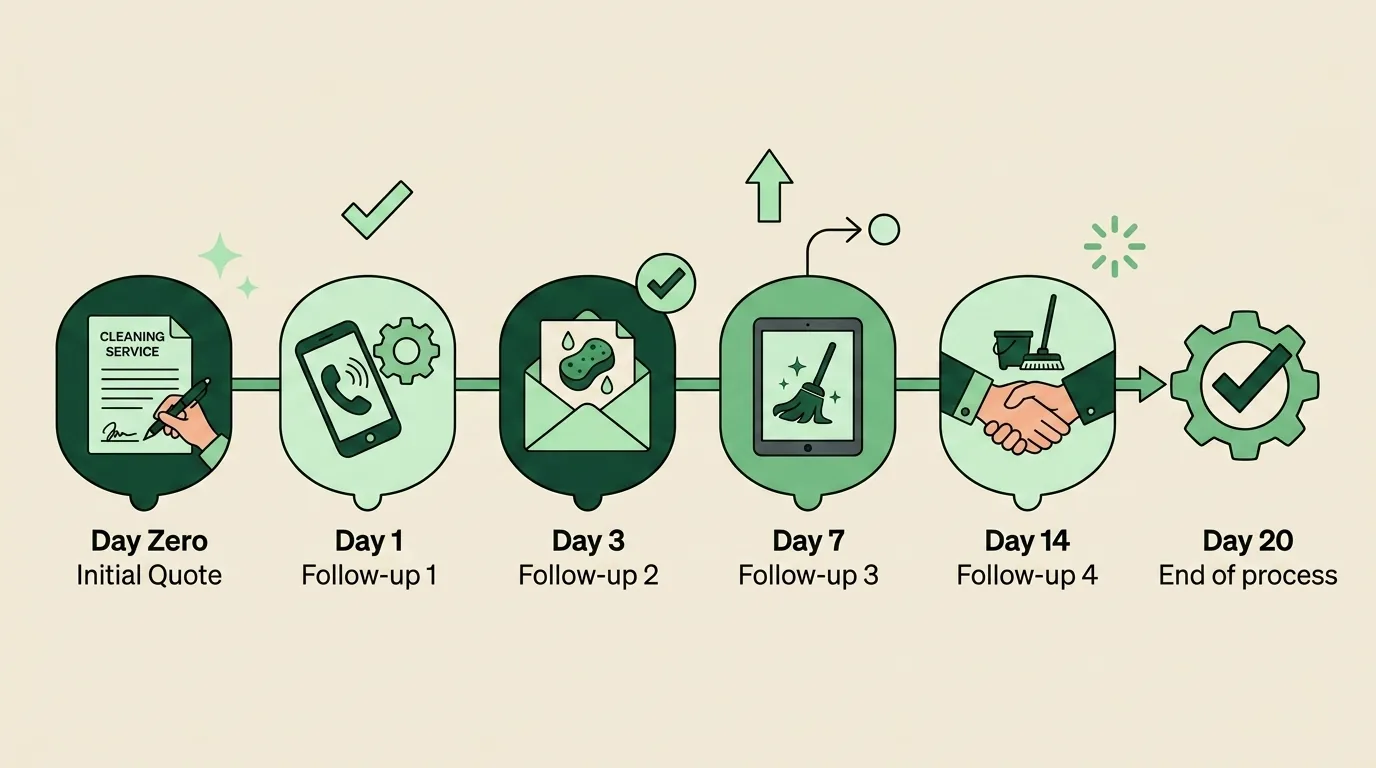
Touch 0, Day 0, the moment you send it (text):
“Hi Dana, it’s Marcus from Sparkline Cleaning. Your quote just landed in your email, three options, you can accept right from your phone. Happy to answer anything.”
(Only text clients who gave you their number for this purpose, under the Telephone Consumer Protection Act, business texts require prior consent and belong between 8 AM and 9 PM local time.)
Touch 1, Day 2 (email):
“Hi Dana, wanted to make sure the quote came through okay. Most folks have a question or two about what’s in each option, so ask away. If it helps: Standard is what most of our biweekly clients choose.”
Touch 2, Day 5 (email, add value, don’t just ‘check in’):
“Hi Dana, one thing I should have mentioned: we’re insured and bonded, and every visit ends with photos of the finished work so you can see exactly what was done. Here’s a recent before-and-after from a home like yours: [link]. Your quote’s still open through August 1.”
Touch 3, Day 10 (text or email, honest urgency):
“Hi Dana, quick heads-up: your quote is open through Aug 1, and our biweekly Thursday slots are close to full for the summer. If Sparkline’s a fit, picking an option this week locks your spot. If not, no hard feelings, tell me what’s missing.”
Touch 4, Day 20 (the break-up email):
“Hi Dana, closing the loop on your quote so I’m not cluttering your inbox. If the timing’s wrong, totally understood; I’ll leave the door open. If something about the quote didn’t work, price, scope, schedule, I’d honestly love the feedback. Either way, thanks for considering us.”
The break-up email outperforms its reputation: it’s often the touch that finally gets a reply, because it’s the first one that’s easy to answer. And when the answer is “you were more expensive,” don’t fold, our playbook for handling price shoppers covers that conversation.
If five touches per quote sounds like a part-time job, that’s because manually, it is. Quote statuses and automated reminders are exactly the kind of grunt work cleaning business software should be doing for you, CleanerHQ tracks every quote from draft to sent to accepted, so nothing dies in a spreadsheet tab. And when a commercial prospect wants more than a quote, a document with scope narrative and terms, that’s a proposal; grab our free cleaning proposal template for those.
Frequently Asked Questions
How long should a cleaning quote be valid?
Thirty days is the standard for recurring residential and commercial work; many operators use 14 days for one-time jobs. An expiration date protects you from cost changes, creates honest urgency, and gives your follow-up sequence a natural endpoint. Always print the actual date, not “30 days.”
How fast should I send a cleaning quote?
Same day, within 24 hours at the outside. A Harvard Business Review audit of 1.25 million sales leads found responding within one hour made companies nearly seven times more likely to qualify the lead than waiting even an hour more. Quote requests decay fast; the first useful answer usually wins.
Should I put three prices on one cleaning quote?
Yes. Good/better/best pricing turns “should I hire them?” into “which option fits?” and the premium tier anchors the middle one as reasonable. Keep tiers roughly 15-20% apart, make the middle option the service you actually want to deliver, and spell out exactly what each tier includes.
How much should I charge for a first-time deep clean?
Price initial and deep cleans at roughly 1.5-2x your recurring visit rate, a common operator rule of thumb. You’re removing months of buildup, not maintaining your own work. Quote it as a separate line item so the recurring price stays attractive and your margin on visit one stays intact.
Do I need a deposit on one-time cleaning jobs?
Yes, a 50% deposit on one-time jobs is standard practice in 2026. Veteran operators report that no-shows and late cancellations otherwise leak roughly 5-10% of revenue. Recurring clients are different: card-on-file billed after each visit is the smoother norm there.
What’s the difference between a cleaning quote and an estimate?
A quote is a fixed price for a defined scope, what this article teaches, and it’s binding once accepted. An estimate is an educated approximation that may change. Clients strongly prefer quotes; just protect yourself with a condition clause and a written exclusion list.

Written by
Rashdi has spent 15+ years building and managing enterprise software, and has worked with US cleaning businesses since 2006. He founded CleanerHQ.