
When and How to Raise Your Cleaning Prices (2027 Edition)
Raise your cleaning prices when labor passes 50% of revenue, your margin dips below 15%, or you're booked solid two-plus weeks out. In 2027, a 5-8% increase is routine maintenance; 8-12% is catch-up after frozen years. Give 4-6 weeks notice, lead with value, and expect to keep far more clients than you fear.
 R Rashdi
·
July 2, 2026
·
13 MIN READ
R Rashdi
·
July 2, 2026
·
13 MIN READ
Quick answer
Raise your cleaning prices when labor passes 50% of revenue, your margin dips below 15%, or you’re booked solid two-plus weeks out. In 2027, a 5-8% increase is routine maintenance; 8-12% is catch-up after frozen years. Give 4-6 weeks notice, lead with value, and expect to keep far more clients than you fear.
Most cleaning business owners underprice for one reason: they fear the no. So they hold rates flat while wages, supplies, and insurance climb, and quietly donate the difference to their clients.
Here’s the uncomfortable math on when to raise cleaning prices: the JaniJobs Cleaning Labor Outlook has had cleaning wages rising 8-12% a year, and the National Employment Law Project tracked minimum-wage increases in 22 states heading into 2026, with more taking effect through 2027. If your prices rose 0% over that stretch, you didn’t hold prices. You cut them, in real terms, twice.
This guide gives you the five signals it’s time, the exact percentage bands to use, a copy-paste increase letter, scripts for pushback, and the churn math that proves the fear is overblown.
When to raise your cleaning prices: the five signals
You don’t need a feeling. You need a trigger. Any one of these five is sufficient; two or more means you’re late.
1. Labor is eating more than half your revenue. Industry rules of thumb put healthy labor (wages plus payroll taxes plus benefits) at 40-50% of revenue. When raises, overtime, and hiring bonuses push you past 50%, the gap comes out of your margin, until your prices catch up.
2. Your net margin slipped below 15%. Veteran operators and cleaning-industry software benchmarks treat 15-20% net as sustainable; below 10% is survival mode. If you don’t know your number, start with our guide to cleaning business profit margins before you change a single rate.
3. You’re booked out two weeks or more. A full calendar is the market telling you you’re underpriced. Demand exceeding capacity is the single safest moment to raise, worst case, you lose a client you didn’t have room for anyway.
4. Your effective hourly rate has decayed. A $50/hr sticker rate typically realizes $30-35 after drive time, utilization gaps, and the occasional dispute, that’s operator economics, not pessimism. If drive time crept up or jobs run long, your real rate fell even though the invoice didn’t change.
5. Costs moved and you didn’t. Supplies should run 5-7% of revenue for an established firm; insurance 1-3%. When those lines drift up for two consecutive quarters, as they did across the industry during the 2026 supply-cost shocks, that’s your trigger, with a built-in explanation clients already believe.
One signal that does NOT count: a competitor’s flyer. Cheap competitors churn through clients and fold. Price to your costs and your value, not to the lowest bidder in town. (Dealing with bargain hunters is its own skill, see handling price shoppers.)
How much to raise prices: the 5-12% bands
Cleaning-industry software benchmarks put routine annual increases at 3-8%. For 2027, with wage growth still running hot, here are the practical bands by situation:
| Situation | Increase band | Notes |
|---|---|---|
| Annual maintenance raise (raised within last 12-18 months) | 5-7% | Tracks wage inflation; barely registers per visit |
| Catch-up (no increase for 2+ years) | 8-12% | Pair with a clear cost explanation; consider phasing over 2 visits |
| Underpriced legacy accounts (below your current new-client rate) | 10-12%, possibly repeated | Bring them to within 5% of rack rate within a year |
| Money-losing accounts (margin negative after drive time) | 12%+ or scope change | If they leave, that’s the system working |
| New clients | Reprice freely | Your new-client rate is your test lab, raise it first |
Two rules make the bands work:
- Translate the percentage into dollars per visit. A 7% increase on a $160 biweekly clean is $11.20. Nobody fires a trusted cleaner over eleven dollars. They fire vague, apologetic letters that smell like there’s more coming.
- Round to clean numbers. $171.20 becomes $172 or $175. Odd cents signal a formula; round numbers signal a decision.
If you’re rebuilding rates from scratch rather than nudging them, work bottom-up: price at no less than 2x loaded labor cost, the operator floor rule that keeps labor under 50% of revenue. CleanerHQ’s smart pricing calculator does this math automatically: it builds each quote up from labor cost and a floor price, so the new rate protects margin instead of guessing at it. You can test your whole price list against your real costs before announcing anything, try it free, card needed to start the trial.
The price increase letter (copy-paste template)
Send it in writing, email is fine, 4-6 weeks before the effective date. The structure: appreciation, the change in plain numbers, one honest sentence of why, what they get, and a confident close. No apologies, no “we hope you understand,” no three paragraphs of throat-clearing.
Subject: A small update to your cleaning rate
Hi {First name},
Thank you for trusting us with your home for {X years/months}, taking care of it is genuinely a pleasure.
Starting {effective date}, your rate for {service, e.g., biweekly cleaning} will change from {$old} to {$new} per visit, about {$X} more.
Like every cleaning company, our wages, supplies, and insurance costs have risen substantially, and this adjustment lets us keep paying the same trusted team you know fairly, so {cleaner’s name} keeps showing up at your door.
Nothing else changes: same team, same checklist, same standard. If you’d like to review your service plan or visit frequency, just reply, I’m happy to find the right fit.
Thank you again for your business.
{Your name}
{Company name} · {phone}
Three details that do heavy lifting: naming the cleaner (clients stay for people, not companies), the per-visit dollar figure (small numbers calm people), and the frequency-adjustment offer (a budget-friendly off-ramp that isn’t “leave”).
Timing: anniversary, annual, or new-clients-first
Three workable systems. Pick one and write it into your operations so increases stop being a yearly crisis of courage.
New-clients-first (start this week). Raise your rack rate for new business today; existing clients keep current rates for now. Zero churn risk, new prospects never saw the old price. Once new-client rates hold for 60-90 days, you’ve proven the market and you bring existing clients up behind them. This is the lowest-anxiety on-ramp and the right move if you haven’t raised in years.
Annual, one date (simplest at scale). Every client adjusts on the same date, February 1 works well: post-holiday, pre-spring-rush. One letter batch, one billing update, one wave of questions you answer in a single week. Commercial accounts get 6-8 weeks notice instead of 4-6, and multi-year contracts should carry a built-in annual escalator so renewal isn’t a renegotiation.
Anniversary-based (smoothest cash flow). Each client adjusts on their signup anniversary. Increases trickle through the year, no single churn wave, and the conversation pairs naturally with “you’ve been with us two years.” Cost: you need cleaning business software or a very good calendar to track it.
What about grandfathering, leaving long-time clients at old rates indefinitely? Use it sparingly and with an expiry date. Permanent grandfathering creates a quiet ledger of below-cost accounts and awkward conversations later. A defined grace period (“your rate holds until September, then moves to the new standard”) honors loyalty without donating margin forever. Across-the-board with a loyalty perk, priority scheduling, an annual free deep-clean room, usually beats two-tier pricing.
Handling pushback: scripts that keep the client
Expect questions from a handful of clients, genuine pushback from fewer. Listen first, then respond with value, never with a defense of your costs line by line.
“Why the increase?”
“Fair question. Our wages and supply costs have gone up significantly over the past two years, that’s industry-wide, and this keeps the same experienced team on your home instead of cheaper turnover. It works out to about {$X} more per visit.”
“That’s more than I want to spend.”
“I understand, let’s find the right fit. We could move you from weekly to biweekly, which actually lowers your monthly total, or trim the scope to your priority areas. What matters most to you on a typical visit?”
“Competitor X quoted me less.”
“There will always be a cheaper quote, and some of them are good people. What I can promise is the same vetted, insured team every visit, photo-documented work, and a phone that gets answered. If price is the deciding factor right now, I completely understand, and you’re welcome back anytime.”
“Can I stay at my old rate?”
“I can’t carry two price lists and be fair to everyone, the new rate applies to every client, including brand-new ones. What I can do is hold your current rate until {date 1-2 months out} so you have time to plan.”
The frequency-downgrade offer deserves special attention: a weekly client at the old $150 who moves to biweekly at the new $172 stays a client, frees a weekly slot you resell at full rate, and often upgrades back within a year. Retention beats rate on any single account, but only when the rate is sustainable. More retention plays are in our customer retention guide.
And triage honestly: fight to keep reliable payers, reasonable expectations, and referral sources. The client who pays late, moves the goalposts, and haggles every invoice? A price increase that loses them is a feature.
What actually happens to churn (the math)
Here’s the part fear skips: you don’t need to keep everyone. You need to keep most.
The break-even arithmetic on an 8% increase: take 100 clients averaging $200 a month, $20,000 monthly. Raise everyone 8% and keep them all: $21,600. Now assume some leave. At 93 clients on the new rate, you gross $20,088, still ahead of the old book. You can lose 7 clients in 100 after an 8% raise and not go backward. The general rule: break-even churn equals the increase divided by (1 + increase), about 7% for an 8% raise, about 11% for a 12% raise.
And that understates your upside in three principled ways:
- Every lost client returns capacity. You refill the slot at the new rate, and acquiring a residential client runs around $150 by operator benchmarks, often less with referrals. One month of the increase across your book typically covers replacing the departures.
- Switching costs are real. Your clients have given you keys, alarm codes, pet routines, and trust built over dozens of visits. A 7% increase is cheaper than re-vetting a stranger, and clients know it.
- The leavers cluster at the bottom. Price-driven departures are concentrated among your least profitable, most demanding accounts. Average margin per remaining client goes up twice: once from the rate, once from the mix.
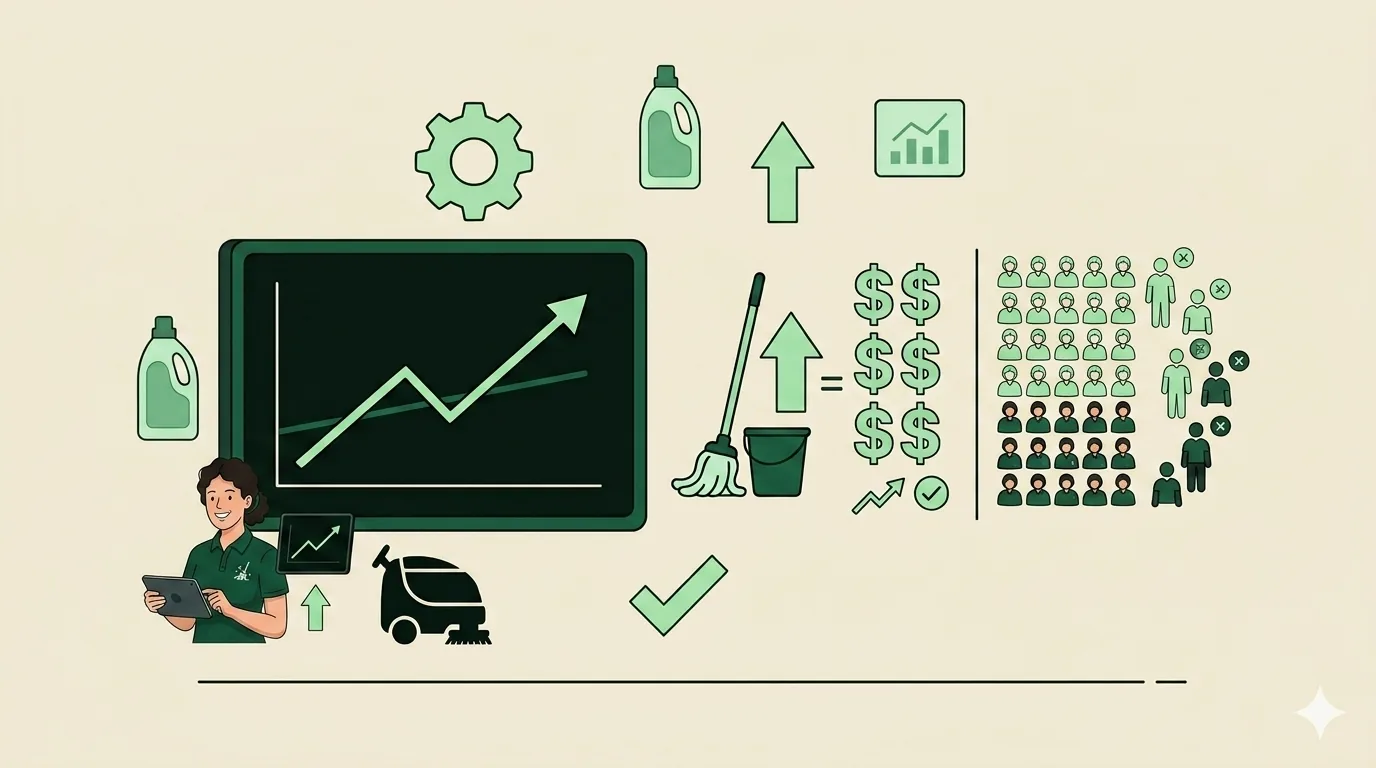
We won’t invent a precise “average churn after an increase” statistic, anyone quoting one without a real dataset is making it up. The honest version: operators who raise within the 5-12% bands, give proper notice, and lead with value consistently report losing far fewer clients than they feared, and the math above shows why even a bad case still pays. If a few do leave and you want them back later, here’s how to win back lost clients.
One more input for confidence: know where you sit against the market before you raise. Our 2027 cleaning rate report compiles what published cost guides say cleaning services charge, most owners discover they’re priced in the bottom half of the published ranges, which makes the increase letter a lot easier to send. If your pricing model itself is the problem, fix that first: flat rate vs hourly changes the whole conversation.
Frequently Asked Questions
How much should I raise my cleaning prices in 2027?
Use 5-7% if you raised within the last 12-18 months, 8-12% if rates have been frozen two years or more, and 12%+ (or a scope change) on accounts that lose money. Cleaning-industry software benchmarks put routine annual increases at 3-8%; with wages rising 8-12% a year per the JaniJobs Cleaning Labor Outlook, skipping a year compounds the squeeze.
How much notice should I give clients before a price increase?
Give residential clients 4-6 weeks of written notice and large commercial accounts 6-8 weeks, ideally aligned to contract renewal. Shorter feels abrupt; much longer invites weeks of renegotiation. State the effective date, the old and new rate, and the per-visit dollar difference in the first three lines.
Will I lose clients if I raise my cleaning prices?
A few, usually fewer than feared, and the math forgives it. After an 8% increase you can lose roughly 7 clients in 100 and still gross the same, with less work. Departures concentrate among the least profitable accounts, freed slots refill at the new rate, and acquisition benchmarks (~$150 per residential client) mean replacements cost less than a month of the increase across your book.
How do I tell clients about a price increase without sounding apologetic?
Lead with appreciation, state the change in plain dollars (“from $160 to $172 per visit, about $12 more”), give one honest reason (wages and supplies), confirm nothing else changes, and offer a frequency or scope adjustment as a budget option. Skip “we regret” and “we hope you understand”, confidence reads as fairness; apology reads as negotiability.
Should I grandfather long-time clients at their old rates?
Only with an expiry date. A grace period of 1-2 extra months at the old rate honors loyalty without creating a permanent two-tier price list that bleeds margin and breeds awkwardness. If you want to reward tenure, use perks, priority scheduling or an annual free deep-clean room, instead of a forever discount.
How often should I review and raise my cleaning prices?
Review costs every 6 months; raise about once a year. Annual 5-7% adjustments track wage inflation and stay almost invisible per visit, while multi-year freezes force the 10-12% catch-up raises that actually scare clients. Put the review date on your calendar like payroll, pricing is maintenance, not crisis response.

Written by
Rashdi has spent 15+ years building and managing enterprise software, and has worked with US cleaning businesses since 2006. He founded CleanerHQ.