CLEANERHQ/PRODUCT/SUPPLY ANALYTICS
◆ TWENTY MODULES · ONE LOGIN · $19 ADMIN · $5 CREW /MO
◆ SUPPLY ANALYTICS

Do You Actually Know What Your Supplies Are Costing You Per Job?

For cleaning business owners who reorder chemicals and paper products by eyeballing the shelf, with no real read on whether spend is normal or quietly eating margin. Supply Analytics tracks spend against an industry benchmark and against what each job was actually quoted for.

§01 — THE PROBLEM

What every cleaning business owner already knows.

You restock chemicals and paper products every couple weeks by eyeballing the shelf, so you always order a little extra just in case. You don’t actually know if last month’s supply spend was normal, or if one crew is burning through degreaser twice as fast as the calculator assumed when you quoted the job, because nobody’s comparing the estimate to what actually got bought.

Supplies typically run 5 to 7 percent of revenue in this industry; a business doing $40,000 a month quietly running at 10 percent is losing an estimated $1,200 a month that never shows up as a single line item anyone notices.

§02 — HOW CLEANERHQ FIXES IT

Supply Analytics, built cleaning-native.

A dashboard widget compares your supply spend as a percent of revenue against the 5 to 7 percent industry benchmark, flagging drift before it becomes a bad month. Every job detail page shows a variance callout: what the calculator estimated for supplies versus what was actually spent, job by job. Load sheets are auto-generated per job from your service-type defaults, and a job can’t dispatch until every item marked critical has been checked out.

You catch supply drift while it’s still a small number, and every job leaves the shop with exactly what it needs, because the packing list was built for it automatically instead of guessed at.

§03 — WHAT YOU GET

Every feature in one place.

Supply spend benchmark widget
dashboard flags when your supply spend runs above the 5 to 7 percent of revenue industry target range
Quoted vs actual variance callout
job detail page shows exactly how far actual supply spend ran from the calculator’s estimate, job by job
Auto-generated load sheets
every job gets a packing list built from your service-type defaults, so nobody guesses what to load
Critical item dispatch check
a job can’t dispatch until every item marked critical on its load sheet has been checked out
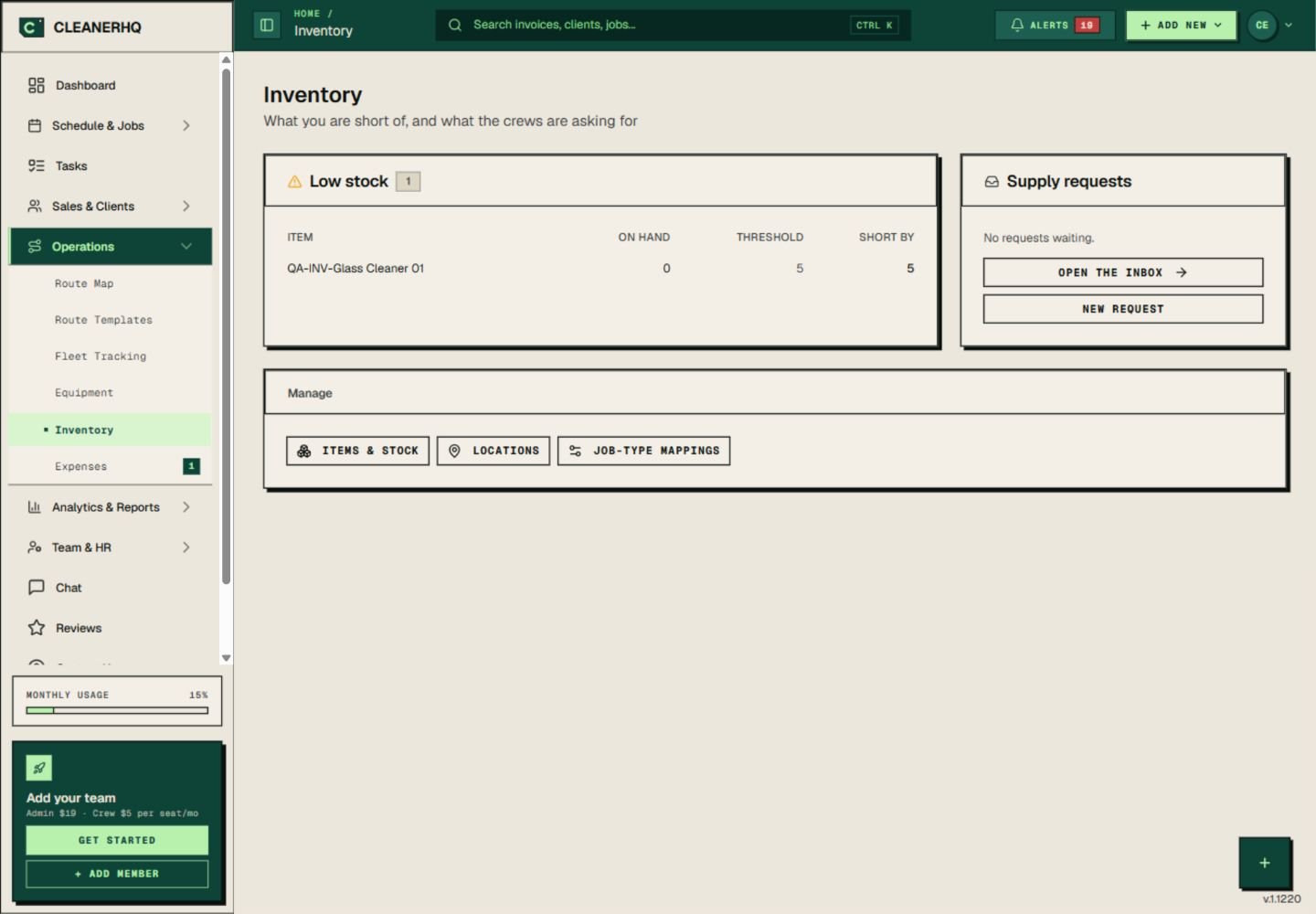
Low-stock supply requests
crew or the system itself flags low stock and files a restock request straight to your fulfillment queue
Chemical safety data sheet linkage
every chemical purchase links to its safety data sheet, flagged automatically if one’s missing or outdated
§04 — WHY IT MATTERS

The business impact, in dollars.

Supply spend is one of the easiest costs to lose track of because it happens in small, frequent purchases instead of one big number. Catching drift against a real benchmark, and catching variance job by job instead of at tax time, turns a fuzzy expense line into a lever you can actually manage, and the safety data sheet linkage keeps you audit-ready if OSHA ever asks.

Cleaning businesses that let supply spend drift past the 5 to 7 percent of revenue benchmark are typically losing $500 to $1,000 a month in margin before anyone notices on the books.
§05 — QUESTIONS WE GET

Frequently asked about Supply Analytics.

What does Supply Analytics do?

It tracks your supply spend against an industry benchmark and against what each job was actually quoted for, so you can catch overspending or waste while it’s still small instead of finding it months later.

What’s the industry supply spend benchmark, and how is it used?

Supplies typically run 5 to 7 percent of revenue for a cleaning business. The dashboard widget compares your actual spend against that range so you know if you’re running efficient or leaking margin.

How do critical item checks stop a job from dispatching without supplies?

Every load sheet marks certain items as critical. If one of those items hasn’t been checked out yet, the job is blocked or flagged from dispatching, so a crew never shows up without what the job needs.

Does it help with OSHA chemical safety compliance?

Yes. Chemical purchases link to a safety data sheet in your registry, and the system flags a chemical expense if it’s missing a current linked SDS, keeping you audit-ready.

Is Supply Analytics included in the base CleanerHQ plan?

Yes. Supply Analytics is one of 20 modules included on every CleanerHQ seat at $19/mo per admin seat plus $5/mo per crew seat. No feature tiers or add-on pricing.

Know your supply spend, before it eats your margin.

Start 14-Day Free Trial →
Book a 20-min Demo
$19 admin · $5 crew /mo · all 20 modules · keep your Stripe · onboard in 1 day