
Cleaning Industry Trends and Opportunities for the Year Ahead
Five areas to review for the year ahead are staffing costs, useful back-office automation, recurring work, local competition and specialist demand. Treat forecasts as scenarios. Use dated primary data and your own job records before changing prices, buying equipment or entering a niche.
 R Rashdi
·
January 5, 2026
·
9 MIN READ

Quick answer
Five areas to review for the year ahead are staffing costs, useful back-office automation, recurring work, local competition and specialist demand. Treat forecasts as scenarios. Use dated primary data and your own job records before changing prices, buying equipment or entering a niche.
Cleaning businesses face different conditions by location and service mix. The five themes below are planning questions for the year ahead, not a forecast that every market will move in the same direction.
Use the five themes below to choose practical checks for your business. Match each source to the decision, and test assumptions against your own job records.

Cleaning Industry Trends: What to Measure
Use these inputs to assess the themes below. A source must match the occupation, market, period and definition before its number is useful.
| Planning input | What to check | Source or record |
|---|---|---|
| Residential demand | Enquiries, booked visits and cancellations in your service area | Your own comparable monthly records |
| Commercial demand | Qualified tenders, renewals and lost contracts | Client and local procurement records |
| Specialist demand | Real sites needing work you can safely deliver | Site enquiries and client requirements |
| National wage reference | $17.71 median hourly wage for janitors and building cleaners, May 2025; not a local hiring quote | U.S. Bureau of Labor Statistics |
| Your labor-cost change | Wages, employer costs, travel and training | Payroll and paid-hour records |
| Staffing constraints | Vacancies, applicants, retention and available hours | Your hiring and scheduling records |
| Job contribution | Earned revenue less the costs included in your definition | Actual job costs and reconciled accounts |
| Automation value | Time saved after review, setup and subscription costs | A measured trial on your workflow |
National market totals do not establish demand or margins in a particular route. Review local enquiries, actual job costs and client retention together before deciding where to expand.
This guide does not have verified comparable growth rates for each niche. Evaluate local demand, procurement requirements, capacity and cost instead of ranking niches by unsupported percentages.
Trend 1: Labor stays the battleground: wages, retention, and the W-2 shift
Staffing is a practical planning issue: can you recruit, train and retain the people needed for the work you have sold?
BLS reports a May 2025 national median of $17.71 per hour for janitors and building cleaners. That occupation and date are a reference point, not a forecast of cleaning wage growth or a local pay recommendation.
Three pressures stack on top of each other:
- Check wage requirements. Verify applicable national, state and local rules and scheduled changes where the crew works.
- Measure your applicant pipeline. Track suitable applicants and accepted offers rather than assuming a national explanation fits your market.
- Measure turnover cost. Include recruitment, paid training, supervision and lost capacity. There is no verified universal turnover percentage or replacement cost in this guide.
A retained cleaner can preserve skills and continuity, but capacity depends on paid hours, utilization and service rates. Use your own figures when deciding how much to invest in recruitment and retention.
Check worker classification. The actual relationship matters more than a contract label. Review applicable tax, labor and state tests before engaging people. The contractor-versus-employee guide explains the questions and sources.
Calculate loaded labor as a share of revenue, then compare it with your own cost model and service mix. A generic percentage does not establish that a job is healthy or unsustainable.

Trend 2: AI hits the back office
Forget the robot headlines for a second. The AI that changes your 2027 P&L doesn’t push a mop, it sits in your office and does the work you currently do at 9 p.m.
Three back-office jobs are being automated right now:
- Quoting. Test whether a calculator captures the actual scope and costs. Review assumptions; an automated estimate does not guarantee a profitable price.
- Proposals. Drafting tools can help assemble a document, but the owner still checks the scope, price, terms and evidence before sending.
- Scheduling. Check travel, availability and client constraints in the actual product. Do not assume every tool supports automated route optimization.
Compare software with the time and errors in your own workflow. CleanerHQ focuses on small cleaning-business operations; there is no universal revenue or crew-size threshold at which software pays for itself.
For floor-cleaning equipment, obtain a site-specific trial and total-cost quote. Include purchase or lease, maintenance, supervision, charging, access and tasks still done by people. A vendor’s payback example is not your forecast.
For a deeper look at what’s hype and what’s usable, see our guide to AI for cleaning businesses and the buyer’s overview of cleaning business software.
Trend 3: Subscription beats one-off: the recurring-revenue economy
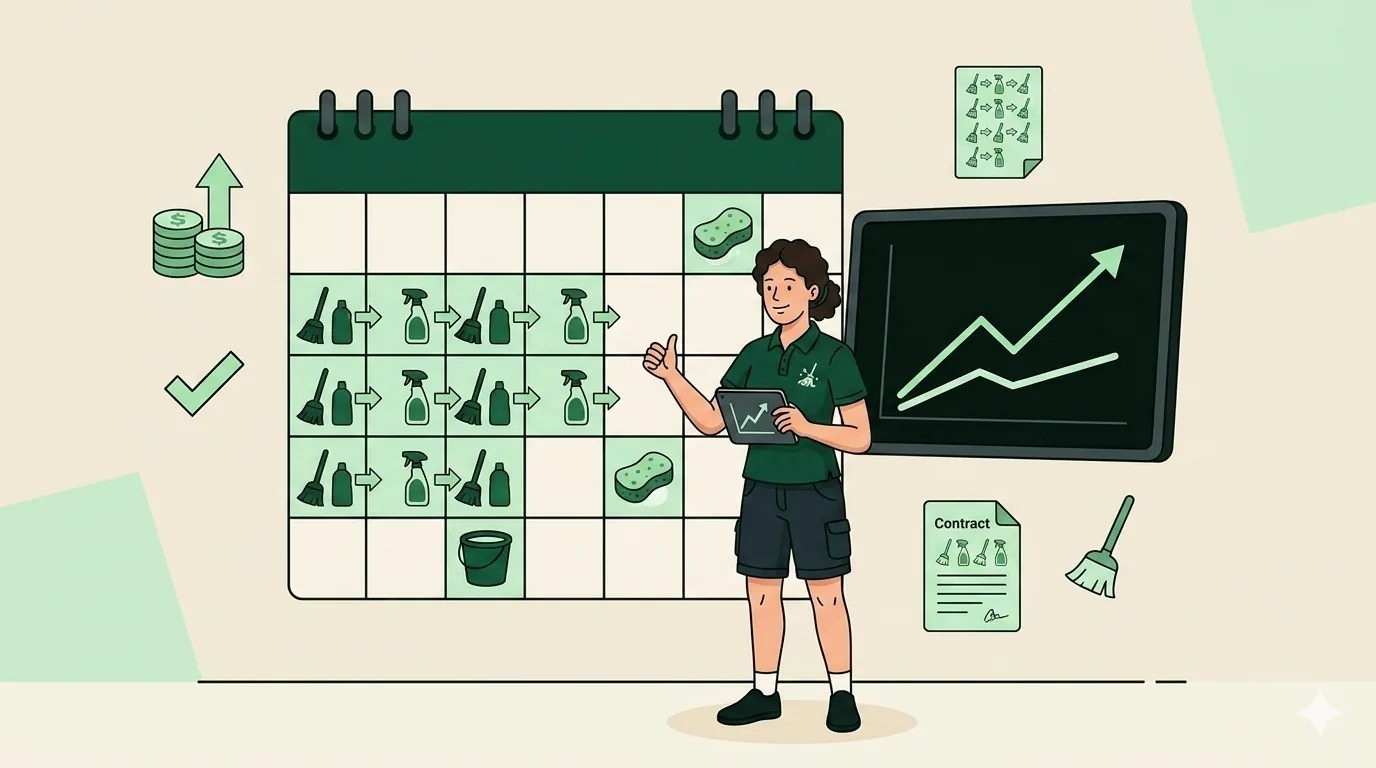
Recurring work can make capacity planning easier when the scope, route and contract economics are suitable.
There is no universal 90/10 revenue mix or client lifetime value. Compare contribution, cancellations, renewal and route density for your recurring and one-time work.
What the shift looks like in practice:
- Productized plans. Weekly, biweekly, and monthly tiers with defined scope, not bespoke negotiations per house.
- One-time payment terms. Agree any deposit and cancellation terms appropriate to the job and local rules before reserving capacity.
- Price reviews. Base changes on actual costs and scope, with the notice required by the agreement. Use the price-change guide.
- Commercial terms. Have renewal, scope-change and cost-adjustment clauses checked for the work and jurisdiction before relying on them.
If your book is still mostly one-time jobs, building recurring revenue is the highest-leverage move on this whole list.
Trend 4: Consolidation comes downstream
Monitor ownership and service changes among the competitors in your actual market. This guide does not substantiate a current acquisition list or a forecast of who will buy local operators.
Why does a 6-cleaner operation care? Two reasons.
Compare competitors’ actual response, scope and proof rather than assuming every larger company has the same strengths or weaknesses. Choose a service promise your team can deliver.
If a future sale is a goal, document contracts, concentration, renewal, job economics and operations that can run without the founder. Buyer requirements and valuations vary; the guide does not establish a guaranteed premium for particular percentages.
Trend 5: Evaluate Specialist Niches Locally
Specialist work can create opportunities and additional obligations. Check actual local demand and readiness before expanding:
- Healthcare and medical-adjacent sites. Confirm facility-specific infection-control, training and documentation requirements.
- Industrial facilities. Assess the actual tasks, exposure controls, access and waste requirements before pricing.
- Post-construction cleanup. Define phases, dust controls and return visits. Follow the site assessment and applicable rules; see the post-construction guide.
- Biohazard work. Confirm specialist training, exposure controls, insurance and waste arrangements before taking work. See the biohazard overview.
- Green cleaning as a bid requirement. EPA’s Safer Choice program now certifies thousands of products, and eco-credentials increasingly appear in commercial RFPs as a checkbox you must tick rather than a premium you can charge.
For short-term-rental turnovers, evaluate local occupancy, travel, timing and cancellations. Avoid treating an unsupported national growth estimate or fixed price premium as a business case.
What to do about it: your action list for 2027
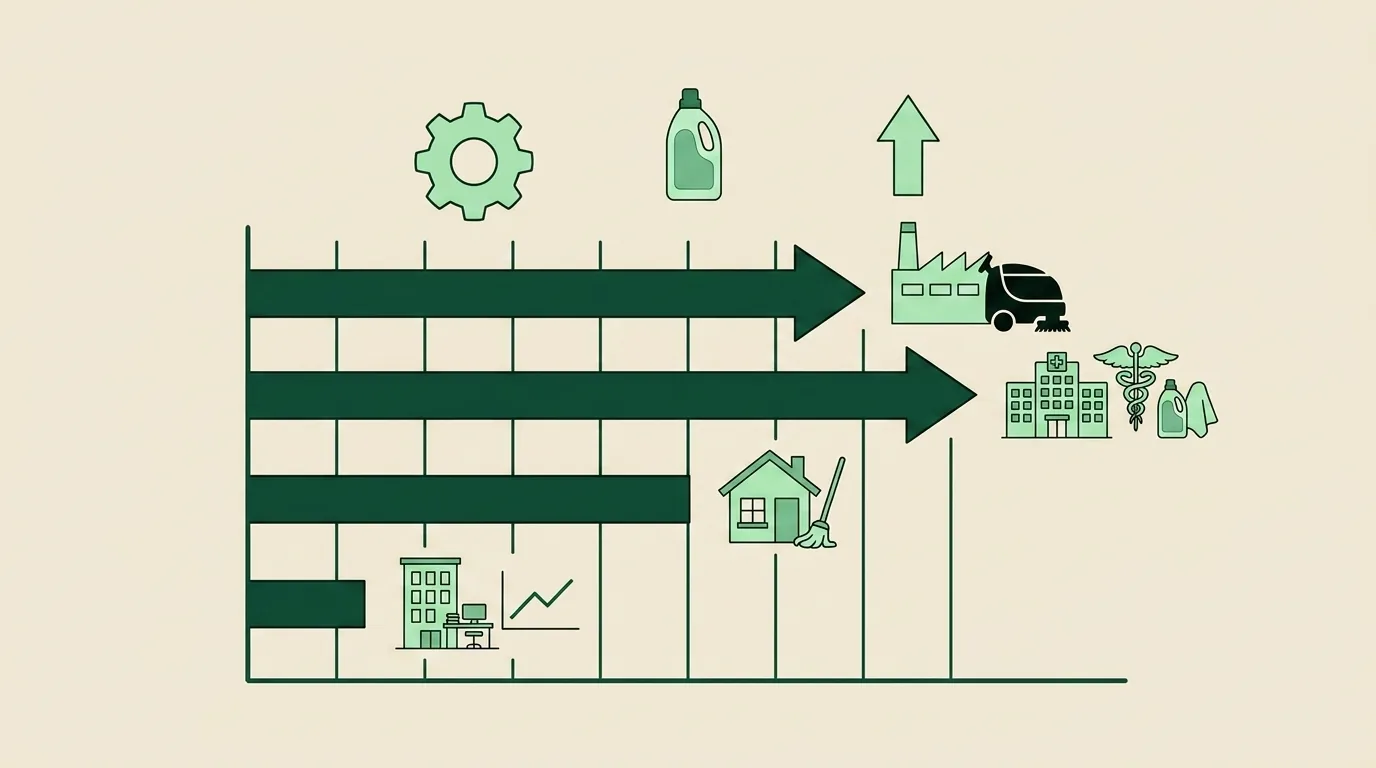
Trends are entertainment unless they change next week’s calendar. Seven moves, in order of leverage:
- Review rates. Compare costs with current prices and schedule any justified change according to the agreement.
- Calculate job costs. Include paid labor and other relevant costs, then investigate differences from the estimate.
- Test recurring offers. Offer them to suitable clients and measure paid visits, retention and contribution.
- Track margin per job, not per month. A profitable month can hide three money-losing accounts. Start with our guide to cleaning business profit margins.
- Investigate one niche. Confirm real demand and the qualifications, equipment and insurance it needs before committing.
- Audit yourself like a buyer. Transferable contracts, customer concentration, renewal rate, documented SOPs, software a stranger could operate. Score yourself against the M&A list in Trend 4.
- Test your back-office workflow. Compare how quotes, schedules, invoices and field records fit together. You can try CleanerHQ for 14 days with no card, for you plus two cleaners, using a workflow that matters to your business.
Frequently Asked Questions
How big is the cleaning industry?
Market-size estimates differ according to geography, service scope and reporting year. This guide does not provide a verified combined market total. Use a clearly defined source and local demand evidence for a business decision.
What is the biggest challenge for cleaning businesses heading into 2027?
The main constraint varies by business. Review hiring, retention, costs, demand and payment timing in your own records before choosing a priority.
Which cleaning niches are growing fastest?
This guide does not have verified comparable growth rates for every niche. Evaluate local enquiries, site requirements, competition and the cost of becoming ready to deliver the work.
How is AI actually used in cleaning businesses?
Mostly in the back office: bottom-up quote pricing, AI-drafted proposals, and scheduling engines that rank time slots by drive time, crew fit, and client preference. On the floor, robotics-industry analyses estimate robotic scrubbers run about $0.41 an hour versus roughly $7.56 for manual labor, compelling for big open floors, irrelevant for detail work.
Are cleaning businesses recession-proof?
No cleaning segment is recession-proof. Demand and payment risk depend on clients, contracts, location and service need. Test lower-demand scenarios and avoid relying on a household-income threshold as protection.
How much should I raise cleaning prices for 2027?
Calculate the rate needed from actual job costs, scope and your chosen margin. Check the agreement’s notice requirements and communicate the effective date clearly. There is no verified universal 2027 increase in this guide.

Written by
Rashdi has spent 15+ years building and managing enterprise software, and has worked with US cleaning businesses since 2006. He founded CleanerHQ.