
How to Write a Cleaning Quote: Checklist and Worked Examples
A cleaning quote identifies the client and site, lists the work and exclusions, shows the price and applicable tax, and explains validity, payment and acceptance. Use the checklist and worked examples below to check each detail before sending. Offer packages only when they help the client choose.
 R Rashdi
·
July 6, 2026
·
15 MIN READ

Quick answer
A cleaning quote identifies the client and site, lists the work and exclusions, shows the price and applicable tax, and explains validity, payment and acceptance. Use the checklist and worked examples below to check each detail before sending. Offer packages only when they help the client choose.
You already know how to clean. The quote is where the money is won or lost, and most owners learn how to write a cleaning quote by copying whatever their first competitor sent them. That usually means one number, no scope, no options, and no follow-up.
This guide includes a worked quote, optional three-package pricing, scope wording and follow-up scripts. Adapt each example to the actual job and the promises your team can keep.

Anatomy of a Cleaning Quote That Closes (Annotated Example)
This fictional residential example shows a three-bedroom, two-bathroom home on a biweekly schedule. The names, address, dates and prices are invented for illustration. A commercial quote needs its own site scope, timing and terms.
Sparkline Cleaning Co., Quote #Q-0147
Prepared for: Dana Whitfield · 412 Alder Court, Maple Grove, MN
Property: 3 bed / 2 bath single-family, approx. 1,900 sq ft, one dog
Walkthrough: July 2, 2026 · Quote valid through: August 1, 2026
Service requested: Initial deep clean, then recurring biweekly cleaning
| Option | Price per visit | What’s included |
|---|---|---|
| 1, Essential Biweekly | $150 | All floors vacuumed and mopped, kitchen counters, sink and appliance exteriors, both bathrooms fully cleaned, reachable-surface dusting, trash out, beds made |
| 2, Standard Biweekly | $175 | Everything in Essential, plus microwave interior, cabinet fronts, baseboards on rotation, interior glass doors, pet-hair detail on upholstery |
| 3, Premium Biweekly | $205 | Everything in Standard, plus fridge interior monthly, oven interior quarterly, window sills and tracks, one load of laundry folded |
One-time initial deep clean: $295. Required before recurring service begins. Covers built-up soil, baseboards, vents, and full detail of both bathrooms and the kitchen.
Not included at these prices: interior windows beyond glass doors, walls, garage, exterior areas, post-renovation dust, biohazard cleanup. Each is available by separate quote.
Terms: 50% deposit reserves your deep-clean date; recurring visits are billed to the card on file after each visit. Pricing assumes the condition observed on July 2, if conditions change, we confirm any price adjustment before work begins, never after. Free reschedule with 48 hours’ notice. This quote expires August 1, 2026.
To accept: open your quote link, pick an option, and sign from your phone.
Now the annotations, six choices in that document that do the selling:
- The property line proves you looked. “3 bed / 2 bath, ~1,900 sq ft, one dog” tells Dana this price was built for her house, not pulled from a flyer. Generic quotes invite price-shopping; specific quotes end it.
- Tasks are listed, not summarized. “Both bathrooms fully cleaned” plus a visible task list beats “general cleaning” every time, because the client can see what $175 buys, and so can your crew when scope questions come up later.
- Optional packages with clear differences. Each price has a distinct scope. Only use a popularity label when you have evidence from your own customers.
- Price the initial clean separately. Estimate its actual tasks and hours rather than applying a fixed multiplier to the recurring price.
- Make exclusions visible. They help prevent misunderstandings, but still confirm scope changes with the client before work.
- State a validity date. Choose a period that fits your costs and capacity; the 30-day period here is an example, not an industry requirement.
Before you send it, run the cleaning quote checklist below: 12 checks with a Word and PDF download.
Capture Everything Once: The Walkthrough
A quote is only as good as the walkthrough behind it. The expensive mistake is quoting from a phone description, discovering reality on day one, and then having the awkward “actually it’s more” conversation that kills trust.
Walk the property (in person or on a video call) and record, once:
- Size and layout. Square footage, levels, bedroom and bathroom counts. For commercial, cleanable square footage and fixture counts.
- Condition. Months since last professional clean, pet situation, clutter level, problem areas the client points out.
- Frequency and timing. Weekly, biweekly, monthly, one-time; access notes, alarm codes, parking.
- The client’s actual priority. Ask “what would make this a five-star service for you?” The answer goes in the quote, in their words. It’s the cheapest personalization available.
Time the job honestly while you’re there. If estimating duration is your weak spot, read how to estimate job time accurately, bad time estimates are the root cause of most underpriced quotes.
Build the price from paid cleaner-hours, travel, supplies, equipment, overhead and fees, then check the amount left. Doubling labor alone can miss other costs. Use the house-cleaning pricing worksheet to work through the calculation.
Three-Option Pricing: Good, Better, Best
A three-option quote can make differences in scope easier to compare. A single clearly scoped option is also appropriate. Test what helps your clients decide rather than assuming more options improve conversion.

Three principles make the structure work:
- The premium option is an anchor, even when nobody buys it. Next to $205, the $175 option reads as sensible rather than expensive. Without the anchor, $175 is the expensive option.
- The middle option is your real offer. Build it as the service you actually want to deliver at the margin you actually want to earn. Essential exists for budget shoppers you’d otherwise lose; Premium exists for the client who always wanted the fridge done and never knew to ask.
- Keep the gaps meaningful but close, roughly 15-20% per step. Too narrow and the options blur together; too wide and the premium tier looks like a different company.
There’s a margin bonus hiding here too: every upgrade from Essential to Standard is revenue with almost no extra acquisition cost. It’s the same mechanic covered in our guide to upselling cleaning services, just moved to the start of the relationship.
One warning: three options only work when each tier’s scope is explicit. “Premium = more thorough” is meaningless. “Premium = Standard + fridge interior monthly + oven quarterly” is a purchase decision.
Wording That Prevents Scope Creep
Scope creep is rarely malicious. The client genuinely believes “cleaning” includes the inside of the oven, and you genuinely never said otherwise. The quote is where you say otherwise. Six sentences to steal:
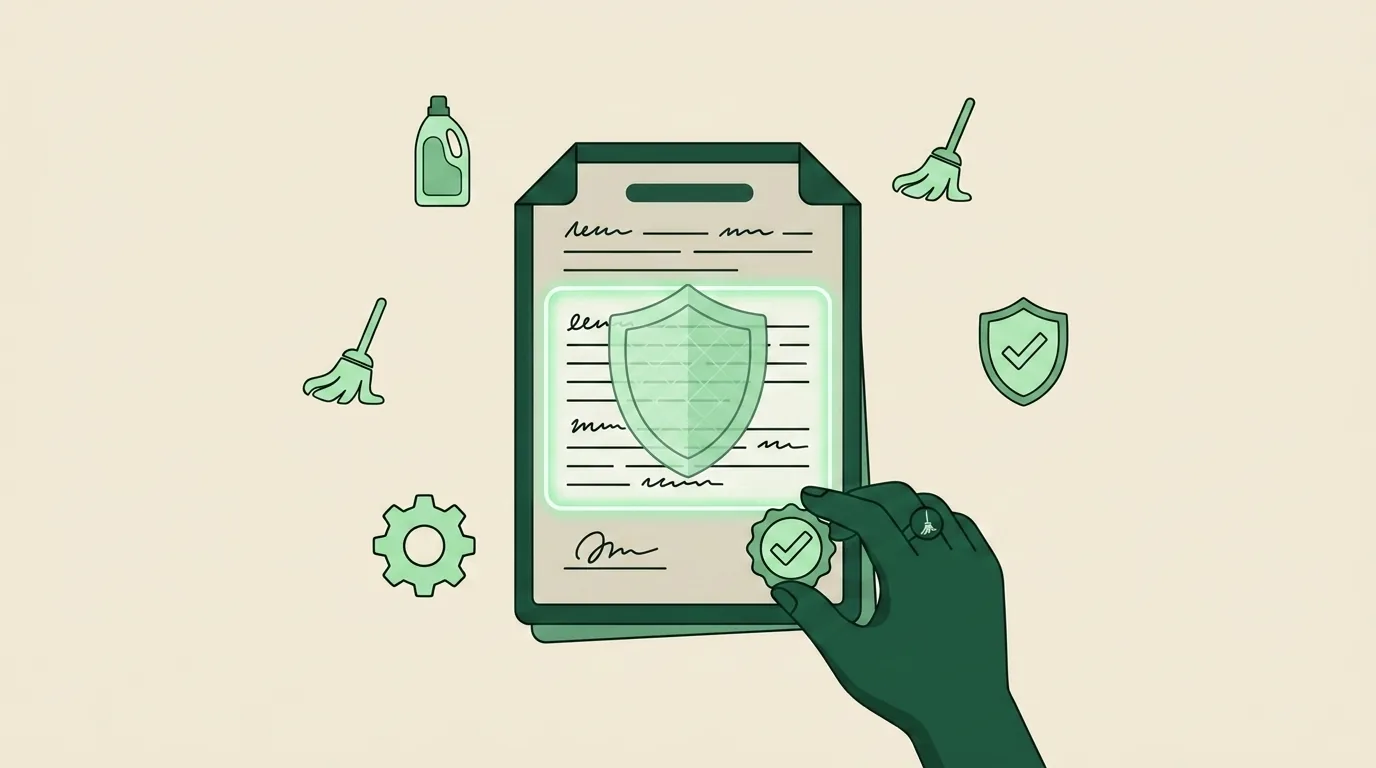
- The inclusion list. Itemize the tasks. If it’s not on the list, it isn’t in the price, but only if there is a list.
- The exclusion list. “Not included at this price: interior windows, walls, garage, post-renovation dust.” Listing exclusions feels negative; in practice clients read it as professionalism, and it converts “you missed a spot” arguments into “would you like to add that?” conversations.
- The condition clause. “Pricing assumes the condition observed at the walkthrough on July 2.” This is your protection when the empty house you quoted becomes a furnished house with two new puppies.
- The change-order sentence. “If the scope changes, we confirm any price adjustment before work begins, never after.” Clients fear surprise invoices more than they fear higher prices. This sentence removes the fear and protects you in the same breath.
- The expiration date. “This quote is valid through August 1, 2026.” Costs change; so does your schedule capacity.
- The add-on menu. Price the common extras up front (oven $35, fridge $30, interior windows $8 each). Scope creep with a price list attached has a different name: upselling.
Cleaning quote checklist: 12 checks before you send
Run these checks on the finished quote, right before you send it. They catch what is missing or unclear; they do not certify legal compliance or guarantee that a client accepts. Each example check uses a fictional house quote (HOME-001, shown in full in the example PDF), not the Sparkline quote above.
Checked means you verified the entry against your current scope and records. Needs clarification means a named person must resolve a question. Not applicable needs a reason; it is not permission to leave an important field blank. Record the reviewer, quote reference, revision and date.
Download the quote checklist
| Free file | Use it for |
|---|---|
| Word checklist | Two editable pages with all 12 checks, three status choices and a line for the owner, action or reason. |
| Checklist PDF | The same two-page checklist for marking by hand. |
| Quote example PDF | Three pages: a fictional house quote and notes showing where each check is satisfied. |
All files are free without signup. The Word file is editable; the PDFs are printable, not interactive forms. The example uses invented identities and USD teaching prices. Replace the assumptions with facts about your own service and have location-dependent tax or contract questions checked appropriately.
1. Business identity and contact
Correct business name and working contact route. Include applicable identifying information; do not assume every business needs to publish a home address.
Example check: Example Cleaning Co; quotes@example.com. Fictional identities and reserved example.com addresses are labelled.
2. Client and service site
Correct client, authorized contact and service location. Include only the personal details needed for the work.
Example check: Example Home Client at 100 Example Lane, Example City, XX 00000: explicitly fictional teaching site.
3. Reference, revision and dates
Unique quote reference, revision, issue date and chosen validity period. Remove old versions and expired dates.
Example check: HOME-001 revision 1, issued September 23, 2026; valid until October 7, 2026.
4. Service and starting condition
State whether this is a first, repeat or one-time clean and record the condition assumptions used for the price.
Example check: First and biweekly repeat cleaning priced separately. Ordinary occupied home, clear accessible surfaces; changes reviewed first.
5. Included areas, tasks and frequency
List rooms and tasks with their frequency and limits. Do not rely on a vague promise to clean everything.
Example check: 1800 sq ft, 3 bedrooms, 2 bathrooms; kitchen surfaces, fixtures, accessible dusting and floors each visit.
6. Exclusions, extras and consumables
State excluded work, separately priced extras and who supplies products, equipment and consumables.
Example check: Oven interior excluded; optional $32 extra requires approval. Provider supplies ordinary cleaning products/equipment; no specialist work.
7. Visit plan and start confirmation
State visit frequency, expected service window and how the first date is confirmed. Separate a proposed date from a booked commitment.
Example check: Every other Monday, 10 a.m.-1 p.m. service window. Proposed October 12 start is confirmed in writing after acceptance.
8. Access and client preparation
Explain the secure access process, parking, pets, clear work areas and contact for problems. Keep alarm/key secrets elsewhere.
Example check: Client arranges secure access, parking and pets; provider contacts client if access fails. No codes or key locations in the quote.
9. Price basis and checked totals
Confirm currency, per-visit/hour/project basis, itemization and totals. Separate initial and recurring charges and optional extras.
Example check: USD $190 per repeat visit; first clean $265. They are alternative visit charges, not a $455 charge for one visit. Oven extra $32 optional.
10. Tax and fee treatment
State tax and fee treatment after checking the applicable location and transaction. Do not treat an unspecified amount as zero.
Example check: Fictional teaching assumption: $0 tax and $0 processing surcharge; real issuer must determine actual treatment. Example totals $190/$265.
11. Payment, schedule changes and scope changes
Choose explicit payment and cancellation/rescheduling terms. State how extra work and price changes are approved.
Example check: No deposit; payment within 7 days after each visit. Request changes 48 hours ahead; no cancellation fee in this example. Changes priced and approved first.
12. Acceptance, proofread and saved version
Clear next step and contact, proofread attachments and amounts, and save the current version for both parties. Acceptance is not assumed.
Example check: Reply with HOME-001 revision 1 and requested service; provider confirms start. Example remains unsigned and unaccepted.
Catch these common errors
| Problem found | Correction before sending |
|---|---|
| “Clean the whole house” | Name the rooms, tasks, limits and frequency. Make excluded interiors or specialist work visible. |
| $265 first clean + $190 repeat shown as $455 due for one visit | Show the applicable visit charge. Initial and repeat charges apply on separate occasions. |
| Optional oven charge included without agreement | Label it optional and record approval before adding it to the confirmed scope and total. |
| Tax field empty | Determine the applicable treatment and state it. An empty field does not mean zero. |
| Proposed date described as booked | Explain what confirms the booking and distinguish the proposed start from an accepted date. |
| Different prices in email and attachment | Correct both, advance the revision and save the version actually sent. |
| Unverified insurance, guarantee or response promise | Remove it or verify the exact statement and conditions. Do not copy another provider’s proof. |
Send It Fast: Speed Beats Polish
Here’s the uncomfortable truth about losing quotes: many were lost before the client ever read yours, because a competitor answered first while you were “getting to it Thursday.”
Respond promptly with a useful next step: a checked quote, a question about scope or a proposed walkthrough. Measure your own response time and accepted quotes; this guide does not have cleaning-industry evidence for a guaranteed conversion uplift.
The reasoning is simple. Quote requests are made at the moment of maximum motivation. Every hour after that, motivation decays, the tabs close, and your quote arrives as an interruption instead of an answer.
Practical standard: quote the same day, within 24 hours at the absolute worst. If the job needs a walkthrough first, then the same-day move is booking the walkthrough, today, with a real time slot.
CleanerHQ helps you prepare an estimate from the job details and send a quote for client approval. Check the scope, costs and acceptance terms before sending. See the current cleaning quote software page for the workflow.
Tired of losing jobs to whoever answered first? Start a free CleanerHQ trial (free for 14 days with no card, for you plus 2 cleaners), and send your next quote the same day you walk the job.
The Follow-Up Cadence (Word-for-Word Scripts)
Use the following cadence as an example, not a requirement to send five messages. Stop when the client declines or opts out, and verify every statement about availability, insurance and past work before copying it.
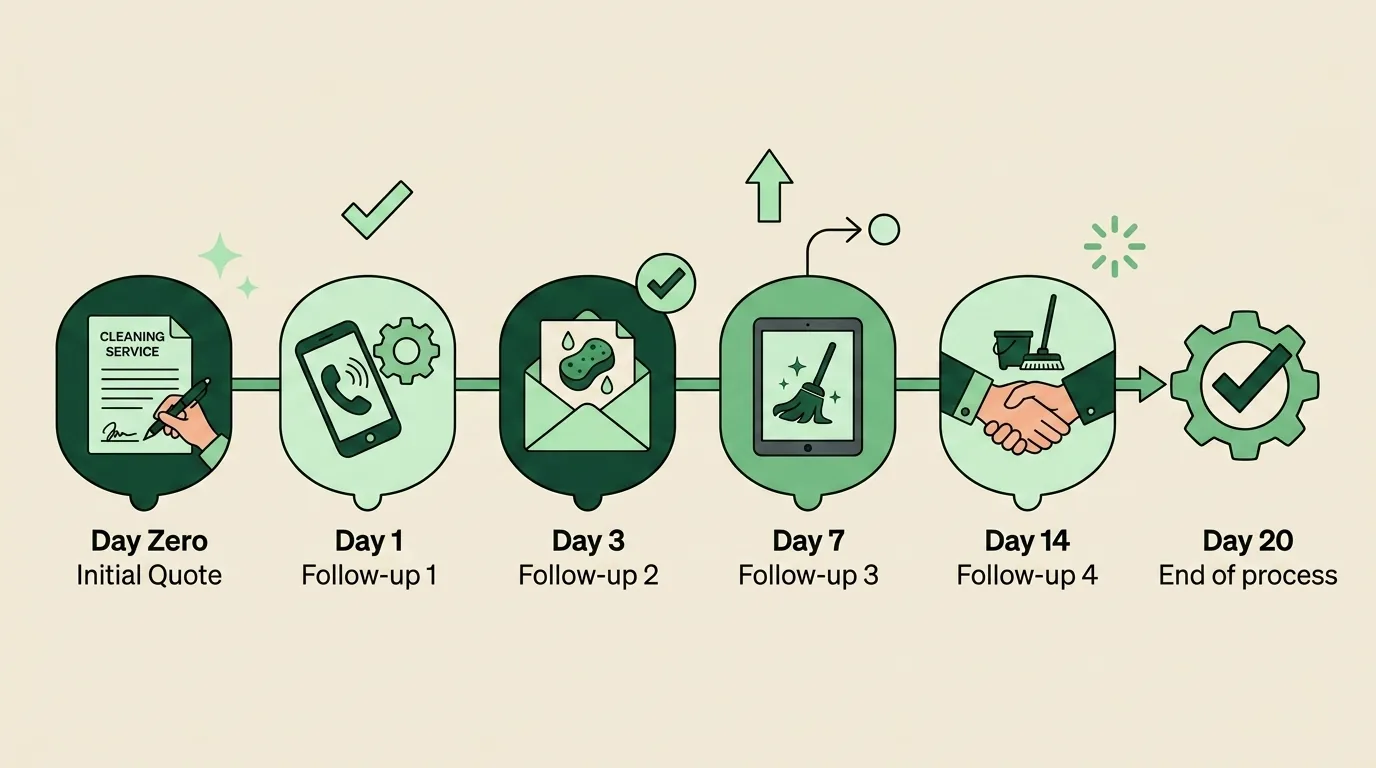
Touch 0, Day 0, the moment you send it (text):
“Hi Dana, it’s Marcus from Sparkline Cleaning. Your quote just landed in your email, three options, you can accept right from your phone. Happy to answer anything.”
Use the contact channel agreed with the client and honor stop requests. Automated or promotional messages can have additional consent and timing requirements. See the client-message guide before setting up follow-ups.
Touch 1, Day 2 (email): “Hi Dana, did the quote arrive safely? I can explain the scope or help you compare the options. Standard includes the microwave interior, cabinet fronts and the listed rotating tasks.”
Touch 2, Day 5 (email, add value, don’t just ‘check in’):
“Hi Dana, one thing I should have mentioned: we’re insured and bonded, and every visit ends with photos of the finished work so you can see exactly what was done. Here’s a recent before-and-after from a home like yours: [link]. Your quote’s still open through August 1.”
Touch 3, Day 10 (text or email, honest urgency):
“Hi Dana, quick heads-up: your quote is open through Aug 1, and our biweekly Thursday slots are close to full for the summer. If Sparkline’s a fit, picking an option this week locks your spot. If not, no hard feelings, tell me what’s missing.”
Touch 4, Day 20 (the break-up email):
“Hi Dana, closing the loop on your quote so I’m not cluttering your inbox. If the timing’s wrong, totally understood; I’ll leave the door open. If something about the quote didn’t work, price, scope, schedule, I’d honestly love the feedback. Either way, thanks for considering us.”
The break-up email outperforms its reputation: it’s often the touch that finally gets a reply, because it’s the first one that’s easy to answer. And when the answer is “you were more expensive,” don’t fold, our playbook for handling price shoppers covers that conversation.
If five touches per quote sounds like a part-time job, that’s because manually, it is. Quote statuses and automated reminders are exactly the kind of grunt work cleaning business software should be doing for you, CleanerHQ tracks every quote from draft to sent to accepted, so nothing dies in a spreadsheet tab. And when a commercial prospect wants more than a quote, a document with scope narrative and terms, that’s a proposal; grab our free cleaning proposal template for those.
Frequently Asked Questions
How long should a cleaning quote be valid?
Choose a validity period that fits the job, cost stability and capacity, then print the actual expiry date. Fourteen and thirty days are examples, not mandatory standards. Explain how the client can request an updated quote after expiry.
How fast should I send a cleaning quote?
Acknowledge the request promptly and give a realistic time for the quote or walkthrough. A same-day response can be a useful service goal, but do not send an inaccurate quote just to meet a timer.
Should I put three prices on one cleaning quote?
Only if the options represent useful, clearly priced scope choices. One well-defined quote can be enough. Cost each package independently and avoid unsupported “most popular” labels.
How much should I charge for a first-time deep clean?
Estimate the initial clean from its condition, tasks and paid hours, plus other job costs and your chosen margin. Show it separately from recurring visits; a fixed multiplier does not fit every home.
Do I need a deposit on one-time cleaning jobs?
Choose a deposit policy that fits the job risk, your agreement and local rules. Explain the amount, when it is due, and cancellation or refund terms before acceptance. Fifty percent in the fictional example is not a universal requirement.
What’s the difference between a cleaning quote and an estimate?
A quote is a fixed price for a defined scope, what this article teaches, and it’s binding once accepted. An estimate is an educated approximation that may change. Clients strongly prefer quotes; just protect yourself with a condition clause and a written exclusion list.

Written by
Rashdi has spent 15+ years building and managing enterprise software, and has worked with US cleaning businesses since 2006. He founded CleanerHQ.


