Revenue per Cleaner: The KPI That Predicts Scale (2027)
Operator benchmarks put a healthy full-time cleaner at $60,000-$90,000 in annual revenue, roughly 1,700-1,800 billable hours (85% utilization) at $35-$50 per billed hour. One franchise founder pegs each new hire at about $50,000 of added revenue capacity; treat that as the floor. Below it, utilization or pricing is broken.
 R Rashdi
·
July 2, 2026
·
11 MIN READ
R Rashdi
·
July 2, 2026
·
11 MIN READ
Quick answer
Operator benchmarks put a healthy full-time cleaner at $60,000-$90,000 in annual revenue, roughly 1,700-1,800 billable hours (85% utilization) at $35-$50 per billed hour. One franchise founder pegs each new hire at about $50,000 of added revenue capacity; treat that as the floor. Below it, utilization or pricing is broken.
Most cleaning business KPIs are noise. Jobs per day, app downloads, social followers, none of them tell you whether the next hire makes you money. One number does: revenue per cleaner. It compresses your pricing, your utilization, and your route density into a single figure, and it predicts whether you can scale, because growth in this industry is hiring, and hiring only works if each cleaner reliably carries $60,000-$90,000 of annual revenue.
This guide gives you the math behind that range, the seven KPIs worth tracking around it (and the ten that waste your Monday), utilization and churn targets, and a dashboard you can stand up in five minutes.
Revenue per Cleaner: The Number and the Math
The benchmark isn’t pulled from the air, it’s three operator rules of thumb multiplied together:
- A full-time cleaner is paid around 2,080 hours a year (40 hours x 52 weeks).
- Healthy billable-time utilization is about 85%. Operators treat drive time above 15% of paid hours as a route-density failure. That yields roughly 1,700-1,800 billable hours.
- Small-company billed rates typically average $35-$50 per cleaner-hour depending on market and niche. (Beginner-operator guides put US residential at $25-45/hour; optimized franchise operations in premium metros report effectively realizing $65-90/hour, both are real, for different stages.)
Multiply: 1,768 billable hours x $35-50 = $62,000-$88,000 per cleaner, per year, call it $60K-$90K, or $5,000-$7,500 a month.
Two reference points to calibrate against. One franchise founder with 12 years of operating data pegs each cleaner onboarded at about $50,000 a year of added revenue capacity. A sensible floor for a newer company with developing routes. And if you’re above $90K per cleaner, congratulations, but check the speedometer: it usually means premium pricing (great) or systematically under-counting hours worked by you and your family (less great).
The formula for your own number:
Revenue per cleaner = trailing 12 months of revenue ÷ full-time-equivalent cleaners (including your own field hours as a fraction of an FTE).
Count FTEs honestly. Two part-timers at 20 hours each are one FTE. The owner cleaning 20 hours a week is half an FTE. Skip that adjustment and your number inflates by exactly the amount of free labor you’re donating.
Why this KPI predicts scale: every input that breaks at growth, loose routes, underpricing, ghost hours, churn-driven retraining, shows up here first, as a falling number, often two quarters before the P&L admits it.
The 7 KPIs Worth Tracking (and 10 to Ignore)
Revenue per cleaner is the headline, but it can’t diagnose itself. These seven numbers, each an operator benchmark, not a study finding, form a complete weekly instrument panel:
| # | KPI | Healthy target (operator benchmarks) | Red flag |
|---|---|---|---|
| 1 | Revenue per cleaner | $60K-$90K/year ($5K-$7.5K/month) | Below ~$50K/year |
| 2 | Loaded labor % of revenue | 40-50% | Above 60% |
| 3 | Billable-time utilization | ~85% of paid hours | Below 75% |
| 4 | Drive time | Under 15% of paid hours | Travel + fuel nearing 30% of revenue |
| 5 | Net profit margin | 15-20% sustainable; 20-35% well-run | Below 10% |
| 6 | Recurring revenue mix | ~90% recurring / 10% one-time | Majority one-time |
| 7 | Client retention | ~2 years average residential | Churn before month 6 |
Numbers 2 and 5 have their own deep dives, the labor cost percentage benchmarks and profit margin benchmarks by niche, and supplies discipline (the 3-8% benchmark) feeds number 5 directly.
And the ten to ignore, not because they’re meaningless, but because they don’t belong on a weekly dashboard: social media followers, website sessions, total revenue without margin, jobs completed per day without margin per job, number of services offered, email open rates, raw review count, app downloads, quote volume without close rate, and hours the owner worked (that one’s a cost, not a KPI). If a number can go up while the business gets worse, it’s not a KPI, it’s a mood.
One carve-out: quality and people metrics, inspection scores, review ratings, crew turnover, absolutely matter, but they’re leading indicators that show up in retention (#7) and revenue per cleaner (#1) within a quarter. Turnover deserves special respect: industry turnover commonly runs well above 100% a year, and one 12-year operator puts the cost of each departure around $4,000 in hiring, training, and lost capacity. Watch them monthly; manage the seven weekly.
Utilization: Billable Hours vs Paid Hours
Utilization is the quiet engine of revenue per cleaner, and the easiest of the seven to improve without touching prices.
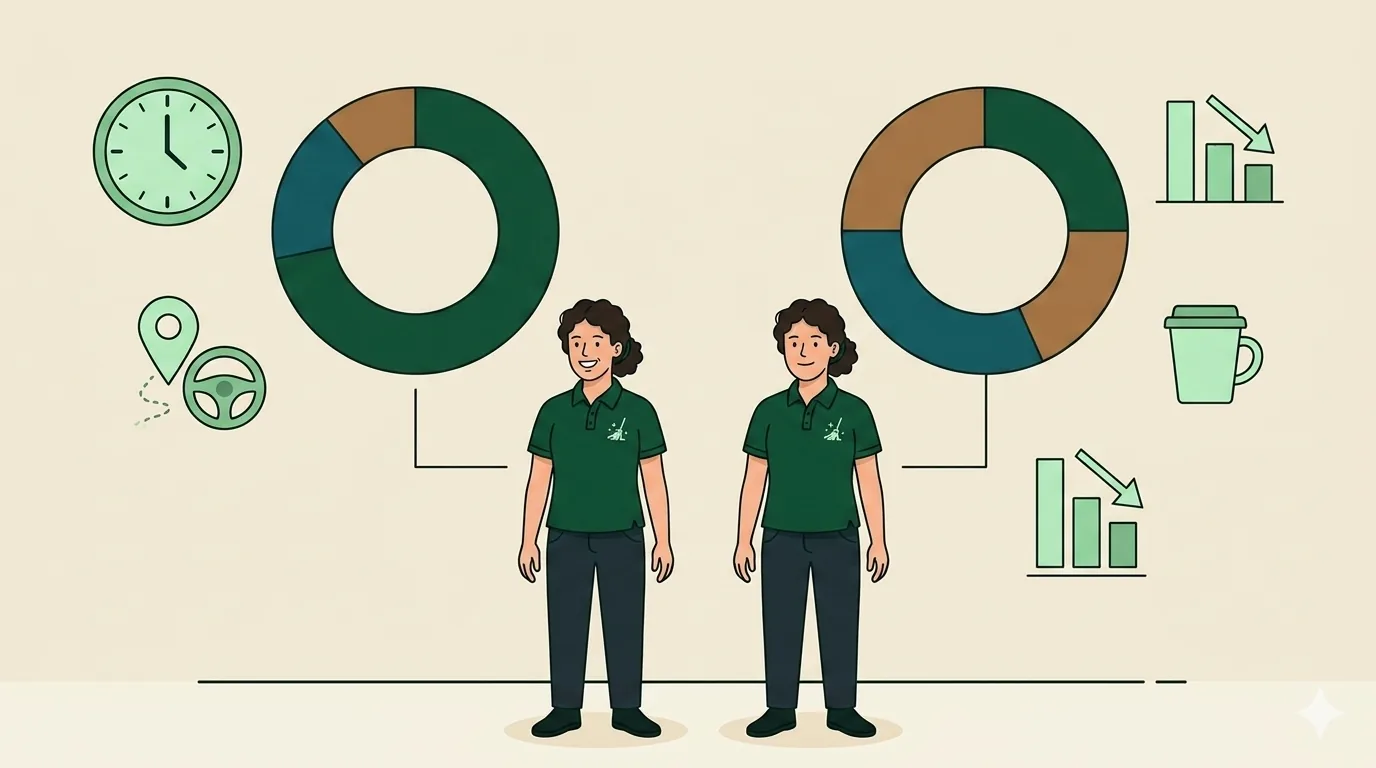
The math, with assumed but typical inputs. A cleaner paid 40 hours a week, billed out at $40/hour:
- At 85% utilization: 34 billable hours → $1,360/week → about $68,000/year. On benchmark.
- At 70% utilization: 28 billable hours → $1,120/week → about $56,000/year. Same wage cost, same cleaner, $12,000 a year less revenue. Per cleaner.
A five-crew company running 70% instead of 85% is leaving roughly $60K a year in the windshield and the gaps between jobs. That’s also why a $50/hour sticker rate typically realizes only $30-35/hour once travel and utilization gaps are counted, operator economics worth tattooing somewhere visible.
Where the lost points hide, in order of frequency:
- Drive time over 15%. Scattered routes, no geographic clustering, one-off jobs accepted 40 minutes out. Density is the fix, not speed.
- Schedule gaps. A 90-minute hole between a 10 a.m. finish and a noon start is paid idleness. Tighter booking windows and route-aware scheduling close it.
- Unverified hours. Paper timesheets round up. GPS-verified clock-in and clock-out makes paid hours equal worked hours, operators consistently find a few percent of payroll was ghost time.
Measure utilization as billable (on-site, revenue-attached) hours ÷ total paid hours, weekly, per crew. Crew-level granularity matters: a company average of 82% can hide one crew at 90% and another at 70%, and those two crews need opposite conversations.
Churn and Lifetime Value Targets
Revenue per cleaner measures the engine; retention measures whether you keep the fuel. The operator benchmarks:
- Recurring revenue mix: ~90% recurring / 10% one-time. Recurring is what makes route density and utilization possible at all, a one-time-heavy book re-solves the routing puzzle every week.
- Residential retention: about 2 years average, per a 10-year operator running in four cities, though the honest range is wide: some high-churn metro models plan around 8-12 months. Know which market you’re in before borrowing anyone’s target.
- Residential lifetime value: roughly $3,000 in gross profit per client (same operator’s data), with recurring clients at $150-200 a visit. Cross-operator consensus: recurring LTV “blasts out” any one-off job, a $550 move-out clean is nice; a biweekly client is a multi-thousand-dollar relationship.
- Customer acquisition cost: ~$150 baseline, falling to ~$130 with referral programs and ~$90 at scale; a dialed Google Local Services playbook achieves $50-75. If CAC runs past $150-300 without compounding referrals and reviews, the marketing engine, not the cleaning, is the problem.
- Commercial is its own physics: a 25-year operator notes a single high-ticket commercial relationship can be worth seven figures over its lifetime. Fewer logos, deeper moats.
The ratio worth writing down: at $3,000 LTV and $150 CAC, every retained client returns 20x their acquisition cost, which is why a month of churn does more P&L damage than a slow month of sales. Operational consistency drives retention more than discounts do; our guide to customer retention for cleaning businesses covers the playbook.
Margin per Job by Service Type
The last layer of the framework: not all $68K-per-cleaner revenue is equal. Margin per job by service type tells you which revenue to go get more of. Operator benchmarks for context:
| Service type | Margin character (operator benchmarks) |
|---|---|
| Recurring residential | Richest base: 30-50% before owner pay on dense routes |
| Commercial janitorial | 20-40% gross, thinner net, volume and stability play |
| Airbnb/STR turnover | 50-75% higher hourly than routine work, schedule-sensitive |
| Specialty (carpet, windows, post-construction) | Premium rates; equipment and skill barriers protect margin |
Compute it per job: revenue minus loaded labor for actual GPS-verified hours, minus supplies, minus an overhead slice. Then re-rank your marketing spend by margin per hour, not revenue per ticket. It’s common to discover the glamorous deep cleans earn less per crew-hour than the boring biweeklies, and that one “anchor” commercial account has quietly become your lowest-margin work since its last price increase three years ago (operator benchmarks put normal increases at 3-8% a year).
Your KPI Dashboard (5-Minute Setup)
You don’t need a BI tool. You need seven numbers, one page, every Monday:
- Pull last week’s revenue and paid hours (payroll) and billable hours (jobs).
- Compute the big three: revenue ÷ FTE cleaners (annualize it), loaded labor ÷ revenue, billable ÷ paid hours.
- Eyeball drive time, recurring mix, and any client cancellations against the targets in the table above.
- Circle the worst number. That’s the week’s project. One number, one fix, not seven.

The spreadsheet version takes about 20 minutes a week and dies the first month you’re slammed, which, again, is exactly when the leaks start. Cleaning business software that already knows your jobs, GPS-verified hours, and invoices computes all seven continuously: margin per job, estimated-vs-actual hours, utilization per crew, labor percentage per week. If you’d rather see your real revenue per cleaner than guess at it, try CleanerHQ free (card needed to start the trial).

Frequently Asked Questions
What is a good revenue per cleaner for a cleaning business?
Operator benchmarks put a healthy full-time cleaner at $60,000-$90,000 in annual revenue, about $5,000-$7,500 a month. The math: roughly 1,700-1,800 billable hours a year (85% utilization on 2,080 paid hours) at $35-$50 per billed hour. One 12-year franchise founder pegs each new hire at about $50,000 of added annual revenue capacity; treat that as the floor.
How do you calculate revenue per cleaner?
Divide trailing-12-month revenue by full-time-equivalent cleaners, counting part-timers by hours (two 20-hour cleaners = 1 FTE) and including the owner’s own field hours as a fraction of an FTE. Example: $340,000 revenue with 4.5 FTE cleaners = $75,500 per cleaner, inside the $60K-$90K benchmark. Recompute monthly and watch the trend, not single months.
What KPIs should a cleaning business track?
Seven, weekly: revenue per cleaner ($60K-$90K/year), loaded labor percentage (40-50% of revenue), billable-time utilization (~85%), drive time (under 15% of paid hours), net margin (15-20% sustainable, 20-35% well-run), recurring revenue mix (~90/10), and client retention (~2 years residential average). All are operator benchmarks, practitioner rules of thumb, not government statistics.
What is a good utilization rate for cleaners?
Operators target about 85% of paid hours billable, with drive time under 15%. The gap is expensive: a cleaner paid 40 hours and billed at $40/hour produces about $68,000 a year at 85% utilization but only $56,000 at 70%, a $12,000 difference per cleaner with identical wage costs. Measure it weekly, per crew, as billable hours divided by paid hours.
What is a good client retention rate and lifetime value?
A 10-year, 4-city residential operator reports roughly 2-year average client retention and about $3,000 of gross profit per client, with recurring visits at $150-200. High-churn metro models plan around 8-12 months instead, the range is market-dependent. Against a ~$150 customer acquisition cost benchmark, a retained recurring client returns about 20x what it cost to win.
Why is revenue per cleaner falling even though sales are up?
Because the KPI divides by headcount: if new hires aren’t reaching full routes, utilization slips below 85%, or new work was priced thin, total revenue rises while revenue per cleaner falls. It’s an early-warning signal, falling utilization, loosening route density, or creeping discounts usually show up here a quarter or two before profit margins visibly drop.

Written by
Rashdi has spent 15+ years building and managing enterprise software, and has worked with US cleaning businesses since 2006. He founded CleanerHQ.