
Flat Rate vs Hourly Pricing for Cleaning Services (2027)
Flat rate wins for recurring, predictable cleaning work: the client gets a fixed bill and you keep every minute of efficiency you gain. Hourly, $25 to $50 per cleaner per hour in published cost guides (Angi), wins for unknowns: first visits, post-construction, hoarding. Most successful operators run both: hourly for visit one, flat from visit two.
 R Rashdi
·
July 2, 2026
·
12 MIN READ
R Rashdi
·
July 2, 2026
·
12 MIN READ

Quick answer
Flat rate wins for recurring, predictable cleaning work: the client gets a fixed bill and you keep every minute of efficiency you gain. Hourly, $25 to $50 per cleaner per hour in published cost guides (Angi), wins for unknowns: first visits, post-construction, hoarding. Most successful operators run both: hourly for visit one, flat from visit two.
The flat rate vs hourly cleaning debate has a boring answer and an interesting one. The boring answer: flat rate for recurring work, hourly for unknowns. Most pricing articles stop there.
The interesting answer is why, and it comes down to one question: who keeps the minutes when your crew gets faster? Under hourly billing, the client does; your reward for training a great team is a smaller invoice. Under flat rate, you do. That single mechanic explains almost every pattern in how cleaning businesses price, and it’s why the industry’s recurring residential work has consolidated on flat rates while restoration-style chaos work stays hourly.
This guide runs the margin math side by side, gives you a decision matrix by job type, covers the cases where hourly is still genuinely the right call in 2027, and ends with the scripts for moving existing hourly clients to flat rates without losing them.

The Two Models, Defined Properly
Hourly pricing bills for time spent: a rate per cleaner per hour, multiplied by hours on site. Published consumer guides put the going rate at $25-$50 per cleaner per hour (Angi), with professional companies ranging up to $80 in HomeAdvisor’s data. The client carries the time risk: if the job runs long, the bill runs long.
Flat-rate pricing quotes a fixed price for a defined scope: $170 for the biweekly clean of this specific 3-bed, 2-bath, whatever the clock says. You carry the time risk, and collect the time reward. Consumer cost guides effectively describe a flat-rate world: the published $118-$238 per-visit range for standard cleans (HomeAdvisor, Angi) is how homeowners shop, by price per visit, not rate per hour.
A third model, per square foot, $0.10-$0.20 for standard cleans per the cost guides, is really a flat-rate generator: a formula for computing the fixed price of a home you haven’t walked. Our house cleaning pricing guide covers the full rate tables behind all three.
The two models converge on the same number when your time estimates are honest. They diverge over time, and that divergence is the whole game.
The Margin Math, Side by Side
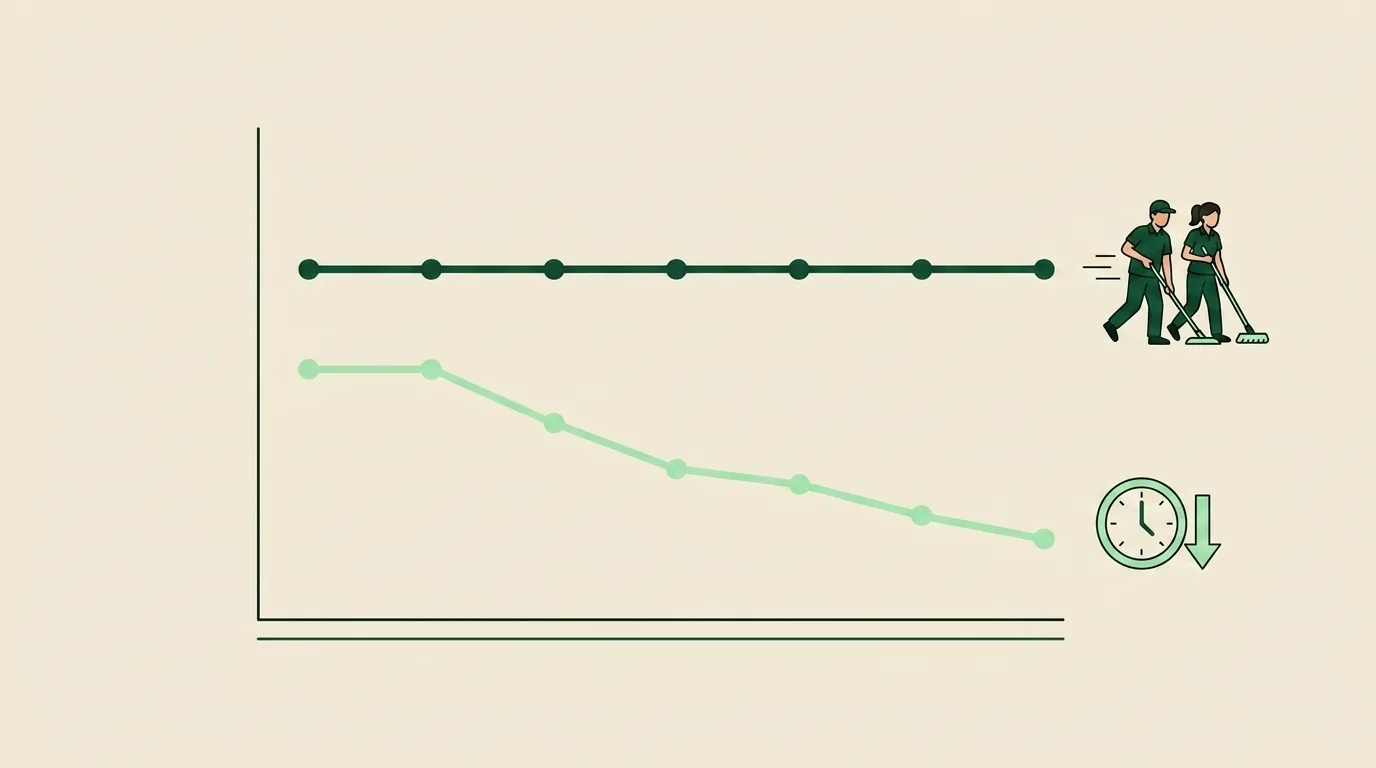
Worked example with stated assumptions. Say your loaded labor cost is $22 per hour per cleaner (wage plus payroll taxes and insurance), a 2-person team cleans a 3-bed/2-bath biweekly, and, like every crew, they get faster with repetition: 4.0 labor-hours on the first visit, settling to 2.8 by visit five as they learn the house.
Price it both ways: hourly at $45 per labor-hour, or flat at $170 per visit. Same house, same crew, same work.
| Hourly ($45/labor-hr) | Flat rate ($170/visit) | |
|---|---|---|
| Visit 1 (4.0 labor-hrs) | Revenue $180 / labor $88 / margin $92 (51%) | Revenue $170 / labor $88 / margin $82 (48%) |
| Visit 5 (2.8 labor-hrs) | Revenue $126 / labor $62 / margin $64 (51%) | Revenue $170 / labor $62 / margin $108 (64%) |
| Effective rate, visit 5 | $45/labor-hr (fixed) | $61/labor-hr |
| Annual revenue (26 visits, settled) | ~$3,280 | $4,420 |
Read the bottom rows twice. Under hourly, your percentage margin holds, but the dollars shrink as the crew improves, and the account is worth ~$1,100 less per year because your team got good. Under flat rate, every minute of learned efficiency converts to margin. Efficiency under hourly is a pay cut; under flat rate it’s a raise.
Two honest caveats keep this from being a sales pitch for flat rates:
- The math cuts both ways. Estimate 2.8 hours on a house that actually takes 4.5 and the same leverage works against you, visit after visit. Flat-rate pricing is an estimating discipline wearing a pricing model’s clothes.
- Speed pressure is real. Crews paid to finish fast will finish fast; without checklists and quality gates, “fast” becomes “skipped the baseboards.” The fix is structural (per-visit checklists, photo proof), not motivational.
There’s a client-side version of the same logic, too: homeowners budget in fixed numbers. A $170 bill that’s $170 every time gets approved once and forgotten; an invoice that wobbles between $126 and $200 gets inspected every time. Predictability is worth real money on both sides of the transaction, which is why flat rate dominates recurring work for reasons beyond your margin. (For where margins should land overall, sustainable operators run 15-20% net as an industry rule of thumb, see understanding your cleaning business profit margins.)
The Decision Matrix
| Job type | Model | Why |
|---|---|---|
| Recurring residential (weekly/biweekly/monthly) | Flat | Predictable scope, repeated learning, client budgets per visit |
| Initial clean of a new recurring account | Flat at 1.5-2x the recurring rate (operator standard) | Known scope, unknown buildup, the premium absorbs it |
| One-time deep clean, walked or video-toured | Flat | You’ve seen it; quote it |
| Move-out / move-in | Flat with condition contingency | Inspection-grade scope is definable; condition is the variable, quote a range, confirm on site |
| Recurring commercial / janitorial | Flat (monthly, from per-sq-ft math) | Contracts demand budgetable numbers |
| Post-construction | Hourly (or phased flat per the industry’s Rough/Final/Fluff stages) | Dust load and punch-list chaos defy estimation |
| Hoarding / extreme condition | Hourly | Scope is undiscoverable until you’re inside |
| “While you’re here” client-directed work | Hourly | The client controls the task list, so they carry the clock |
| Your first 90 days in a new service line | Hourly, while you collect time data | You can’t flat-rate what you can’t yet estimate |
When Hourly Still Makes Sense in 2027
Hourly isn’t the legacy model, it’s the right tool for genuine uncertainty, and pretending otherwise loses money in the other direction:
- You can’t see the job. Post-renovation units, hoarding situations, “it’s been a few years” houses. If your walkthrough can’t produce a confident hour count, the client carries the clock, or you pad the flat quote so heavily you lose the bid anyway.
- The client directs the work. Some clients want four hours of “whatever needs doing most.” That’s staffing, not scoping, bill it hourly and everyone’s incentives stay clean.
- You lack time data. New service line, new market, new building type: run hourly (or T&M) until you’ve got enough completed-job actuals to estimate honestly. Then convert.
- The scope mutates mid-job. Event cleanup and emergency callouts where the brief changes hourly. A flat quote here is a coin flip.
The discipline that makes hourly palatable to clients: give an estimated range up front (“most first cleans like yours run 3-4 team-hours”), cap it (“we’ll call before exceeding $300”), and track time verifiably. Clock-watching disputes kill hourly relationships; GPS-verified time tracking ends the argument before it starts because the hours on the invoice are the hours on the record.
Flat-Rate Quoting Without Losing Your Shirt
Flat rate transfers time risk to you, so the entire craft is estimating. Five practices, all standard among operators who’ve made the model work:
- Estimate from data, not optimism. Track actual time per job for every house you clean, by GPS clock-in/out, not memory. Industry practice says collect at least a few months of actuals before converting a service line to flat rates. Our guide to estimating job time accurately covers the production-rate method.
- Buffer the estimate. Operators commonly add a 15-20% time buffer to flat-rate estimates, the difference between an average and the bad days the average hides.
- Hold a hard floor. Never let a flat price fall below roughly 2x your loaded labor cost for the estimated hours, the operator rule that keeps labor at or under 50% of revenue.
- Define scope in writing, including what’s excluded. A flat rate prices a defined service. Inside the oven, inside the fridge, interior windows, each is an itemized add-on (the cost guides price them at $25-$50, $25-$45, and $4-$10 per window respectively), not an assumed freebie. Scope creep is the silent killer of flat-rate margins.
- Review variance monthly, reprice yearly. Compare estimated vs actual hours per job and per client. A house that drifts from 2.8 to 3.6 hours has changed, a new dog, a new baby, a home office, and its price should change too. Pair the variance review with an annual rate adjustment (the industry benchmark is 3-8% per year); our guide on when and how to raise your cleaning prices has the playbook.
This loop, estimate from production rates, floor-protect the price, compare quoted vs GPS-verified actuals, catch the drifters, is precisely what CleanerHQ automates. The Smart Pricing Calculator builds every flat quote bottom-up from your labor cost across 16 cleaning-specific calculator types, takes the higher of the labor model and your floor price on every job, and outputs Good/Better/Best tiers; then variance analysis flags the jobs where actual hours are eating the quote. Start a free trial (card needed to start the trial) and run your five worst-margin accounts through it.

Transitioning Existing Clients From Hourly to Flat
The fear is churn. The reality, when the transition is priced honestly, is that most clients prefer the predictable number, you’re removing the one thing they disliked about hourly billing. The operator-standard sequence:
- Convert new clients first. Every new account starts on flat rates from day one (after an hourly or premium-priced first visit). Your hourly book shrinks by attrition while you practice the model where mistakes are cheapest.
- Set each client’s flat rate from their own history. Average their last six invoices. If the Hendersons have averaged $156 a visit, their flat rate is $155 or $160, not a number from a chart. The pitch is “same money, no surprises,” and it has the advantage of being true.
- Give 30 days’ written notice. Standard practice, and it frames the change as service, not a squeeze.
- Script it simply. “Starting May 1, your visits will be a flat $160 instead of hourly billing. That’s right at your recent average, the only change is you’ll always know the number in advance. Nothing about the service changes.” Then stop talking. Long justifications signal doubt.
- Absorb the edge cases. A few clients whose homes run faster than average will be paying slightly more than their old math; if one pushes back, show their invoice history and offer to hold their rate for six months. You’ll keep nearly all of them, and the route-level margin gain outweighs the exceptions.
- Keep tracking time after the switch. The clock stops appearing on invoices; it should never stop appearing in your data. Post-transition actuals are how you catch the accounts you converted at the wrong number.
Run the transition once, properly, and you end up where the recurring side of this industry has been heading for years: clients who budget confidently, crews rewarded for efficiency, and margins that improve as your team does, the economics that make a cleaning company scalable in the first place. (It’s also the pricing foundation everything else in your cleaning business software stack builds on: flat quotes become recurring jobs, completed jobs become invoices, untouched by re-negotiation.)

Frequently Asked Questions
Is flat rate better than hourly for cleaning services?
For recurring, predictable work, yes: under flat-rate pricing you keep the margin gains as your crew gets faster, while hourly billing turns crew efficiency into smaller invoices. In a worked example at $22/hr loaded labor, a settled biweekly account earns roughly $108 margin per visit flat versus $64 hourly. Hourly remains better for unknowns, first visits, post-construction, hoarding.
What is a typical hourly rate for house cleaning?
Published cost guides put hourly house cleaning at $25-$50 per cleaner per hour (Angi), with professional companies up to $80 per hour in HomeAdvisor’s data. Independent solo cleaners sit at the low end; insured companies in high-cost metros at the high end. If you bill hourly, give an estimated range and a not-to-exceed cap to prevent disputes.
How do I convert my hourly cleaning clients to flat rates?
Set each client’s flat rate from their own invoice history, average the last six visits and round to the nearest $5, then give 30 days’ written notice with a one-line pitch: same average cost, fully predictable bill. Convert new clients first to practice. Operators who price the switch from real history report keeping nearly all converted accounts.
How much buffer should I build into a flat-rate quote?
Operators commonly add 15-20% to the estimated time before pricing, then apply a hard floor of at least 2x loaded labor cost for those hours. The buffer absorbs bad days; the floor keeps labor at or below roughly half of revenue, the industry rule-of-thumb band. Without both, a flat rate is a bet, not a price.
When should a cleaning business still charge hourly?
Whenever time genuinely can’t be estimated: post-construction and hoarding work, client-directed “do what needs doing” visits, emergency callouts, and any new service line where you lack completed-job time data. Bill at the published $25-$50 per cleaner hourly range, state an estimate range up front, cap the total, and track hours verifiably with GPS clock-in.
Do clients prefer flat rate or hourly cleaning prices?
Consumer behavior says flat: the major cost guides present house cleaning as per-visit prices ($118-$238 for a standard clean, per HomeAdvisor and Angi) because that’s how homeowners budget and compare. A fixed number gets approved once and forgotten; a variable invoice gets inspected every month. Hourly survives mainly where clients direct the work themselves.

Written by
Rashdi has spent 15+ years building and managing enterprise software, and has worked with US cleaning businesses since 2006. He founded CleanerHQ.