Sample Commercial Cleaning Contract (Free Template)
A commercial cleaning contract needs 12 clauses: scope of work, schedule and access, term and renewal, pricing, payment terms, price escalation, supplies, insurance, indemnification, non-solicitation, performance standards with a cure period, and termination. Copy the free sample contract below, then have a local attorney review it before you sign.
 R Rashdi
·
July 13, 2026
·
13 MIN READ
R Rashdi
·
July 13, 2026
·
13 MIN READ
Quick answer
A commercial cleaning contract needs 12 clauses: scope of work, schedule and access, term and renewal, pricing, payment terms, price escalation, supplies, insurance, indemnification, non-solicitation, performance standards with a cure period, and termination. Copy the free sample contract below, then have a local attorney review it before you sign.
A signed contract is the difference between a commercial account and a commercial rumor. The sample commercial cleaning contract below is the full document, every clause reproduced on this page with a plain-English explanation of what it does, what to negotiate, and where owners get burned.
Commercial relationships are worth protecting on paper. One 25-year operator puts it bluntly: a single good commercial relationship can be worth seven figures over its lifetime. You do not run that on a handshake.
A necessary disclaimer: this template and guide are educational, not legal advice. Contract law varies by state, and your situation has details no template can know. Have a licensed attorney in your state review any contract before you send or sign it, it is usually an hour or two of their time, and it is the cheapest insurance in this article.

Download the Commercial Cleaning Contract Template
The download includes the same agreement as a Word document (.docx) you can edit and rebrand, plus a PDF for reference. Every clause is also printed in full below.
Why Commercial Cleaning Contracts Beat Month-to-Month Handshakes
Commercial janitorial is a volume business on thin margins, operator benchmarks put commercial margins at 20-40%, and IBISWorld has pegged the average janitorial net margin at roughly 6.3%. At those numbers, one client who pays 45 days late or cancels without notice can wipe out a month of profit.
A contract fixes four things a handshake cannot:
- Scope disputes. The “while you’re here, could you also…” conversation gets an answer written in advance.
- Payment timing. Net-30 invoicing is the corporate norm; the contract is what makes the 30 enforceable, with a late charge behind it.
- Revenue predictability. Typical commercial terms run 6-12 months with auto-renewal. That is the recurring revenue that makes a cleaning business sellable, see our guide on building recurring revenue with cleaning contracts.
- Exit rules. Both sides know exactly how the relationship ends: notice periods, cure windows, and final payment.
If you are still working on landing the account in the first place, start with how to get commercial cleaning contracts and how to bid on commercial cleaning contracts. This article assumes the client said yes.
The 12 Clauses Every Commercial Cleaning Contract Needs
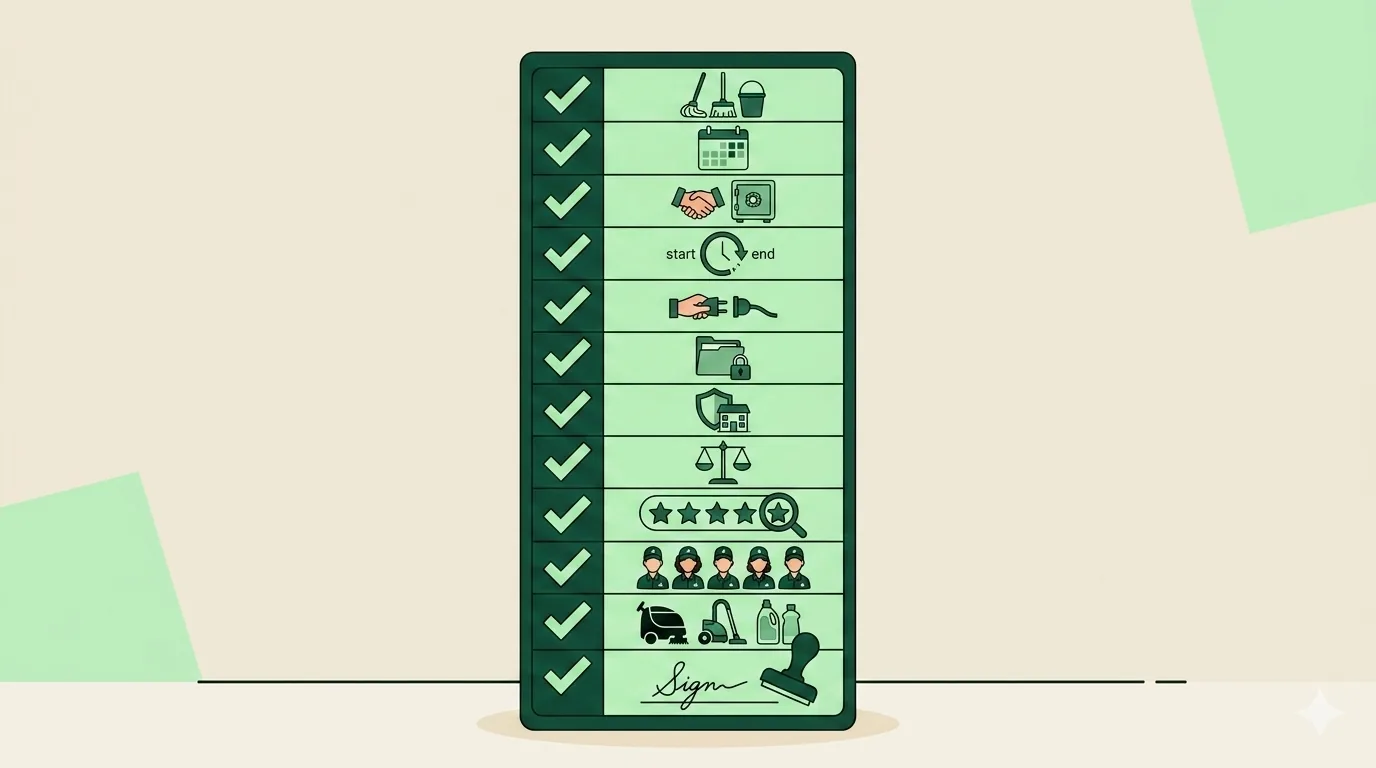
| # | Clause | What it protects |
|---|---|---|
| 1 | Services (scope of work) | You, from scope creep |
| 2 | Schedule and access | Your crew’s billable time |
| 3 | Term and renewal | Your recurring revenue |
| 4 | Price and payment | Your cash flow |
| 5 | Price adjustments | Your margins as costs rise |
| 6 | Supplies and equipment | Clarity on who buys what |
| 7 | Insurance | Both parties, from accidents |
| 8 | Indemnification | You, from claims you did not cause |
| 9 | Personnel and non-solicitation | Your staff, from being poached |
| 10 | Keys, security, confidentiality | The client’s building and data |
| 11 | Performance standards and cure | The relationship, from one bad night |
| 12 | Termination and general provisions | Both parties’ exit |
Sample Commercial Cleaning Contract: Full Template, Clause by Clause
Replace everything in [brackets]. The bracketed numbers are common starting points, not magic, adjust them to your market and have your attorney confirm them against state law.
COMMERCIAL CLEANING SERVICES AGREEMENT
This Agreement is made as of [date] between [Contractor legal name] (“Contractor”) and [Client legal name] (“Client”) for cleaning services at [premises address] (the “Premises”).
Clause 1: Services (scope of work)
1. Services. Contractor will perform the cleaning services described in Exhibit A (the “Services”) at the Premises. Work not listed in Exhibit A is excluded and, if requested, will be quoted separately in writing.
Plain English: the contract body stays short; the task-by-task detail lives in Exhibit A (below). The second sentence is the anti-scope-creep clause, anything extra becomes a new quote, not a free favor.
Clause 2: Schedule and access
2. Schedule and access. Services will be performed [three (3) times per week, Monday/Wednesday/Friday, between 6:00 p.m. and 10:00 p.m.]. Client will provide access to the Premises, working utilities, and a secure janitorial closet. If Contractor cannot access the Premises at a scheduled time, the visit is billable unless Client gives at least [24] hours notice.
Plain English: the lockout sentence matters most. A crew that drives to a locked building has burned payroll and route time; this clause makes that the client’s cost, not yours.
Clause 3: Term and renewal
3. Term and renewal. This Agreement begins on [start date] and runs for [twelve (12) months] (the “Initial Term”). It renews automatically for successive [twelve-month] terms unless either party gives written notice of non-renewal at least [60] days before the end of the current term.
Plain English: 6-12 months is the typical commercial term. Auto-renewal keeps good accounts from lapsing by accident; the 60-day window gives both sides time to renegotiate instead of scrambling.
Clause 4: Price and payment
4. Price and payment. Client will pay $[X] per month, invoiced monthly in arrears. Invoices are due within thirty (30) days of the invoice date (net 30). Amounts unpaid after the due date accrue a late charge of [1.5]% per month or the highest rate permitted by law, whichever is less. Contractor may suspend Services if any invoice is more than [15] days past due, after written notice.
Plain English: net 30 is what corporate accounts-payable departments run on, fighting it usually costs more goodwill than it is worth. The teeth are the late charge (the “highest rate permitted by law” wording keeps you inside state caps) and the suspension right, which turns a 60-day-late client into a conversation instead of a write-off.
Clause 5: Price adjustments
5. Price adjustments. Pricing is fixed for the Initial Term. Thereafter, Contractor may adjust pricing once per twelve-month period with at least [60] days written notice. If Client materially changes the Premises or the requested scope (square footage, occupancy, frequency), the parties will agree on a revised price in writing before the change takes effect.
Plain English: this is the clause owners forget and regret. Wages and supplies rise every year; cleaning-industry benchmarks put typical annual increases at 3-8%. Without this clause, your only renegotiation lever is threatening to quit the account. The scope-change sentence covers the client who doubles their office and expects the same invoice.
Clause 6: Supplies and equipment
6. Supplies and equipment. Contractor provides all cleaning supplies, chemicals, and equipment, except consumables stocked by Client: [trash liners, paper products, hand soap]. Contractor will maintain Safety Data Sheets for chemicals used at the Premises as required by the OSHA Hazard Communication Standard (29 CFR 1910.1200).
Plain English: decide consumables explicitly, paper and liners quietly eat margin if nobody agreed who buys them. The SDS sentence is not boilerplate: HazCom was the second most-cited OSHA violation in 2024 per OSHA enforcement data, and putting compliance in the contract signals professionalism to facility managers who audit vendors.
Clause 7: Insurance
7. Insurance. Contractor will maintain commercial general liability insurance of at least $[1,000,000] per occurrence, workers’ compensation insurance as required by law, and a janitorial bond, and will provide certificates of insurance on request.
Plain English: $1M per occurrence is the floor most commercial clients require; larger properties may ask for $2M aggregate or an additional-insured endorsement. Expect to hand over a COI before your first visit.
Clause 8: Indemnification
8. Indemnification. Each party will indemnify and hold the other harmless against third-party claims arising from its own negligence or willful misconduct. Contractor is not responsible for pre-existing damage or for losses arising from conditions of the Premises outside its control.
Plain English: mutual indemnification means each side owns its own mistakes. Watch for client-drafted versions that are one-way, where you indemnify them for everything including their own negligence. That is the single most common red flag your attorney will catch.
Clause 9: Personnel and non-solicitation
9. Personnel; non-solicitation. Contractor’s personnel are employees or contractors of Contractor, not of Client. During the term and for [12] months after, neither party will solicit for employment the other party’s personnel who performed or supervised the Services, without written consent.
Plain English: good cleaners get job offers from the buildings they clean. With industry turnover commonly running well above 100% a year, you cannot afford to train staff into a client’s payroll. Some operators add a placement fee for breaches; ask your attorney what is enforceable in your state.
Clause 10: Keys, security, and confidentiality
10. Keys, security, confidentiality. Client-issued keys, fobs, and access codes remain Client property; Contractor will log all holders and return all items on termination. Contractor will follow Client’s posted security procedures and keep confidential any non-public information observed at the Premises.
Plain English: night crews see payroll sheets on desks and prototypes in labs. This clause is often the difference between passing and failing a corporate vendor review.
Clause 11: Performance standards and cure
11. Performance standards; cure. Services will be performed in a professional, workmanlike manner consistent with Exhibit A. Client will report deficiencies in writing within [48] hours, and Contractor will correct verified deficiencies within [3] business days at no charge. If Client believes Contractor has materially failed to perform, Client will give written notice describing the failure, and Contractor will have [10] business days to cure before Client may terminate for cause.
Plain English: the cure clause is your protection against losing a 12-month account over one bad night. The client must tell you what went wrong in writing, and you get a defined window to fix it. The 48-hour reporting rule also kills the month-old complaint produced as ammunition during a price negotiation.
Clause 12: Termination and general provisions
12. Termination; general. Either party may terminate: (a) for convenience, with [30] days written notice; (b) for cause, if a material breach is not cured within the period in Clause 11 (or, for non-payment, within [10] days of written notice); or (c) immediately, if the other party becomes insolvent. On termination, Client pays for Services performed through the final day. This Agreement is the entire agreement between the parties; amendments must be written and signed. Neither party is liable for delay caused by events beyond its reasonable control. Neither party may assign this Agreement without consent, except to a successor in a sale of the business. This Agreement is governed by the laws of [State].
CONTRACTOR ______________________ Date ________
CLIENT __________________________ Date ________
Plain English: 30-day convenience termination cuts both ways, it lets you exit an unprofitable account, too. The assignment exception matters if you ever sell: buyers pay premiums for transferable contracts, as M&A advisors in this industry consistently report.
Exhibit A: Scope of work
Exhibit A, Scope of Work, [premises address]
| Area | Tasks | Frequency |
|---|---|---|
| Offices and common areas | Empty trash, dust surfaces, vacuum carpet | Each visit |
| Restrooms | Clean and disinfect fixtures, restock paper and soap, mop | Each visit |
| Break room | Wipe tables and counters, clean sink, mop | Each visit |
| Hard floors | Machine scrub | Monthly |
| Interior windows | Full clean | Quarterly |
Excluded: exterior windows, carpet extraction, biohazard cleanup, handling of personal items. Available by separate written quote.
Plain English: write Exhibit A at task level, never as “general cleaning.” If you priced the job by square foot, typical commercial bids run $0.05-0.20 per square foot per visit, by operator benchmarks, the scope table is what justifies the number. The same specificity rules from our cleaning proposal template apply here; for house accounts, use the residential cleaning contract template instead.
From Signed Contract to First Invoice
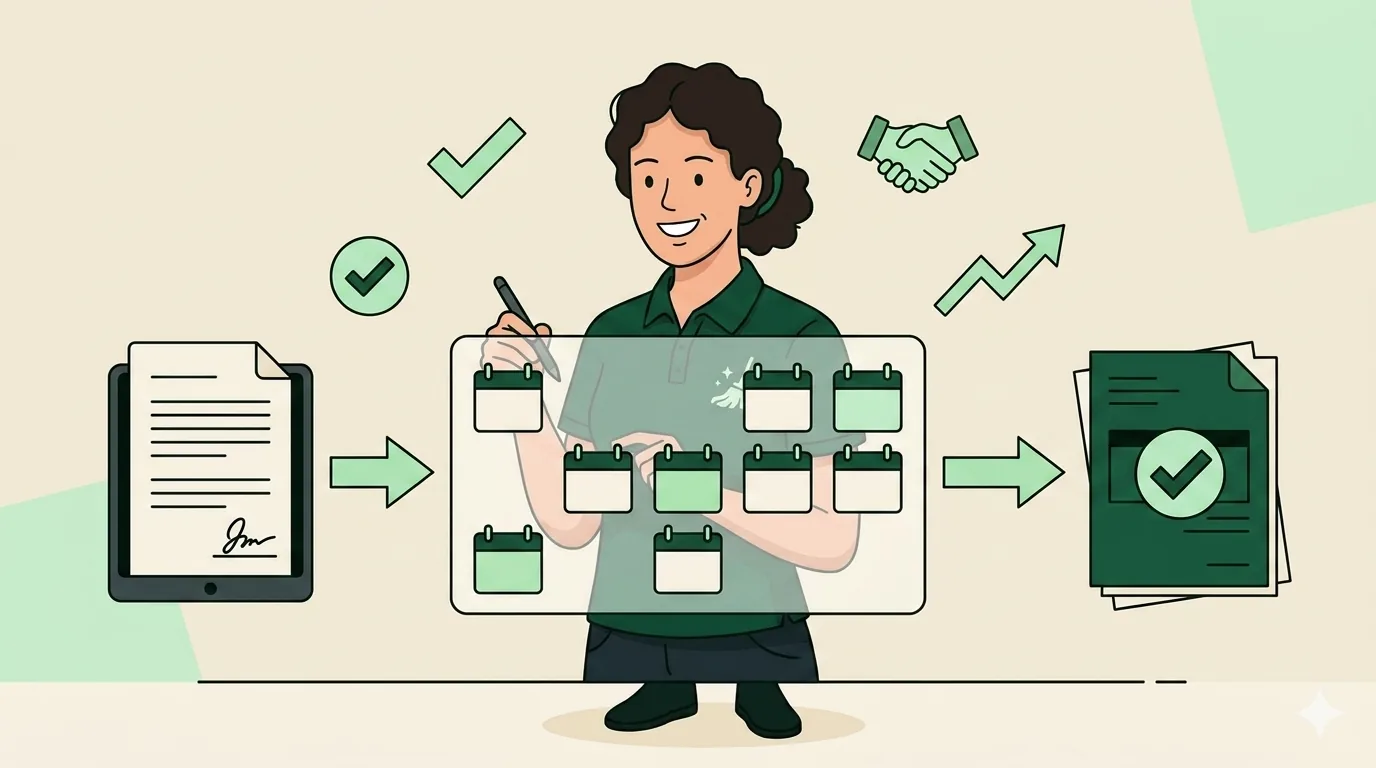
The contract is paperwork until it becomes a schedule and an invoice. The handoff that keeps the first month clean:
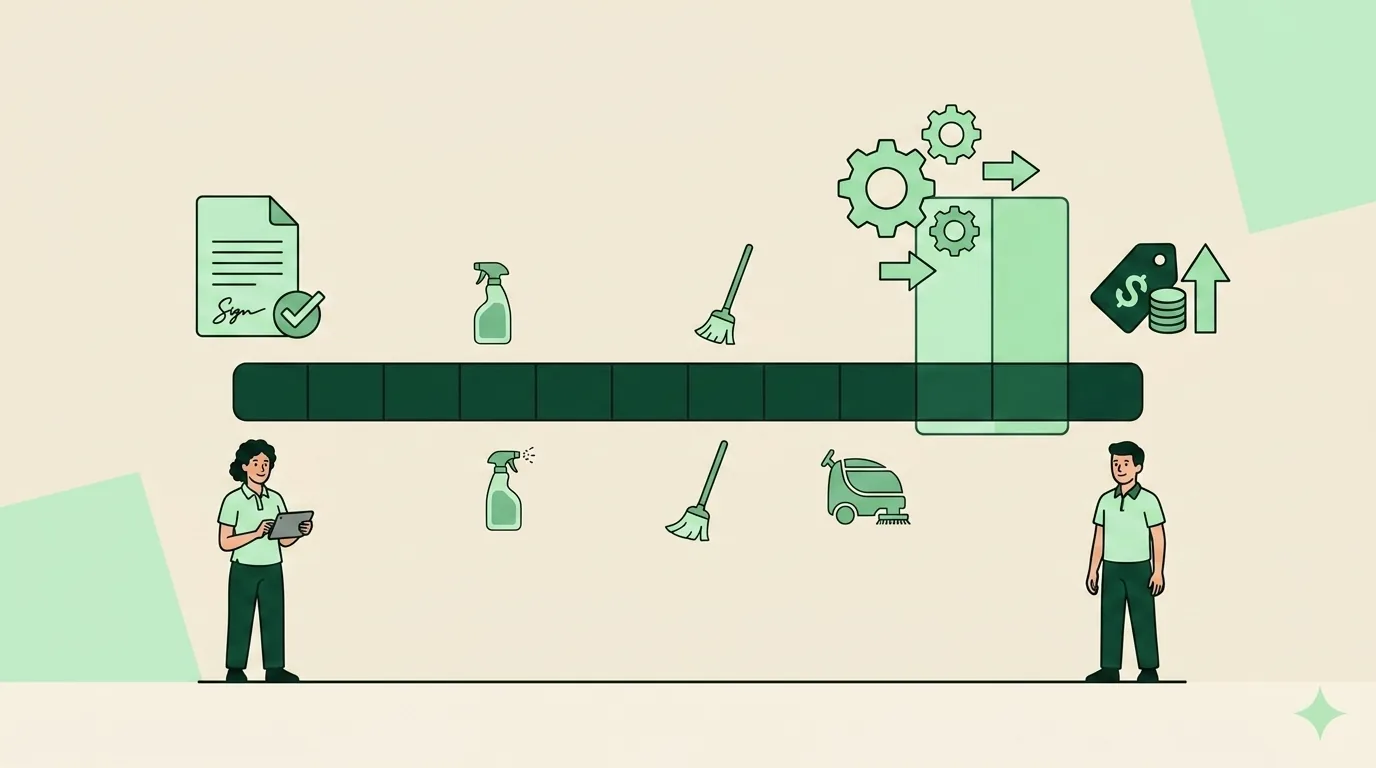
- Get the signature digitally. A contract that requires printing dies in someone’s inbox. In CleanerHQ, the client approves and signs the quote from a tracked link or the client portal, and the signature is stored with the account.
- Build the recurring schedule from Exhibit A. Three-times-weekly visits become a recurring job pattern with skip dates and holiday exceptions handled, no manually recreating Wednesday’s job every week.
- Invoice on the contract’s terms, automatically. Set net 30 on the account, and invoices generate from completed jobs with the contract’s line items. Automated reminders follow at 3, 7, and 14 days past sending, and stop the moment payment lands.
- Document performance from day one. Checklists and before/after photos on every visit build the record that makes Clause 11 disputes short, and renewals easy.
Start a free trial (card needed to start the trial) and run the whole quote-to-contract-to-invoice flow from the invoices and proposals stack, part of the full cleaning business software workflow.
Frequently Asked Questions
How long should a commercial cleaning contract be?
The typical initial term is 6-12 months, with automatic renewal for successive 12-month terms and a 60-day non-renewal notice window. Shorter terms (month-to-month) are easier to sign but give you no protected revenue; longer initial terms (24+ months) usually require concessions on price or termination rights.
What payment terms are standard for commercial cleaning?
Net 30 from the invoice date, billed monthly in arrears, is the corporate norm. Back it with a late charge of around 1.5% per month (capped at what your state allows) and the right to suspend service after 15 days past due with written notice. Without those two teeth, net 30 quietly becomes net 60.
Can I raise prices during a commercial cleaning contract?
Not during the initial term unless the scope changes, that is the point of a fixed term. Build in a price-adjustment clause allowing one increase per 12 months with 60 days written notice. Cleaning-industry benchmarks put typical annual increases at 3-8%, which tracks rising wages and supply costs.
What is a cure clause in a cleaning contract?
A cure clause gives the contractor a defined window, commonly 10 business days, to fix a documented performance failure before the client can terminate for cause. Pair it with a 48-hour written deficiency-reporting rule so complaints surface while they are fixable, not months later as negotiating ammunition.
Do I need a lawyer for a commercial cleaning contract?
You do not need a lawyer to draft it, a solid template covers the structure. You do want a licensed attorney in your state to review it before first use: an hour or two of review confirms your late-fee rate, non-solicitation clause, and indemnification language are enforceable where you operate. This article is educational, not legal advice.
Who provides supplies in a commercial cleaning contract?
Most contracts make the contractor responsible for cleaning supplies, chemicals, and equipment, while the client stocks consumables like trash liners, paper products, and hand soap. Whatever you choose, write it down, and keep Safety Data Sheets for your chemicals on site, as required by OSHA’s Hazard Communication Standard.

Written by
Rashdi has spent 15+ years building and managing enterprise software, and has worked with US cleaning businesses since 2006. He founded CleanerHQ.