How to Get Clients for a Cleaning Business: First 10 Fast
Warm outreach, Nextdoor, and a week-one Google Business Profile: the exact playbook operators use to land their first 10 cleaning clients in 2-6 weeks.
 R Rashdi
·
July 2, 2026
·
10 MIN READ
R Rashdi
·
July 2, 2026
·
10 MIN READ
Quick answer
The fastest way to get clients for a cleaning business is your warm network: text 20 people you know, ask for introductions, and offer a founding-client rate. Operators typically land their first 10 clients in 2-6 weeks by stacking warm outreach, Nextdoor and Facebook groups, and a Google Business Profile set up in week one.
If you launched your cleaning business this January, you do not have a marketing problem. You have a speed problem. Rent is due in weeks, not quarters, and most advice about how to get clients for a cleaning business assumes you have six months and an ad budget.
This playbook assumes you have neither. It ranks every channel by time-to-first-client, gives you the exact scripts to send today, and shows the week-one Google Business Profile setup that starts compounding while you clean.
If you already have suitable website visitors, the retargeting guide for cleaning owners can help you decide whether to run a small ad test or wait. Its free worksheet checks the audience, job costs and reasons to stop.
The first-10 framework: speed over scale
Your first 10 clients have one job: prove the business works and generate the reviews, referrals, and before/after photos that make clients 11 through 50 cheaper to win.
That changes the rules. Forget brand building. Forget a perfect website. The first-10 phase rewards channels that produce a booked job this week, even if they never scale. You will run uglier, more personal, more manual plays than a 20-person company would, and that is correct.
Three principles before the channel list:
- Recurring beats one-time. A biweekly client at $160 a visit is worth roughly $4,000 a year; a one-off deep clean is worth one check. One 10-year, four-city operator pegs the lifetime gross profit of a recurring residential client at about $3,000 over a typical two-year stay. Pitch recurring from the first conversation.
- Track where every client came from. Use per-channel offer codes (NEXTDOOR20, FLYER20) and ask “how did you find us” on every call. Veteran operators treat this as the cheapest attribution system that exists.
- Price like a professional from day one. A widely circulated beginner benchmark puts residential cleaning at $25-45 per hour. Quote inside that band, charge 1.5-2x your recurring rate for first-time deep cleans, and take a 50% deposit on one-time jobs, standard practice that kills most cancellations.
How to get clients for a cleaning business: channels ranked fastest to slowest
Here is the honest ranking, by how fast each channel typically produces a first booked job for a brand-new operator.
| Rank | Channel | Typical time to first client | Out-of-pocket cost | Role in the first 10 |
|---|---|---|---|---|
| 1 | Warm network (texts + asks for intros) | 2–7 days | $0 | Clients 1–3 |
| 2 | Nextdoor + local Facebook groups | 3 days–2 weeks | $0 | Clients 2–5 |
| 3 | Google Local Services Ads | 1–3 weeks (verification first) | $25–70 per lead | Buying speed once licensed/insured |
| 4 | Google Business Profile (map pack) | 2–6 weeks after verification | $0 | The compounding engine |
| 5 | Partnerships: realtors, property managers, offices | 2–8 weeks | Coffee money | Recurring and B2B volume |
| 6 | Flyers and door hangers | 1–4 weeks | Printing (~$50–100) | Dense target neighborhoods |
| 7 | Website + local SEO | 3–6 months | Hosting | The long game; start it, do not wait on it |
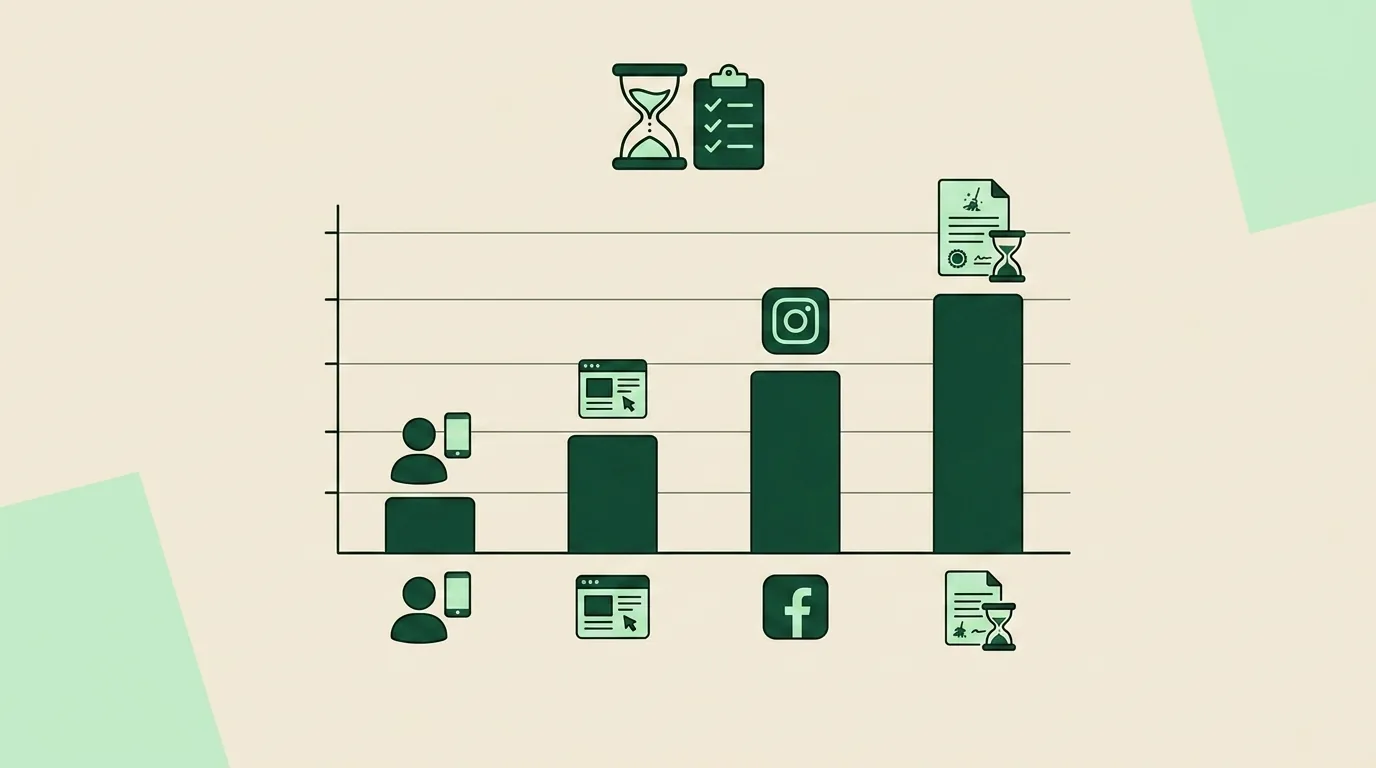
Two notes on the paid row. Google Local Services Ads charge per lead, not per click, and veteran operators report leads landing around $25-70 each, with direct-Google leads closing at roughly 50%, versus around 15% on marketplaces like Thumbtack, where every lead is shopped to several competitors at once. If you have insurance and licensing sorted, LSAs are the one paid channel worth turning on this early. If you are still setting that up, our guide on how to start a cleaning business covers the order of operations.
One legal warning on row 6. Flyers must never go inside or on mailboxes, because mailboxes are federally protected for postage-paid mail (18 USC 1725, enforced by USPS) and the fines apply per mailbox. Door hangers, door mats, and community boards are fine.
Your warm network, without being weird
Nobody wants to spam their friends. Good news: the play is not “please hire me.” It is “who do you know.” You are asking for introductions, not charity.
The announcement text (send to 20+ people today):
Hey {name}, quick news: I just launched {company}, a residential cleaning service here in {city}. I am taking on my first 10 clients at a founding rate this month. Do you know anyone tired of cleaning their own house or unhappy with their current cleaner? An intro would mean a lot.
The founding-client offer (when someone bites):
Your first clean will cost [introductory price] for [agreed tasks]. This offer does not depend on leaving a review or giving photo permission.
The follow-up (3-4 days later, only once):
Hey {name}, following up on my note from earlier this week. No pressure at all, if anyone comes to mind who could use a reliable cleaner, just pass them my number. Thanks either way.
Keep any introductory offer separate from review requests. Ask clients for honest feedback without a reward, whether their experience was good or bad. Ask for photo permission separately too.
Google Business Profile: the week-one setup
Your Google Business Profile is the single highest-leverage free asset you will own, and most new operators set it up half-way. Do this in week one, completely:
- Claim and verify the profile at business.google.com. Verification (postcard or video) can take days, start now.
- Category: primary category “House cleaning service” (add “Janitorial service” or “Commercial cleaning service” only if you genuinely serve them).
- Service area: list the specific cities and neighborhoods you serve, not a 100-mile circle.
- Services: add every service with a from-price, standard clean, deep clean, move-out clean. Real prices filter out tire-kickers.
- Photos: upload 10 or more real photos, you, the crew, equipment, and before/after shots. Phone photos beat stock photos. Our guide to creating before-and-after content shows how to shoot them well.
- Booking link: add a direct link to your booking or quote form.
- Review link: grab the “Ask for reviews” short link from the dashboard. You will use it after every one of your first jobs.
- Posts: publish one weekly photo post. It signals to Google that the profile is alive.
Use one neutral invitation for clients you may contact, and avoid repeat requests after every visit. Our cleaning review request guide has messages and a free log. For profile setup, see Google Business Profile for cleaning businesses.
One more week-one move: put a quote form on whatever one-page website you have, even a basic one. Calls you miss while cleaning are clients you lose. CleanerHQ’s lead intake widget takes this further, it shows instant Good/Better/Best pricing from home details and books the job, creating the client record and quote automatically, so your website sells while your hands are in a sink. Start a free trial, card needed to start the trial.
Nextdoor, Facebook groups, and local SEO
Neighborhood platforms are where “can anyone recommend a cleaner?” gets asked daily. Your job is to be the answer, as a person, not a billboard.
Nextdoor. Set up a business page, but engage from your personal profile where the platform allows. Search your area for recommendation threads and reply helpfully (“Happy to help, I run {company}, just launched, here is my number”). Post one launch announcement with a neighborhood-specific code (NEXTDOOR20) so you can track it. Do not post the same promo weekly; neighbors report spam fast.
Facebook groups. Join every “{city} community,” “{city} moms,” and “{neighborhood} buy/sell” group. Answer recommendation threads first, post before/after photos second (where rules allow), promote third. One genuinely impressive oven-transformation photo in a local group outperforms a week of ads, and costs nothing.
Local SEO. This is the slow channel, but the work is front-loaded and cheap: consistent name-address-phone across listings, a page per service, a page per city you serve. Start in month one, expect results in month four. Our local SEO guide for cleaning businesses covers it step by step, and the broader channel mix lives in our cleaning business marketing strategies guide.
From first client to first referral
The first 10 clients are also your first sales force, if you build the machine.
The numbers explain why this matters. Operators commonly benchmark customer acquisition cost at around $150 per client through paid channels, dropping to roughly $130 when referrals are in the mix, and mature residential companies report 30-50% of new clients arriving by referral after a couple of years. Referrals are not a bonus channel; they become the main one.
The starter referral program, kept stupid-simple:
- The offer: $25 off for the referrer, $25 off the first clean for the new client. Two-sided offers get shared; one-sided ones do not.
- The ask timing: after the second or third clean, once trust is real, not after the first.
- The script: “Quick favor, we grow through referrals. If you know a neighbor or coworker who could use us, you both get $25 off. Want me to text you the details to forward?”
- The reminder: mention it in the visit-confirmation message once a quarter. Quiet programs die.
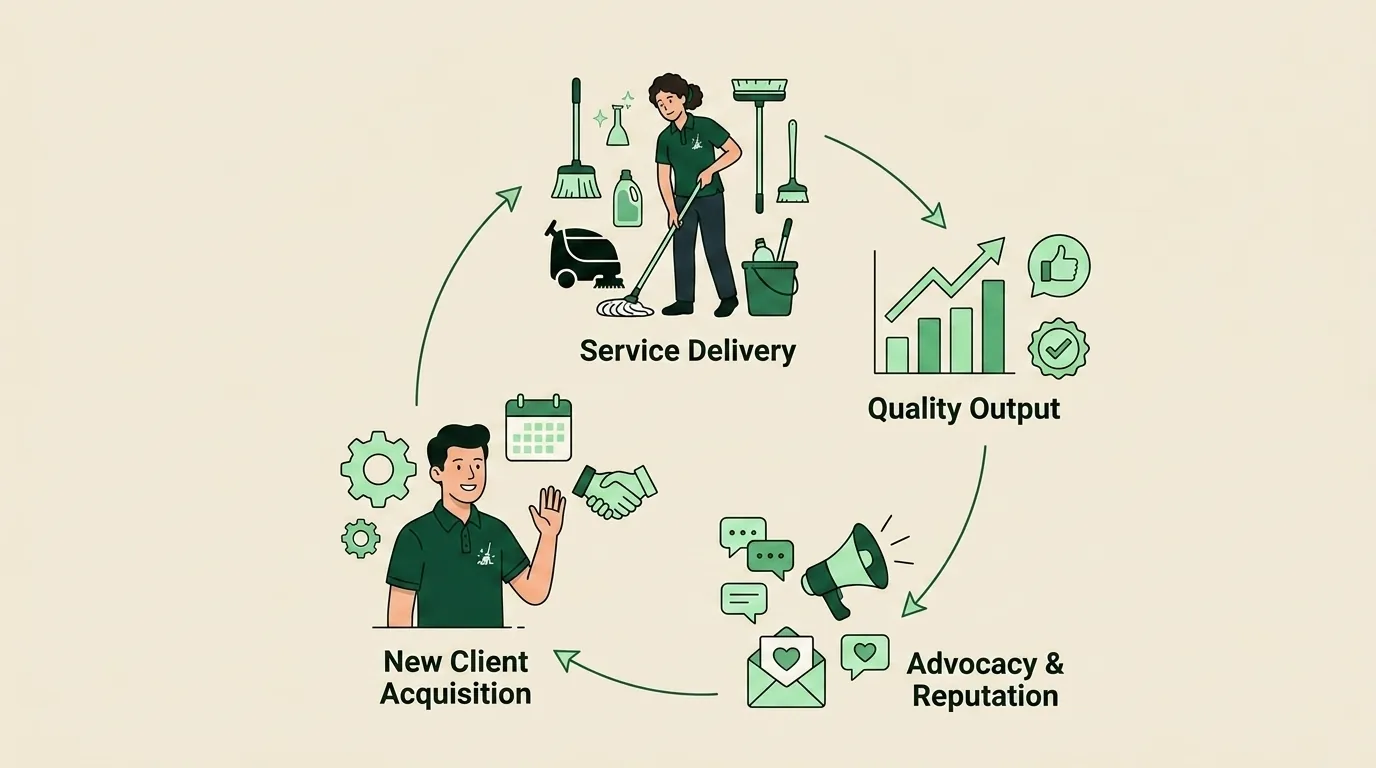
Track referrals and review requests separately. A referral offer must not become a reward for a public review. For the wider job workflow, see our cleaning business software guide.
Frequently Asked Questions
How long does it take to get your first cleaning client?
Through your warm network, 2-7 days is realistic: text 20 or more contacts with a founding-client offer and ask for introductions. Nextdoor and Facebook groups typically produce a first booking within 1-2 weeks. Google Business Profile and Local Services Ads take 2-6 weeks because of verification, so start them in week one and let warm channels carry you meanwhile.
How do I get cleaning clients with no money?
Stack the free channels: warm-network texts, Nextdoor, local Facebook groups, and a fully built Google Business Profile cost $0. Door hangers run about $50-100 in printing, just never place anything in mailboxes, which is a federal violation (18 U.S.C. 1725). From free channels, expect your first 5 clients inside 2-4 weeks, assuming consistent daily effort rather than a one-week burst.
How much should a new cleaning business charge?
A widely used beginner benchmark is $25-45 per hour for residential work, varying by market. For first-time deep cleans, charge 1.5-2x your recurring rate. Take a 50% deposit on one-time jobs. Discount the first clean for founding clients if you like, never the recurring rate.
Are Google Local Services Ads worth it for a new cleaning business?
Yes, once you have insurance and any required license, because you pay per lead instead of per click. Operators report lead costs around $25-70 and close rates near 50% on direct-Google leads, versus roughly 15% on shopped marketplaces like Thumbtack. Answer LSA calls live, speed to phone is most of the close rate.
How many clients does a cleaning business need to be sustainable?
Ten recurring biweekly clients at $160 per visit produce roughly $3,500 a month, a real part-time income and proof the model works. Most solo operators target 20-30 recurring clients for a full schedule. Recurring contracts matter more than raw count: 10 biweekly clients beat 30 one-time jobs every month of the year.

Written by
Rashdi has spent 15+ years building and managing enterprise software, and has worked with US cleaning businesses since 2006. He founded CleanerHQ.