
Independent Contractors vs Employees for Cleaning (2027 Rules)
If you control how, when, and with what tools someone cleans, the IRS sees an employee, no contract label changes that. A W-2 cleaner costs roughly 15-25% above the wage once payroll taxes and workers comp load in; contractors carry their own. Misclassification triggers back taxes plus penalties under IRS Section 3509, so classify before you hire.
 R Rashdi
·
July 2, 2026
·
14 MIN READ
R Rashdi
·
July 2, 2026
·
14 MIN READ

Quick answer
If you control how, when, and with what tools someone cleans, the IRS sees an employee, no contract label changes that. A W-2 cleaner costs roughly 15-25% above the wage once payroll taxes and workers comp load in; contractors carry their own. Misclassification triggers back taxes plus penalties under IRS Section 3509, so classify before you hire.
Independent contractors vs employees is the highest-stakes paperwork decision a cleaning business makes. Get it right and you know your true labor cost. Get it wrong and the cleaning industry’s least fun fact applies: house cleaning and janitorial work sit under specific IRS, Department of Labor, and state scrutiny for worker misclassification, and the back taxes land on you, not the worker.
This guide gives you the IRS control test in plain English, the current status of the DOL rule (it has changed repeatedly, we date-stamp everything), the true-cost math side by side, the public penalty figures, and a playbook for converting 1099 cleaners to W-2 without losing them. One note up front: this is operator-to-operator guidance, not legal or tax advice, confirm your specific situation with a CPA or employment attorney.

The IRS control test in plain English
The IRS uses a common-law test with three factor groups: behavioral control, financial control, and the relationship of the parties. No single factor decides it; the IRS weighs the whole picture. Here’s what each one means when the work is cleaning.
Behavioral control, who decides how the work gets done?
If you set the schedule, assign the route, require your checklist, train people on your methods, and tell them which products to use on which surface, you’re describing an employee. A real contractor decides their own methods and hours; you buy a result (“the office is clean by 6 AM”), not a process.
The uncomfortable part for cleaning businesses: almost everything that makes service quality consistent, SOPs, required checklists, training programs, branded uniforms, supervision, is evidence of behavioral control. You generally can’t have both a tightly standardized service and a 1099 workforce delivering it.
Financial control, who runs the business side?
Contractors invest in their own equipment and supplies, cover their own vehicle costs, carry their own liability insurance, can profit or lose money on a job, and typically serve multiple clients. If your workers show up to your jobs, in your van, with your vacuum and your chemicals, and you reimburse their expenses, the financial-control factor points hard at employee.
Relationship of the parties, what does the arrangement look like?
An open-ended relationship with a regular weekly schedule looks like employment. A defined project with a deliverable and an end date looks like contracting. Benefits of any kind, PTO, insurance, bonuses, point to employee. And the IRS is explicit that a contract saying “independent contractor” does not override the actual working relationship. The label is the least important fact in the file.
The plain-English summary for a cleaning company: a genuine 1099 relationship in this industry usually looks like a specialist, a carpet-cleaning sub with their own truck-mount, a post-construction crew that bids your overflow jobs, a window cleaner who serves ten companies. A cleaner who works your schedule, your route, and your method, week after week, is an employee in everything but paperwork.
The DOL independent contractor rule in 2027: what’s current
The Department of Labor’s independent-contractor rule under the Fair Labor Standards Act has changed direction three times in six years, so treat any blog post (including this one) as a snapshot and verify at dol.gov before making decisions.
Here’s the verified status as of our last check (mid-2026):
- The 2024 rule (a six-factor “economic reality” analysis adopted under the previous administration) is still technically on the books, but the DOL announced in May 2025 (Field Assistance Bulletin 2025-1) that its investigators would stop applying it in enforcement.
- In February 2026, the DOL formally proposed rescinding the 2024 rule and replacing it with a streamlined analysis based on longstanding court precedent. The public comment period closed in April 2026; a final rule was pending when we last verified.
- Courts can still apply the 2024 rule in private lawsuits until the rescission is final, which is why “the DOL isn’t enforcing it” is not the same as “it can’t be used against you.”
The practical takeaway doesn’t change with the politics: every version of the DOL test, old or new, asks the same economic-reality questions, does the worker depend on your business for their livelihood, who controls the work, who invests in the equipment, can the worker profit or lose, how permanent is the relationship, and is the work integral to your business. Cleaning the buildings your cleaning company is contracted to clean is about as integral as work gets. Build your classification to survive every version of the test, and the rulemaking ping-pong stops mattering to you.
State tests are often stricter: the ABC problem
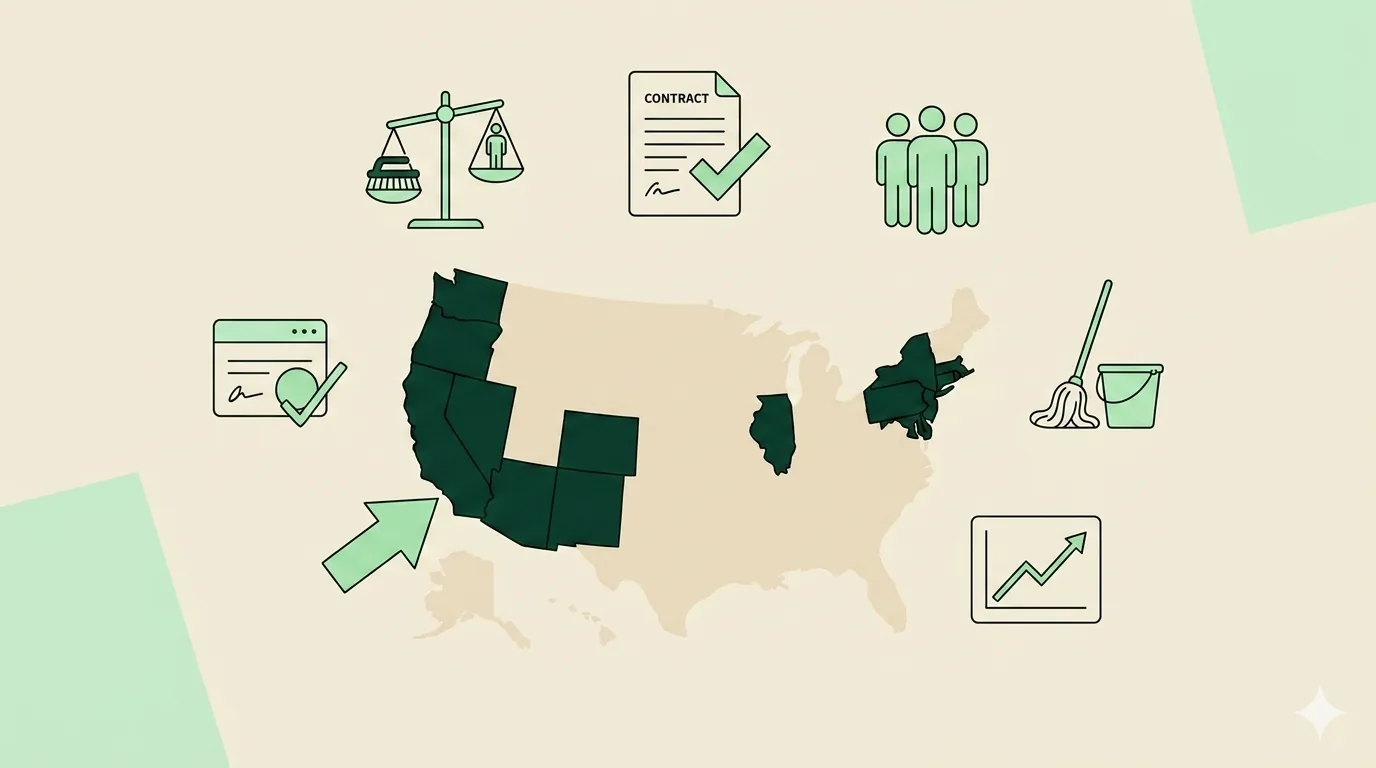
Federal tests are the floor, not the ceiling. A growing list of states applies some version of the ABC test, and California’s is the strictest mainstream example. To call a worker a contractor there, you must prove all three:
- A. The worker is free from your control and direction in performing the work;
- B. The work is outside the usual course of your business; and
- C. The worker has an independently established business doing this kind of work.
Read prong B again. If your business is cleaning and the worker is cleaning, you fail B, regardless of how independent they are. That’s why 1099 cleaning crews are close to impossible to defend in ABC-test states. Other states use modified ABC tests or their own multi-factor standards, and state unemployment-insurance agencies audit classification independently of the IRS. You comply with the strictest test that applies to you, not the friendliest.
True cost comparison: 1099 vs W-2 (the loaded-cost table)
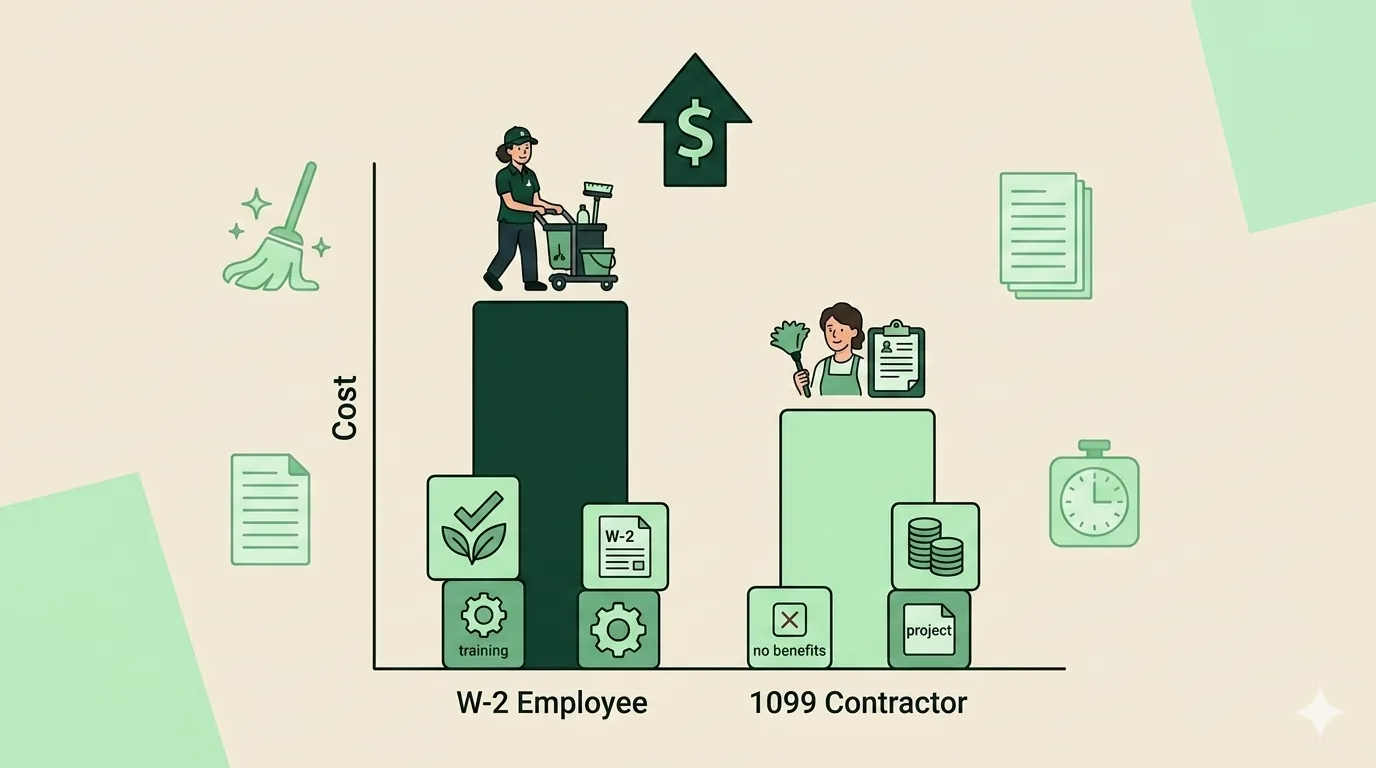
Owners often frame this as “contractors are cheaper.” Sometimes true, often not, contractors price in their own taxes, insurance, and equipment, and Bureau of Labor Statistics data puts typical cleaner wages around $14-18/hour nationally, while specialist subs commonly bill $25 and up.
Here’s the honest side-by-side. Say you’d pay a W-2 cleaner $18/hour, and the equivalent contractor quotes $25/hour. Assume a workers comp rate of $3 per $100 of payroll (rates vary widely by state and class code) and combined federal/state unemployment taxes around 2.5% on the relevant wage bases.
| Cost line | W-2 employee | 1099 contractor |
|---|---|---|
| Base pay | $18.00/hr | $25.00/hr |
| Employer Social Security + Medicare (7.65%) | $1.38/hr | $0, contractor pays both halves (15.3% self-employment tax) |
| Federal + state unemployment (~2.5% assumed) | $0.45/hr | $0 |
| Workers comp (assumed $3 per $100 payroll) | $0.54/hr | $0, contractor carries own coverage (verify their certificate) |
| Supplies & equipment | You provide | Contractor provides |
| Training & supervision time | Yours to fund | Minimal, and legally it has to stay minimal |
| Overtime liability (1.5x over 40 hrs, FLSA) | Yes | No |
| Loaded hourly cost | ~$20.40/hr (+13%) | $25.00/hr |
Add PTO, health benefits, or paid drive time and a W-2 loaded cost typically lands 15-25% above the base wage. The contractor still costs more per hour in this example, what you’re buying with the W-2 premium-that-isn’t is control: your schedule, your checklist, your standard, your brand. What you’re buying with the contractor’s higher rate is zero payroll administration and capacity that scales down to zero between jobs.
The real decision rule: recurring, scheduled, supervised work, the core of a maid service or janitorial operation, belongs on W-2. Specialty overflow (carpet, windows, post-construction surge) is where genuine 1099 relationships live. Most healthy cleaning companies run both.
One more 2027-relevant paperwork note: the 1099-NEC reporting threshold is no longer $600. Federal law raised it to $2,000 in annual payments starting with 2026, indexed for inflation in later years, check irs.gov for the current figure when you file. The threshold only governs the form; contractors owe tax on every dollar regardless.
Misclassification penalties: the public numbers
When the IRS reclassifies your “contractors” as employees, the bill stacks. The public framework (IRS Section 3509, for unintentional misclassification where you filed 1099s):
- 1.5% of the wages paid (for federal income tax that wasn’t withheld), plus
- 20% of the employee’s share of Social Security and Medicare that wasn’t withheld, plus
- 100% of the employer’s share of FICA you never paid, this one is yours in full, plus
- Interest, and failure-to-file/failure-to-deposit penalties on top.
If you never filed 1099s at all, the first two rates double (3% and 40%). If the IRS finds the misclassification willful, Section 3509’s reduced rates disappear entirely, the trust-fund recovery penalty (100% of the unwithheld taxes, assessable against you personally) comes into play, and criminal exposure is possible.
The DOL side is separate and additive: back wages for minimum-wage and overtime violations going back two years (three if willful), liquidated damages that can double the back-wage figure, and state agencies stacking their own per-worker fines, unemployment-insurance assessments, and workers comp premiums on top. Misclassified workers can also sue, including as a class.
Common audit triggers worth knowing: a “contractor” files for unemployment benefits after you stop using them (this is the classic one), a workers comp claim from someone with no coverage, a Form SS-8 filed by a worker asking the IRS to rule on their own status, and routine state UI audits.
If you realize you have a problem, the IRS Voluntary Classification Settlement Program (VCSP, Form 8952) lets eligible businesses reclassify workers prospectively and settle the past for just over 1% of the prior year’s payments to those workers, with no interest or penalties, dramatically cheaper than losing an audit. (The live IRS pages for Section 3509, SS-8, and VCSP have the current details; your CPA will know the fit.)
Converting 1099 cleaners to W-2 without losing them
Most owners who run this conversion fear a walkout. Done with the right math and the right framing, it rarely happens, cleaners mostly care about take-home pay and predictability, and W-2 status quietly improves both. The playbook:
1. Do the rate translation honestly. A contractor at $25/hr pays both halves of FICA (15.3% self-employment tax) and buys their own coverage. A W-2 offer at $20-21/hr with workers comp, unemployment coverage, overtime eligibility, and half their FICA paid by you is frequently equal or better take-home. Show the math side by side on one page, don’t ask them to trust you.
2. Time it to a quarter boundary. Clean payroll-tax quarters (January 1, April 1, July 1, October 1) make the accounting simpler for both sides, and your payroll provider and CPA will thank you. If you’re settling the past via VCSP, sequence that first.
3. Make the offer about what they gain. The script that works: “The rules around contractor cleaning crews have tightened, and I want you on a footing that protects both of us. Here’s the offer: $20.50 an hour on W-2, workers comp coverage if you’re ever hurt on a job, unemployment protection, overtime at time-and-a-half, and you stop owing quarterly self-employment tax. Here’s the take-home comparison.”
4. Expect to keep the true specialists as contractors. The carpet sub with three other clients and a truck-mount doesn’t convert, and doesn’t need to. Conversion is for the people who were employees all along.
5. Paper the new relationship properly. Offer letter, W-4, I-9, state new-hire reporting, workers comp policy update, and background checks run compliantly. Budget the admin time: onboarding a converted crew of five is a weekend of paperwork, not an afternoon.
The deeper upside: W-2 crews can be trained, scheduled, branded, and held to your standard, which is the whole growth model of a well-hired cleaning team. Conversion isn’t a compliance tax; it’s the prerequisite for building a company instead of a referral network.
Running compliant W-2 field ops
Saying yes to W-2 means saying yes to wage-and-hour mechanics: accurate hours, overtime at 1.5x past 40, and records that survive an audit. Paper timesheets and “I think I left around 4” texts are how compliant intentions become DOL findings.
This is where the operational tooling earns its keep. CleanerHQ’s GPS clock-in verifies that hours happened at the job site (default 150-meter geofence, configurable), timesheets compute regular and overtime hours against a 40-hour threshold automatically, and time entries categorize into billable, travel, and prep, the exact records a wage-and-hour inquiry asks for. GPS time tracking also closes the other compliance gap: paying hours that never happened. If you’re converting a crew this quarter, start a free trial (card needed to start the trial), and your first W-2 payroll can run on verified hours instead of guesses, with payroll-ready exports to QuickBooks, Gusto, or ADP formats. It’s one piece of a complete cleaning business software platform.
Two adjacent obligations to calendar now rather than discover later: payroll tax deposits run on a schedule (your payroll provider automates this), and if you keep any genuine contractors, your own quarterly estimated taxes and their 1099-NECs each January still apply. Meanwhile, W-2 wages, employer payroll taxes, and workers comp premiums are all deductible, see the full list of cleaning business tax deductions.
Frequently Asked Questions
Can a house cleaner be an independent contractor?
Yes, but only if the relationship is genuinely independent: the cleaner controls their own methods and schedule, brings their own supplies and equipment, carries their own insurance, can profit or lose money, and typically serves multiple clients. A cleaner who works your weekly route, follows your checklist, and uses your products fails the IRS control test and should be a W-2 employee.
What is the IRS test for independent contractor vs employee?
The IRS common-law test weighs three factor groups: behavioral control (who directs how, when, and with what methods work gets done), financial control (who invests in equipment, who can profit or lose), and relationship of the parties (permanency, benefits, how integral the work is). No single factor decides; a contract labeled “independent contractor” does not override the actual relationship.
How much more does a W-2 cleaning employee cost than a 1099 contractor?
A W-2 employee typically costs 15-25% above the base wage once you add employer Social Security and Medicare (7.65%), federal and state unemployment taxes, and workers comp. An $18/hour cleaner lands around $20.40-$22.50 fully loaded. Contractors avoid those line items but usually bill higher rates, often $25+/hour, because they cover both halves of FICA and their own insurance.
What are the penalties for misclassifying cleaning employees?
For unintentional misclassification with 1099s filed, IRS Section 3509 assesses 1.5% of wages plus 20% of the employee’s unwithheld FICA share, plus 100% of the employer’s FICA share, plus interest. Rates double if no 1099s were filed. The DOL can add two to three years of back overtime plus liquidated damages, and states stack their own per-worker fines.
Do I need to send my cleaning contractor a 1099?
For payments made in 2026 and later, you file Form 1099-NEC for contractors paid $2,000 or more in a calendar year, federal law raised the old $600 threshold, and the figure is indexed for inflation going forward, so check irs.gov for the current year’s amount. The contractor owes income and self-employment tax on every dollar either way.
What is the current DOL independent contractor rule?
As of our last verification (mid-2026), the DOL had stopped enforcing the 2024 six-factor rule and formally proposed rescinding it in February 2026, reverting investigators to the longstanding economic-reality analysis. The 2024 rule could still appear in private lawsuits until rescission is final. The rule has changed three times in six years, verify the current status at dol.gov before relying on it.

Written by
Rashdi has spent 15+ years building and managing enterprise software, and has worked with US cleaning businesses since 2006. He founded CleanerHQ.