
Choosing between specialization and generalization can make or break a cleaning business in today’s crowded market. Plenty of cleaning service owners wrestle with this decision, unsure if they should offer every possible service or focus on becoming pros in specific areas like carpet cleaning, commercial offices, or post-construction cleanup.
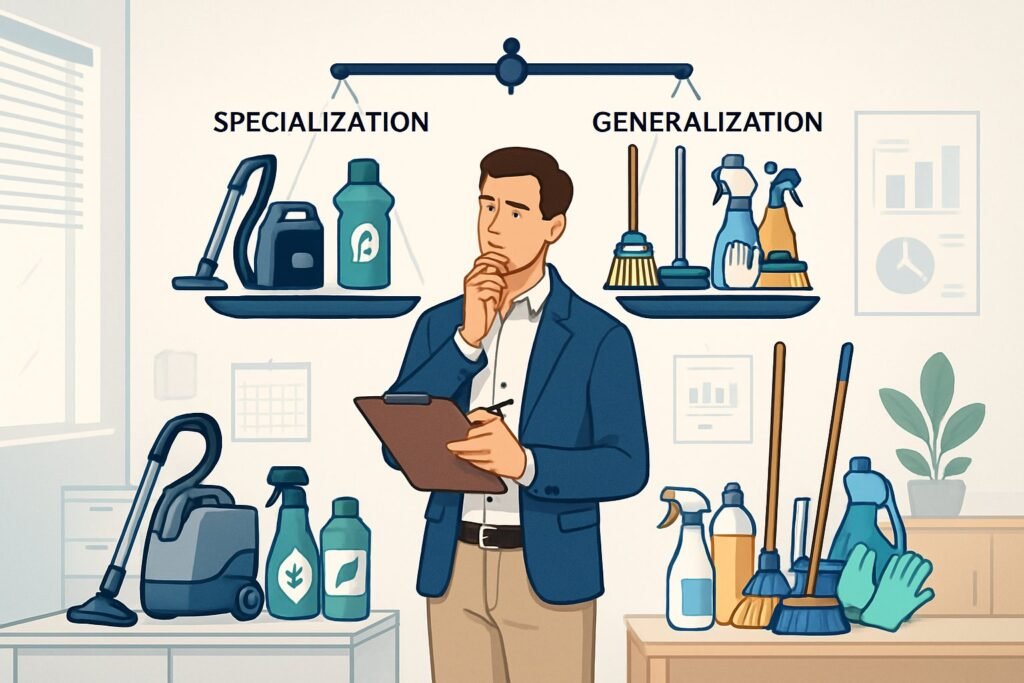
The right strategy really depends on your local market, how fierce the competition is, and what you want for your bottom line. Specializing usually means you can charge higher rates and build stronger customer loyalty than if you try to do everything.
A specialized approach lets cleaning businesses charge premium prices and build expertise that stands out. On the flip side, generalization can bring in more consistent work and cushion you during slow spells.
Smart cleaning business owners dig into their local market before deciding. They check which services are everywhere, where gaps exist, and which route might offer better long-term growth.
This decision isn’t set in stone. Many successful businesses start with one approach and shift gears as they learn more about their market and what customers actually want.
Key Takeaways
- Specializing usually means higher prices and stronger market positioning than general cleaning services.
- Let market research drive your choice by showing you where demand gaps and competition exist.
- You can pivot between specialization and generalization as your market changes—nobody says you can’t.
Defining Specialization and Generalization in Cleaning Businesses
Cleaning businesses face a fork in the road: focus on specific services, or offer a broad range. A specialist zeros in on particular cleaning tasks. A generalist covers lots of different needs.
What Does It Mean to Specialize in Cleaning?
A cleaning specialist focuses on one or two services and really digs deep. They become the go-to person in those areas, instead of offering every kind of cleaning.
Common cleaning specializations include:
- Carpet and upholstery cleaning
- Window cleaning services
- Post-construction cleanup
- Medical facility sanitization
- Kitchen appliance deep cleaning
Specialists can charge higher rates since they’ve got unique skills. They invest in niche tools and products. Their marketing targets folks looking for those exact services.
Maybe a specialist just cleans ovens and fridges. They know all the tricks for grease removal and have the right tools for the job. Their flyers talk about appliance cleaning, not general housework.
This approach often works well in busy markets. People need help with tasks they dread or don’t have time for. Specialists can tackle tricky problems that generalists might not handle as well.
Understanding the Generalist Approach
A generalist cleaning business covers a lot of ground. They take on regular house cleaning, office jobs, and a bunch of other tasks.
Typical generalist services include:
- Weekly house cleaning
- Office maintenance
- Move-in/move-out cleaning
- Basic window washing
- Light organizing
Generalists appeal to customers who want one company for everything. They build long-term relationships and get steady work from repeat visits—not just pricey specialty jobs.
A generalist might clean homes during the week and offices on weekends. They keep basic supplies that work for most jobs. Their marketing leans on reliability and convenience.
In smaller markets, this strategy can be a lifesaver. Demand for specialty services might be low, but generalists can adapt to whatever customers need. They keep a steady income from regular clients.
Comparing the Core Differences
Pricing Structure:
- Specialists charge premium rates for their expertise.
- Generalists use competitive pricing for regular services.
Equipment Investment: Specialists need pricey, specialized tools. Generalists stick with standard equipment that works for most jobs.
Marketing Focus: Specialists go after specific problems, like dirty ovens or stained carpets. Generalists sell convenience and reliability for ongoing needs.
Customer Relationships:
- Specialist: Short-term projects, higher profit per job.
- Generalist: Long-term contracts, steady monthly income.
Market Position: Specialists compete on expertise and results. Generalists compete on variety and dependability.
Your choice shapes everything: pricing, equipment, and how you find your customers.
Key Factors in Choosing Your Business Strategy
Three big factors shape your business strategy: your current skills, your long-term career goals, and what local customers actually want (and will pay for).
Analyzing Your Skill Set and Strengths
You need to take a real look at your abilities and what comes naturally. Some people are great with details, like carpet cleaning or window washing. Others juggle multiple tasks and enjoy the variety.
Technical Skills Assessment:
- Deep cleaning skills (carpets, upholstery, tile)
- Equipment know-how
- Chemical safety training
- Time management
Personal Strengths Evaluation:
- Problem-solving for tough stains
- Customer service
- Physical stamina
- Fast learning for new techniques
If you’ve got strong technical skills in one area, specialization might be your lane. If you love variety and adapt quickly, generalization could suit you better.
Experience counts, too. New business owners often start out general to see what they like. Seasoned cleaners can lean into their specialty.
Identifying Your Career Goals
Clear goals make decisions easier. Maybe you want steady local income. Or maybe you dream of building a big company or even franchising.
Specialization Goals:
- Become the local expert in one service
- Higher profit margins per job
- Less competition in niche markets
- Build a reputation as the go-to specialist
Generalization Goals:
- Serve more customers with different needs
- Multiple income streams
- Easier to find new clients
- Flexibility during slow seasons
Income expectations matter, too. Specialized services often command higher rates, but general cleaning brings in consistent work. If you want quick growth, generalizing might be the way. If you want higher hourly earnings, specialization could be better.
Your long-term vision shapes your day-to-day. Building a team takes different skills than working solo.
Considering Local Market Demand
Your local market can make or break your strategy. Rural areas might need general cleaners. Wealthy suburbs might support several specialists.
Market Research Methods:
- Survey potential customers
- Check out competitor services and pricing
- Look through local business directories
- Study demographic data
High-Demand Specialist Services:
- Post-construction cleanup
- Move-in/move-out cleaning
- Medical facility sanitization
- Carpet and upholstery restoration
If you plan to hire, the local job market matters. Areas with lots of available workers make expansion easier. Tight labor markets make hiring a headache.
Local employers play a role, too. Office buildings need regular service. Manufacturing plants may need specialized cleaning. Tourism areas have seasonal ups and downs.
The best business owners match their strategy to what their area actually needs. They figure out what customers pay for—and what competitors overlook.
Benefits and Risks of Specializing
Specializing brings big upsides: focused expertise and higher prices. But it also makes you more vulnerable to market changes and, honestly, can get boring after a while.
Developing Deep Expertise and Mastery
Specialist cleaning businesses build real mastery by repeating one thing over and over. That expertise is gold for clients with specific problems.
Commercial kitchen cleaning specialists know food safety rules, how to handle grease, and what health codes demand. They pick the right products for stainless steel or tile.
Carpet cleaning specialists can tell fiber types apart, understand stains, and keep their machines in top shape. They notice things general cleaners might miss.
Mastery takes time—usually a couple of years. The learning curve includes:
- Figuring out specialized equipment
- Learning industry rules
- Mastering advanced techniques
- Building relationships with suppliers
With deep expertise, specialists work faster and solve problems others can’t. A medical facility cleaner knows how to disinfect an operating room. Restoration specialists understand water damage inside out.
Building Reputation in a Niche
Specialization helps you build a strong reputation in your chosen market. Word gets around fast in a tight niche.
Restaurant owners talk to each other about the best kitchen cleaners. Property managers share names of move-out cleaning specialists who do a thorough job.
A specialist’s reputation brings:
- Referral networks in the industry
- Higher trust from clients who value expertise
- Easier marketing with a clear message
- Industry recognition through certifications
Specialists often become the go-to expert in their area. That reputation keeps new competitors at bay.
Building a reputation takes consistent quality and networking. Specialists go to industry events, join associations, and keep in touch with key clients.
Profit Potential and Client Retention
Specialized cleaning services can charge a lot more than general cleaning. Clients pay extra for know-how and unique skills.
Biohazard cleaning might fetch $300-500 per hour, while general cleaning sits at $25-50. Data center cleaning pays $75-100 an hour, compared to $30-40 for office cleaning.
Specialists hang on to clients because:
- It’s a hassle for clients to switch providers
- Specialists know their clients’ unique needs
- Training a new cleaner costs clients time and money
- Specialized equipment creates dependency
Long-term contracts are common in niche markets. Medical facilities, restaurants, and industrial clients want steady relationships with proven specialists.
Over time, profit adds up as specialists work faster and offer premium services.
Managing the Risks of Over-Specialization
Specializing comes with risks. You can end up too dependent on one market.
Economic downturns hit specialists hard. Restaurant cleaners struggled during COVID-19. Office cleaning specialists took a hit when remote work took over.
Doing the same thing for years can get old, too. The repetitive work can sap motivation and creativity.
To manage risk, you can:
- Diversify within your niche by serving different types of clients
- Expand geographically to avoid being tied to one local market
- Add related services that fit your specialty
- Build an emergency fund for slow times
Technology shifts can disrupt a niche fast. Automated systems might replace some cleaning tasks. Specialists need to stay on top of industry changes.
Some specialists keep 20-30% general cleaning work as a backup. It gives them a safety net if their main market dries up.
Advantages and Challenges of Generalizing
Generalists in cleaning services have broad appeal and flexibility, but it’s not all upside. Balancing the benefits of serving many markets with the downsides of not being a true expert isn’t always easy.
Flexibility Across Services
Generalists can switch up their services as demand changes. If offices close, they focus on homes. When construction picks up, they jump into post-construction cleanup.
This flexibility helps them keep revenue steady all year. Commercial contracts might slow during holidays, but residential deep cleaning picks up before big family events.
Generalists can test new services without major hassle. Adding carpet cleaning or window washing is a minor tweak, not a total overhaul.
Cross-selling is easier, too. A client who needs regular office cleaning might ask for event cleanup or seasonal services.
Greater Versatility and Adaptability
Generalists build adaptability into their business. If local factories shut down, they chase medical facility or retail cleaning jobs without starting from scratch.
Staff training covers more ground but is more flexible. Employees learn lots of techniques and tools, so it’s not a disaster if someone calls in sick.
Equipment does double duty. Industrial vacuums work in offices and big homes. Floor machines handle different surfaces.
Market research is a bit simpler for generalists. They track big-picture cleaning trends instead of niche developments and can spot new opportunities across the board.
Employment Security and Career Mobility
Generalist businesses usually offer more stable jobs. If one client type cuts back, others often pick up the slack.
Employees get a wide range of skills, making them more valuable in the job market. They learn both residential and commercial cleaning, plus a few specialty tricks.
Career paths open up, too. Workers can move between service areas or step up to management roles that oversee multiple departments.
Training is broader, so employees become well-rounded. They learn how to handle homeowners and business clients alike.
Risk of Being a Jack-of-All-Trades
Generalists often can’t charge top dollar because they aren’t seen as experts. Clients might think they’re good enough, but not amazing at any one thing.
Marketing gets tricky when you try to appeal to everyone. Homeowners and business clients want different things, so your message can get muddled.
Competition is everywhere. Generalists go head-to-head with specialists in every market. Specialists usually have better knowledge and equipment for their niche.
Quality control is harder, too. Managing different service types means more chances for mistakes or uneven results.
Assessing Market Demand and Profitability
Understanding local demand patterns and profit potential helps cleaning business owners make smart choices between specializing and offering broad services. Market research reveals which approach generates better returns in specific areas.
Researching Competitors and Client Needs
Business owners should start by mapping local competitors and their service offerings. This kind of research points out gaps in the market and uncovers what clients actually want.
Direct competitor analysis means visiting competitor websites, checking their pricing, and reading customer reviews. Notice which services they push the hardest.
Client research methods:
- Survey potential customers about their biggest cleaning headaches.
- Check local Facebook groups and neighborhood apps for service requests.
- Call property managers and business owners to ask about their needs.
- Read online complaints about existing cleaning companies.
Small businesses and busy families often want different things than big offices. Residential clients might ask for weekly house cleaning, while commercial clients usually need daily janitorial work.
The job market for cleaning workers changes the strategy too. Areas with lots of employment might go for premium services, while places with more job seekers could lean toward lower-cost options.
Profitable Niches vs. Broad Service Offerings
Different cleaning strategies offer different profit margins and growth potential. Specialized services usually fetch higher prices but serve smaller markets.
High-profit niche examples:
- Post-construction cleanup ($40-60 per hour)
- Medical facility cleaning ($25-45 per hour)
- Crime scene cleanup ($300-600 per hour)
- Green cleaning services ($20-35 per hour)
Broad service benefits:
- Steady residential contracts ($15-25 per hour)
- Multiple revenue streams lower risk
- Easier to find replacement clients
- Lower marketing costs per service type
Niche services need special training and equipment. Medical cleaning requires certifications, while general house cleaning just needs basic supplies.
Employers in specialized fields pay premium rates for certified cleaners. General cleaning jobs are easier to find, but usually pay less.
Aligning Strategy With Demand Trends
Current market trends shape which cleaning strategies work best. After the pandemic, demand for disinfection services shot up and created new opportunities for specialists.
Growing demand areas:
- Eco-friendly cleaning products and methods
- Disinfection and sanitization services
- Move-in/move-out cleaning for rental properties
- Senior-focused cleaning services
Declining demand:
- Basic office cleaning (remote work trend)
- Weekly residential cleaning (budget constraints)
- Traditional carpet cleaning (hard floor popularity)
Local economic conditions really affect demand. Wealthy areas can support premium specialized services, while working-class neighborhoods often need affordable basics.
Business owners should watch for local construction permits, new business licenses, and population shifts. These things hint at future cleaning demand in certain market segments.
The job market for cleaning workers shifts by specialization. Specialized roles usually need training but pay better and feel more secure than general positions.
Pivoting Your Cleaning Business Strategy
Business owners have to adjust when their first strategy doesn’t deliver. Strategic pivoting means making calculated changes to boost profits while keeping service quality up.
Recognizing When to Shift Your Approach
A few obvious signs tell you when it’s time to pivot your cleaning business. If revenue drops for three months straight, your current approach probably isn’t working.
Key warning signs:
- Client retention rate below 70%
- Trouble booking new appointments on a regular basis
- Competitors winning contracts you used to get
- Service requests piling up in unexpected areas
Market feedback matters a lot. If customers keep asking for services you don’t offer, that might be a chance to expand.
Geography can force changes too. Urban markets might want specialized appliance cleaning, while suburban areas lean toward full-home services.
Track monthly metrics like client acquisition costs and average job values. If acquisition costs go over 30% of job value, it’s time to rethink things.
Transitioning Between Niche and General Services
Moving from specialized to general services takes planning and resources. Business owners need to expand their skill set gradually, so they don’t slip on quality.
Start by picking out complementary services. A garage cleaning specialist could branch out into basement organization or storage area maintenance.
Steps for a successful transition:
- Train on two extra services each month.
- Test new services with current clients first.
- Update marketing materials bit by bit.
- Keep pricing steady across services.
Switching from general to specialized services calls for a different approach. Analyze client data to spot the most profitable service category.
The career path narrows during specialization. Staff training focuses on mastering specific techniques, not just broad cleaning skills.
Timelines vary. Going from specialized to generalized usually takes 6-12 months, while specializing can be quicker—maybe 3-6 months.
Building a Hybrid or T-Shaped Skill Set
The T-shaped approach means you go deep in one area but know the basics of several others. This mix keeps you flexible and competitive.
Business owners should build real expertise in high-demand services like deep kitchen cleaning or post-construction cleanup. Then they should add secondary skills—maybe basic residential maintenance or organization.
Core competency areas:
- Primary specialty (deep expertise)
- Secondary services (working knowledge)
- Emergency capabilities (basic proficiency)
Staff training should follow this T-shaped model too. Team members master one specialty and learn the basics of other services you offer.
This hybrid style boosts adaptability when the market shifts. Owners can pivot between services as seasons or the economy change.
Sometimes, combining service types sparks new ideas. A carpet specialist might add furniture protection services and create something unique.
Ensuring Sustainable Growth Through Adaptation
Sustainable growth depends on regular market checks and smart changes. Business owners need to balance innovation with operational stability.
Quarterly strategy reviews make more sense than annual ones. The cleaning industry changes fast, especially with heavy competition.
Growth sustainability factors:
- Profit margins above 15%
- Client satisfaction over 85%
- Employee retention rates above 80%
- Monthly revenue growth between 5-15%
Flexibility in services guards against relying too much on one revenue stream. Businesses with variety weather economic storms better than those that specialize too much.
Document what works and what flops during pivots. Save those notes—they’ll help next time you need to adjust.
Adopting new tech helps you pivot faster. Modern booking systems handle both specialized and general service models without a hitch.
Frequently Asked Questions
Cleaning business owners face big choices about market focus and service scope. These questions get into the nitty-gritty of market research, profitability, and smart pivots.
How can identifying the local market demand inform my choice between specializing or generalizing in the cleaning business?
Local market research shows what services people really want in your area. A business owner should look at competitors to spot gaps in specialty services like appliance cleaning or garage organization.
High-income neighborhoods usually want specialized things like upholstery cleaning or luxury home maintenance. Lower-income areas tend to need basic house cleaning at good prices.
Population density matters too. Dense urban areas can support lots of specialists because there are enough customers for each one. In rural places, generalists who do a bit of everything are more in demand.
Business owners should check local job boards and review sites. These places show what customers complain about not finding, or which competitors get slammed for bad specialty work.
What are the pros and cons of choosing a niche specialization over a generalist approach in the cleaning industry?
Specialized cleaning businesses can charge more for expert work. Customers pay premium prices for appliance cleaning, carpet restoration, or post-construction cleanup because those jobs need specific skills.
Specialists don’t face as much direct competition. Not many cleaners focus just on garage organization or oven cleaning, so it’s easier to own that niche.
But specialists have fewer potential clients. A business that only cleans appliances has a much smaller pool than one offering whole-house cleaning.
Generalists can serve more people and keep steady income from regular house cleaning contracts. They can upsell extra services to the same client too.
The downside? Generalists compete with tons of other companies offering the same thing. That competition usually pushes prices down and shrinks profit margins.
In what circumstances is it more profitable to be a generalist cleaning company rather than a specialist?
Generalist approaches shine in smaller markets with fewer customers. If your area has under 50,000 people, there’s probably not enough demand for lots of cleaning specialists.
New business owners often do better by generalizing at first. They can try out different services to see what customers want most—and what actually pays well—before picking a specialty.
When the economy dips, generalists have the edge. People cut back on luxury specialty services first, but basic house cleaning is always needed.
Generalists also do well if they can land commercial contracts. Offices, schools, and stores need all-around cleaning, not just niche work.
If you’ve got a tight marketing budget, generalizing makes sense. Advertising one broad service is way cheaper than promoting a bunch of specialties to different groups.
Can you discuss effective strategies for pivoting a cleaning business if the current specialization or generalization approach is not successful?
Track monthly revenue and customer acquisition costs for six months before making any big changes. Data helps you figure out if the problem is your strategy or just how you’re doing things.
Specialists who are struggling can add related services to reach more customers. For example, an appliance cleaning specialist could start offering kitchen deep cleans or move-out cleans.
Generalists who aren’t seeing results should look at which services make the most profit and customer satisfaction. Cut out the low performers and focus your marketing on the winners.
Expanding into new areas is another way to pivot. A specialist who’s tapped out their local market could branch out to nearby cities instead of switching focus.
Test new ideas slowly. Keep your current revenue stream going while you try changes, so you don’t risk your whole business.
How critical is understanding customer demographics in determining whether to offer specialized or generalized cleaning services?
Customer age really shapes what services people want. Younger homeowners often look for eco-friendly cleaning, while older clients might stick with traditional deep cleaning.
Income levels drive willingness to pay for specialty services. Households making over $75,000 a year are way more likely to hire specialists for carpet cleaning or window washing.
Family setup matters too. Families with little kids need different cleaning than empty nesters or single professionals in apartments.
Working professionals want convenience and time savings. They usually prefer complete cleaning packages instead of juggling multiple specialists.
Pet owners create special market opportunities. Homes with lots of pets need odor removal and deep carpet cleaning, and they’ll pay more for those.
What are the long-term implications for a cleaning business when choosing between a broad service offering and a niche market?
Specialists can build stronger brand recognition in their chosen field. People tend to remember and refer businesses that really shine in appliance cleaning or garage organization—way more than just another generic house cleaner.
Niche businesses often get higher customer loyalty. If clients find a specialty service they trust, they usually stick around for years and tell their friends.
Generalists have more flexibility to react to market changes. They can add or drop services when needed, without tossing out their whole business identity.
Scaling looks pretty different depending on your approach. Specialists usually train employees in their own specific methods, so it’s a bit easier to keep quality up as they grow.
Generalists, though, feel constant pressure to compete in lots of areas at once. They end up having to invest in training, equipment, and marketing for all sorts of cleaning specialties, all at the same time.