Running a cleaning business means you’ve got to juggle some tricky labor laws. These rules can absolutely make or break your company.
A lot of cleaning business owners get blindsided by fines or lawsuits when they don’t know the basics—wage and hour rules, overtime, or how to classify employees.
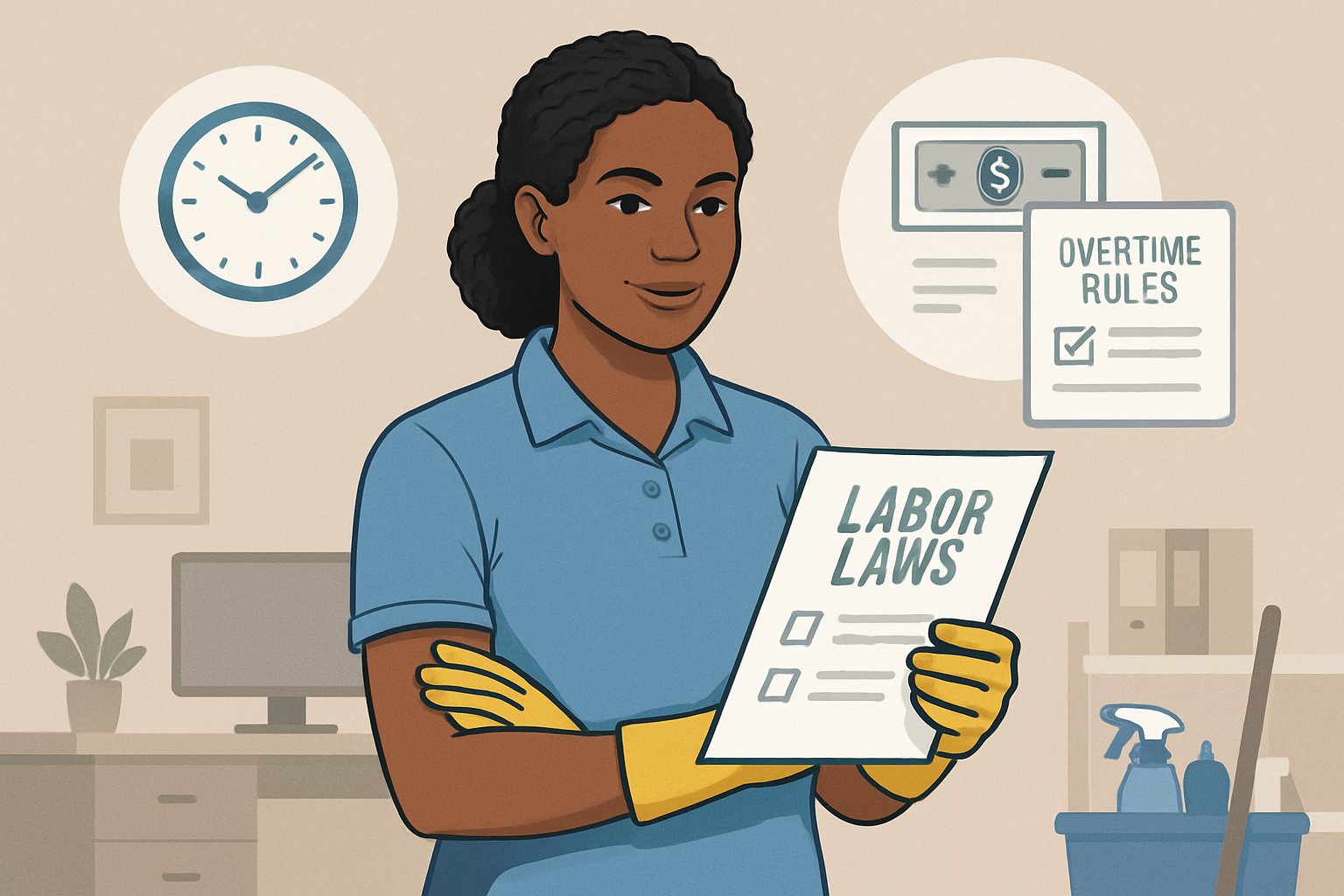
If you get the basics down, you protect your cleaning business from expensive violations and keep things fair for your workers. The cleaning industry brings its own headaches: workers bounce between job sites, work odd hours, and sometimes need special break arrangements.
Messing up labor laws can cost you thousands in penalties and back wages. Here’s what you need to know to stay out of trouble.
Key Takeaways
- Cleaning businesses must pay overtime after 40 hours per week and count all hours worked across multiple job sites.
- You’re legally required to keep records of hours, breaks, and wages.
- Proper employee classification and understanding break rules saves you from huge penalties.
Wage and Hour Requirements
You’ve got to follow both federal and state wage laws. These set minimum pay rates and make sure workers get paid for every minute they’re on the clock.
California’s minimum wage is higher than federal law and changes depending on where you’re located and how big your business is.
Understanding Federal and State Minimum Wage Laws
The Fair Labor Standards Act (FLSA) sets the federal minimum wage at $7.25 per hour. California, though, goes higher.
In California, if you have 25 or fewer employees, you pay at least $14 per hour. If you’ve got 26 or more, it’s $15.
State law always wins if it’s better for workers. So in California, you can’t just pay the federal rate.
Minimum wage usually goes up every year. Check the Labor Commissioner’s site often to stay current.
If you don’t pay required minimum wages, that’s wage theft. It can get expensive fast.
Required Compensation for All Hours Worked
You must pay for every hour your employees work, period. That includes travel time between job sites during their shift.
Don’t forget about setup, cleanup, and waiting between assignments. It all counts.
Tips always go to the employee. You can’t use tips to meet minimum wage, and owners or managers can’t take a cut.
You need to give detailed pay stubs—showing hours, wages, and deductions. Employees have the right to see exactly how their pay breaks down.
Variations in Minimum Wage by Location
Some California cities set their own higher minimum wages. You have to pay the highest rate wherever your employee actually works.
Location matters more than where your business is based. If your cleaner works in a city with a higher minimum wage, you pay that higher rate for those hours.
San Francisco, Los Angeles, and other big cities often require more than $16 per hour. Some places even add paid sick leave and other perks.
It’s smart to check wage requirements for every city you clean in. Local rules can change out of nowhere.
If you’re working in multiple cities, record-keeping is huge. You’ll need to track where each person worked to make sure you’re paying the right rate.
Overtime Rules for Cleaning Businesses
You need to pay overtime to non-exempt employees who work more than 40 hours in a week. That’s time and a half their regular rate.
The FLSA sets the basics, but state laws can be stricter.
Defining Overtime and Eligibility
The FLSA says overtime kicks in after 40 hours in a workweek for non-exempt employees.
Non-exempt employees get overtime whether they’re paid hourly or on salary. Most cleaning staff fall into this group.
Exempt employees don’t get overtime, but the requirements are strict:
- They must earn at least $43,888 per year as of July 2024.
- They’re paid on a salary basis.
- Their main duties are executive, administrative, or professional.
Most cleaning jobs don’t qualify. Calling someone a “supervisor” doesn’t make them exempt.
You can’t get around overtime by calling someone an independent contractor, paying a flat rate per job, or averaging hours across weeks.
State-Specific Overtime Regulations
Some states go beyond federal overtime rules. You’ve got to follow whichever law is better for your employees.
A few states, like California, require overtime pay after 8 hours in a single day. Alaska does this too.
Some states have their own overtime rates or different thresholds. Always check your state’s Department of Labor site.
If state and federal laws don’t match, you apply the one that benefits the employee most. That might mean a higher overtime rate or a lower threshold.
Calculating Overtime Pay
Overtime is one and a half times the regular hourly rate for every hour over 40 in a week.
For hourly workers, it’s simple:
- Regular rate: $15 per hour
- Overtime: $15 × 1.5 = $22.50 per hour
Salaried non-exempt employees take a little more math:
- Divide annual salary by 52 weeks.
- Divide weekly salary by hours worked that week.
- Multiply by 1.5 for overtime hours.
You’ve got to include things like shift differentials, non-discretionary bonuses, and commissions in the regular rate.
You don’t count discretionary bonuses, gift cards, or vacation pay.
A workweek is seven straight 24-hour periods. You can pick the starting day, but you need to stick with it for each employee.
Employee Classification: Exempt vs. Non-Exempt
How you classify employees under the FLSA decides if they get overtime pay and minimum wage. Get it wrong, and you could owe years of back pay and face some nasty penalties.
Distinguishing Between Exempt and Non-Exempt Employees
Non-exempt employees get overtime for hours over 40 in a week and the full protection of minimum wage laws.
Almost every cleaning worker falls into this group—housekeepers, janitors, carpet cleaners, window washers, you name it.
Exempt employees don’t get overtime, but they must:
- Be paid a fixed weekly salary (not hourly).
- Make at least $684 per week ($35,568 a year).
- Actually do executive, administrative, professional, computer, or outside sales work.
You have to look at what the person actually does. Giving someone a manager title isn’t enough. Their main job needs to be managing people, not cleaning.
Blue-collar workers can never be exempt. If someone’s doing physical work with their hands, they’re non-exempt.
Risks of Misclassification
If you misclassify someone, you could owe years of unpaid overtime and face big fines.
Financial penalties might include:
- Back pay for overtime
- Double damages (liquidated damages)
- Attorney fees and court costs
- Department of Labor fines
A common mistake: calling a team leader or supervisor exempt when they’re really just cleaning most of the time. Training new hires or ordering supplies doesn’t make someone exempt.
The Department of Labor investigates these issues all the time. One employee complaint can bring an audit on your whole company.
If your records are a mess, you’ll have a harder time defending yourself.
Best Practices for Employee Classification
Assume everyone is non-exempt unless you’re sure otherwise. It’s safer.
Write clear job descriptions that match what people actually do every day.
Check classifications every year—job roles change, and someone promoted to supervisor might still spend most of their time cleaning.
If you’re not sure, talk to a lawyer. Employment attorneys can help with tough cases.
Keep good records of duties and hours. You’ll need them if there’s ever a dispute.
Train your managers so they know what makes a job exempt or non-exempt. Titles alone don’t cut it.
Consider tracking hours for everyone, even those you think are exempt. It gives you a backup if you have to reclassify someone later.
Meal and Rest Break Requirements
Federal law doesn’t require meal or rest breaks for adults, but a bunch of states do. If you skip breaks, you could owe extra pay.
Federal and State Meal Break Laws
The FLSA doesn’t say anything about meal breaks, but 23 states have their own rules.
Most require a 30-minute unpaid break after 5–6 hours of work. The break has to be totally duty-free, or you have to pay for it.
Missed breaks can mean penalty pay—usually an extra hour at the regular rate.
Here are some examples:
| State | Meal Break Requirement | Shift Length |
|---|---|---|
| California | 30 minutes unpaid | After 5 hours |
| Colorado | 30 minutes unpaid | After 5 hours |
| Connecticut | 30 minutes unpaid | Over 7.5 hours |
| Illinois | 20 minutes unpaid | 7.5+ hours |
| New York | 30-60 minutes unpaid | Varies by industry |
California and Colorado enforce these rules strictly. Miss a break, and you owe extra pay.
Nevada, Oregon, and Washington require both meal and rest breaks. It can get complicated.
Rest Break and Paid Break Policies
Ten states require paid rest breaks, separate from meal periods. Rest breaks are always paid because workers are still on the clock.
Usually, it’s 10 minutes paid for every 4 hours worked. You can’t combine these with meal breaks—they’re separate.
States that require paid rest breaks include:
- California
- Colorado
- Kentucky
- Nevada
- Oregon
- Washington
Minnesota says employees should get “enough time” for restroom breaks about every 4 hours. Maine wants a 30-minute break after 6 hours if three or more people are working together.
Some states let union contracts change break rules, but most cleaning businesses just follow state law.
Recording and Compensating Break Time
You need to track break times accurately or you risk wage violations.
Rest breaks always count as paid time and go into overtime calculations.
Meal breaks are unpaid only if:
- The employee is totally off-duty
- The break lasts at least 30 minutes
- The employee can leave the work area
If employees work through lunch or stay on-call, you have to pay for that time. Short breaks under 20 minutes are always paid, no matter what.
You should:
- Record break start and end times
- Track missed or short breaks
- Pay penalties for missed breaks
- Keep records for at least 3 years
If you use a time tracking system, set it up to flag missed breaks—especially in states where you owe an hour’s pay for each missed break.
Record-Keeping Obligations
You’ve got to keep detailed employment records to comply with the FLSA and protect yourself from wage theft claims. This means tracking employee info, wage data, and storing everything safely for the right amount of time.
What Records Must Be Maintained
The Fair Labor Standards Act says employers have to keep certain records for every non-exempt employee. These records need to include accurate details about hours worked and wages earned.
Required Employee Information:
-
Full name and social security number
-
Complete address with zip code
-
Birth date if under 19
-
Sex and job title
Time and Wage Records:
-
Time and day when the workweek starts
-
Daily hours worked
-
Total weekly hours
-
Hourly pay rate and how wages are determined
-
Total weekly earnings and overtime pay
Payment Documentation:
-
All wage additions or deductions
-
Total wages paid each period
-
Payment dates and covered pay periods
Employers can use whatever timekeeping method works for them, as long as it’s complete and accurate. Time clocks, handwritten logs, or electronic systems all do the job.
If employees have fixed schedules, businesses can keep a record of the regular schedule. They only need to note actual hours when workers go off their normal routine.
Retention Periods and Storage Solutions
Federal law sets different retention rules for employment records. Payroll records have to be kept for at least three years from when they’re created.
Three-Year Retention:
-
Payroll records
-
Collective bargaining agreements
-
Sales and purchase records
Two-Year Retention:
-
Time cards and timekeeping records
-
Wage rate tables
-
Work schedules
-
Records of wage additions or deductions
You can store records at the workplace or at a central office. Digital storage works fine, as long as records stay accessible for inspection.
The Department of Labor might ask to check these records anytime. Employers need to let inspectors review, copy, or request extra calculations based on the documentation.
Addressing Record-Keeping Errors
Record-keeping mistakes can get expensive and even lead to wage theft violations. Employers really should review their documentation systems regularly to catch errors.
Common mistakes? Not recording actual hours worked, missing overtime calculations, and leaving out employee info. These slip-ups may result in back wage payments and fines.
Best Practices for Error Prevention:
-
Review time records every week
-
Train supervisors on good documentation habits
-
Stick to consistent timekeeping methods
-
Keep backup copies of everything
When you find an error, correct it right away and figure out any wages owed. Fixing mistakes quickly shows you’re trying to comply if anyone investigates.
Cleaning businesses should set up clear procedures for dealing with timekeeping disputes. Sorting out problems fast keeps them from turning into legal headaches.
Avoiding Costly Labor Violations
Cleaning businesses can face big financial risks from wage theft violations and not following the Fair Labor Standards Act. Back pay, penalties, and legal fees can pile up and threaten your business.
Common Wage and Hour Pitfalls in Cleaning Businesses
Cleaning companies often make expensive mistakes with employee classifications and overtime. It’s surprisingly common for owners to call workers independent contractors when, by law, they’re employees.
High-Risk Classification Errors:
-
Calling regular cleaning staff contractors
-
Misclassifying supervisors as exempt
-
Not tracking hours for mobile cleaning teams
Travel time between job sites trips up a lot of businesses. Employers have to pay for travel during the workday—not just the time spent cleaning. If workers drive from one client to another, that’s paid time.
Overtime gets messy when companies don’t pay time-and-a-half for hours over 40 a week. Some try to dodge overtime by paying different rates for different jobs, but that’s not allowed.
Common Overtime Mistakes:
-
Calculating overtime using different hourly rates
-
Not counting short breaks as paid time
-
Leaving out bonuses when figuring overtime
Minimum wage compliance is another tricky area. Cleaning businesses must pay at least the federal minimum wage, or more if state or local laws require it.
Implementing Compliance Systems
Solid compliance systems help cleaning businesses steer clear of wage theft violations and penalties. Digital time tracking systems make it easier to keep accurate records of hours and locations.
Essential Compliance Tools:
-
GPS-enabled time clocks for mobile teams
-
Automated overtime calculation software
-
Digital record storage (at least three years)
Managers need to understand Fair Labor Standards Act requirements. Training them on employee classifications and overtime rules specific to cleaning can prevent a lot of trouble.
Payroll audits every quarter help catch issues early. Business owners should check classifications, overtime payments, and record-keeping practices. This kind of regular review can save you from bigger headaches later.
Monthly Compliance Checklist:
-
Review overtime payments
-
Check travel time compensation
-
Verify minimum wage compliance
-
Update employee classifications
Documentation goes beyond just time sheets. Employers need records explaining why they classified each worker as exempt or non-exempt.
Responding to Employee Complaints
Quick action on wage complaints helps cleaning businesses avoid bigger violations and penalties. Employees who think they’ve been shortchanged can file complaints with state or federal agencies.
Immediate Response Steps:
-
Write down the complaint
-
Review payroll records
-
Calculate any unpaid wages
-
Respond within 48 hours
Internal complaint procedures make it easier for employees to speak up before going outside the company. Policies should clearly say how workers can report wage issues without worrying about retaliation.
If you find a violation, pay back wages right away. Acting fast shows you’re cooperating, which usually helps lower penalties.
Best Practices for Complaint Resolution:
-
Keep complaint records confidential
-
Investigate thoroughly and fairly
-
Pay corrected wages right away
-
Update policies to stop future problems
Sometimes, you need to call a lawyer—especially if the complaint involves tricky classification issues or the risk of a class action. Employment attorneys can guide cleaning businesses through Fair Labor Standards Act requirements and help limit liability.
Frequently Asked Questions
Cleaning business owners deal with wage and hour questions all the time. Overtime, breaks, documentation, worker classification, penalty risks, and minimum wage rules—it’s a lot to keep straight.
How should overtime compensation be calculated for non-exempt employees in the cleaning industry?
Non-exempt cleaning workers get overtime at one and a half times their regular hourly rate for every hour over 40 in a workweek. The regular rate includes hourly wages plus any non-discretionary bonuses or shift differentials.
If employees earn different rates for different tasks, employers have to calculate a weighted average for overtime. That’s the number to use.
Overtime needs to be paid in the same pay period when the extra hours were worked. Employers can’t average hours across weeks to avoid paying overtime.
Some cleaning companies think they can offer comp time instead of overtime pay, but private employers must pay overtime in cash.
What are the legal requirements for providing meal and rest breaks to cleaning staff under federal labor law?
Federal law doesn’t require employers to give meal or rest breaks. If you offer short breaks (20 minutes or less), you have to pay for that time.
Meal breaks of 30 minutes or more are usually unpaid, but employees must be completely off duty. If they’re still working, it’s paid time.
Many states have their own break rules, sometimes more generous than federal law. Cleaning businesses need to follow whichever law gives workers the better deal.
Employers should check their state requirements. Some states require paid rest breaks every few hours or unpaid meal breaks after a certain number of hours worked.
What are the essential record-keeping practices for employers in regards to wage and hour documentation?
Employers have to keep accurate records of hours worked and wages paid for all non-exempt employees for at least three years. This includes daily start and stop times, total hours each day, and total wages each pay period.
Records should include the employee’s full name, Social Security number, address, birth date if under 19, and job title. Employers also need to keep records of any wage deductions.
Time records should show when employees start, take breaks, leave for meals, and end shifts. Handwritten logs, time clocks, or electronic systems all work.
Employers must keep payroll records, collective bargaining agreements, and sales and purchase records for three years. These need to be available if Department of Labor officials ask for them.
How can a cleaning business determine whether a worker should be classified as an independent contractor or an employee?
The main thing is control. Independent contractors decide how they do their work, while employees follow the employer’s instructions.
Contractors usually bring their own equipment and work for multiple clients. They set their own schedules.
Employees get trained, use company equipment, and work hours set by the employer. The business controls when, where, and how the work gets done.
There’s also the economic side. Contractors can make or lose money based on their decisions. Employees get regular wages, no matter how the business is doing.
What are the potential penalties for misclassifying employees as independent contractors in the cleaning business?
Employers who misclassify workers have to pay back wages for unpaid overtime and minimum wage violations. They also owe their share of Social Security and Medicare taxes that should’ve been withheld.
The Department of Labor can hit you with civil penalties up to $1,100 per violation for willful or repeated offenses. Criminal penalties can come into play if violations are intentional.
States may add more fines. Some states have extra penalties for misclassification that can reach thousands per misclassified worker.
Misclassified employees can sue for damages. Courts can award attorney’s fees and extra damages equal to the unpaid wages.
What steps should be taken to ensure compliance with minimum wage laws in the cleaning industry?
Employers have to pay at least the federal minimum wage of $7.25 per hour to all non-exempt employees. But honestly, many states and cities set higher minimum wages that take priority over the federal rate.
It’s smart to check local minimum wage rates often, since they seem to change all the time. Some areas even set different rates depending on the size of the employer or the specific industry.
Pay employees for all time worked at minimum wage or higher. That means covering time spent traveling between job sites, training, and even waiting around if employees can’t leave the premises.
Employers shouldn’t make deductions that drop an employee’s pay below minimum wage. This covers things like uniforms, equipment damage, or even cash register shortages.
