
Cleaning Business Working Capital & Cash Flow 101
Veteran operators target two to three months of payroll in cash reserve, enough to survive slow seasons, late net-30 commercial payments, and a surprise van repair in the same month. Build it by saving a fixed percentage of every deposit, invoicing the day the job finishes, and planning the December-January valley in advance.
 R Rashdi
·
July 2, 2026
·
11 MIN READ
R Rashdi
·
July 2, 2026
·
11 MIN READ

Quick answer
Veteran operators target two to three months of payroll in cash reserve, enough to survive slow seasons, late net-30 commercial payments, and a surprise van repair in the same month. Build it by saving a fixed percentage of every deposit, invoicing the day the job finishes, and planning the December-January valley in advance.

Cleaning business working capital is the cash that keeps payroll clearing while you wait to get paid. It is not profit. Plenty of profitable cleaning companies have died on a Friday because the bank balance, not the P&L, pays the crew.
This guide covers the number to hold (two to three months of payroll, and why), the commercial net-30 trap, the math on invoice speed, and how to plan for the December valley that is probably starting around you right now.
Why Profitable Cleaning Businesses Run Out of Cash
Profit and cash live on different calendars. Three patterns put cleaning companies in the gap:
Labor is paid before revenue arrives. Industry benchmarks put labor at 40-50% of revenue for cleaning businesses, and it goes out every one or two weeks, on time, every time. A commercial client paying on net-30 terms means you front four to six payrolls before their first check lands.
Growth eats cash. Winning a big commercial account feels like the problem is solved. It is actually the moment of maximum danger: new hires, new equipment, new supplies, all paid for weeks before the first invoice is even allowed to go out. The faster you grow on slow-paying contracts, the more cash you burn.
Margins are thinner than they feel. IBISWorld has pegged the average janitorial-services net margin at roughly 6%. Residential operators do considerably better, but the lesson holds: a business keeping six cents on the dollar has almost no cushion when a payment slips 30 days.
None of these are signs of a bad business. They are signs of a business that needs a working capital system, not a bigger top line.
The Number: 2-3 Months of Payroll in Reserve
Ask veteran operators how much cash a cleaning business should hold, and the most common rule of thumb is two to three months of payroll, sitting in a separate account you do not touch.
Why payroll and not “expenses”? Because payroll is the obligation you can never miss. Suppliers will wait a week. Your landlord will take a late fee. Your cleaners will quit, and in an industry where turnover already runs well above 100% a year by most published framings, losing a good cleaner over a late paycheck is the most expensive mistake on this page.
Work the math for a typical small operation:
| Crew | Avg. loaded cost/hr | Hours/week | Monthly payroll | 2-month buffer | 3-month buffer |
|---|---|---|---|---|---|
| 3 cleaners | $20 | 32 each | ~$8,300 | ~$16,600 | ~$25,000 |
| 6 cleaners | $20 | 32 each | ~$16,600 | ~$33,300 | ~$50,000 |
| 10 cleaners | $21 | 35 each | ~$31,900 | ~$63,700 | ~$95,500 |
(Loaded cost = wages plus payroll taxes and workers’ comp. Bureau of Labor Statistics data puts cleaning wages around $14-18/hour nationally; the loaded figure runs a few dollars higher.)
If those buffer numbers look impossible today, that is normal. The system in the last section builds them gradually. The point of the benchmark is direction, not shame.
The Net-30 Commercial Trap
Commercial contracts are the prize everyone chases, recurring revenue, bigger tickets, professional clients. The trap is hidden in the payment terms.
“Net-30” rarely means 30 days. You finish a month of service, invoice on the 1st, and the clock starts when their accounts-payable department processes it. In practice, many net-30 invoices pay in 40-55 days. Stack that against weekly payroll and a single mid-size contract can have you financing six weeks of labor out of your own pocket, permanently, for as long as you hold the account.
Defenses that work, roughly in order of how often operators actually get them:
- Invoice the moment the period closes. Every day you wait to send is a day added to the far end. Same-day invoicing is fully in your control.
- Bill twice monthly instead of monthly. Splitting a $6,000 monthly contract into two $3,000 invoices cuts the cash you front roughly in half. Many facility managers accept this if you ask at signing, almost none offer it.
- Take deposits on one-time work. A 50% deposit on one-time and first-time jobs is standard practice in 2026; without it, cancellations and slow payers commonly leak 5-10% of revenue.
- Charge late fees, politely. 1.5% per month, stated in the contract and on every invoice. You will rarely collect it; its job is to move you up the payment pile.
- Be careful with invoice factoring. Selling invoices for immediate cash works, but the discount routinely eats more than your net margin. Treat it as an emergency tool, not a system.
And the quiet one: check payment reputation before you sign. One call to another vendor of that building tells you whether their net-30 is really net-90, before you are six payrolls deep. For more on structuring contracts that protect you, see our guide to building recurring revenue with cleaning contracts.
Invoice Speed: The Cheapest Working Capital You Will Ever Find
Here is the math most owners never run. A $25,000/month cleaning business earns about $820 per calendar day. If your average invoice goes out five days after the work is done, you have roughly $4,100 permanently parked in unbilled work, money you earned, sitting in nobody’s account. Cut the delay to zero and that cash comes home once, and stays home forever.
Speed has three components:
- Invoice on completion, not on Sunday night. If invoices wait for your weekly admin block, your average delay is 3-4 days by default. Software that generates the invoice from the completed job removes the wait entirely, CleanerHQ’s auto-invoicing turns a finished job into a sent invoice in one click, line items carried over.
- Follow up on a schedule, not when you remember. Polite, automatic reminders at 3, 7, and 14 days after sending collect most late invoices without a single awkward phone call. (CleanerHQ runs that cascade automatically and stops it the moment payment lands.)
- Make paying take two minutes. An invoice with a card-payment link gets paid faster than an invoice that asks for a check. If you take cards through your own Stripe account, you keep processing costs at Stripe’s standard rate with no platform markup, see getting paid by credit card.
One more speed lever: documentation. Operators with GPS-stamped time records and before/after photos report collecting roughly 95% of billings, because disputes die when proof exists. A clean invoice template with the evidence attached is a collections department in a PDF.
If invoicing is still a manual evening chore in your business, this is the highest-ROI fix on this page. Try CleanerHQ free (card needed to start the trial), and watch the gap between “job done” and “invoice sent” drop to zero.
Planning the December Valley
If you run residential routes, you can feel it already: holiday skips, clients traveling, then the January belt-tightening after the credit card bills arrive. Many residential-heavy operators see their softest stretch from mid-December through late January. Commercial work holds up better, offices still need cleaning, but one-time and discretionary work goes quiet.
The valley is survivable because it is predictable. The playbook:
- Know your own pattern. Pull the last two or three years of monthly revenue. Your valley has a shape, the same shape, most years. Budget against it instead of being surprised by it.
- Pre-sell January in December. Post-holiday deep cleans, “new year reset” packages, and gift certificates sold in December are January revenue collected early. Move-out cleans also keep flowing, leases end in winter too.
- Chase counter-seasonal work. Post-event cleanup, post-construction punch work, and carpet/floor projects that commercial clients schedule while staff are away all fill December gaps.
- Cut variable costs with revenue, not after it. Match supply orders and discretionary hours to the booked schedule. Protect your best cleaners’ hours first, replacing them in February costs far more than carrying them through January, with one veteran franchise operator pegging each departure at about $4,000.
- Time big purchases for the slow weeks. Equipment maintenance and December purchases also intersect nicely with year-end tax planning, a deductible buy in the quiet season is two wins.
Building the Buffer: A System, Not a Resolution
Nobody saves three months of payroll by deciding to. Operators who get there use some version of this:
- Open a separate reserve account. Different bank if you can, friction is the feature. Money you can see in your operating balance gets spent.
- Skim a fixed percentage of every deposit. Start with 5% of every payment that lands. Painless at $500, meaningful at $50,000. During peak season, push it to 10-15%, busy-season cash is what slow seasons are made of.
- Automate the transfer. A weekly automatic sweep beats a monthly act of willpower every time.
- Set the target and stop there. Two to three months of payroll, per the table above. Past the target, surplus cash goes back to growth, debt, or your own pocket, a reserve is insurance, not a savings hobby.
- Arrange a line of credit while you don’t need it. Banks lend on strong months. A credit line you never draw costs little and turns a slow February from a crisis into a footnote.
- Review one number weekly. Cash on hand ÷ monthly payroll. When that ratio trends down two weeks running, you want to know in week two, not at payroll time. Watching it next to your profit margins tells you whether the problem is pricing or timing.
Good cleaning business software makes most of this automatic, invoices out same-day, reminders on schedule, payments by card, and the numbers in one dashboard instead of three spreadsheets.

The One-Page Cash Flow Rhythm
| Cadence | Action | Time |
|---|---|---|
| Job completion | Invoice goes out (automated) | 0 min |
| Daily | Payments recorded, card links chased by auto-reminder | 0-5 min |
| Weekly | Check cash ÷ payroll ratio; sweep % to reserve | 10 min |
| Monthly | Review AR aging; call anything past 45 days | 30 min |
| Quarterly | Re-run payroll buffer target; adjust skim % | 20 min |
| Annually | Pull seasonal revenue curve; pre-plan the valley | 1 hr |
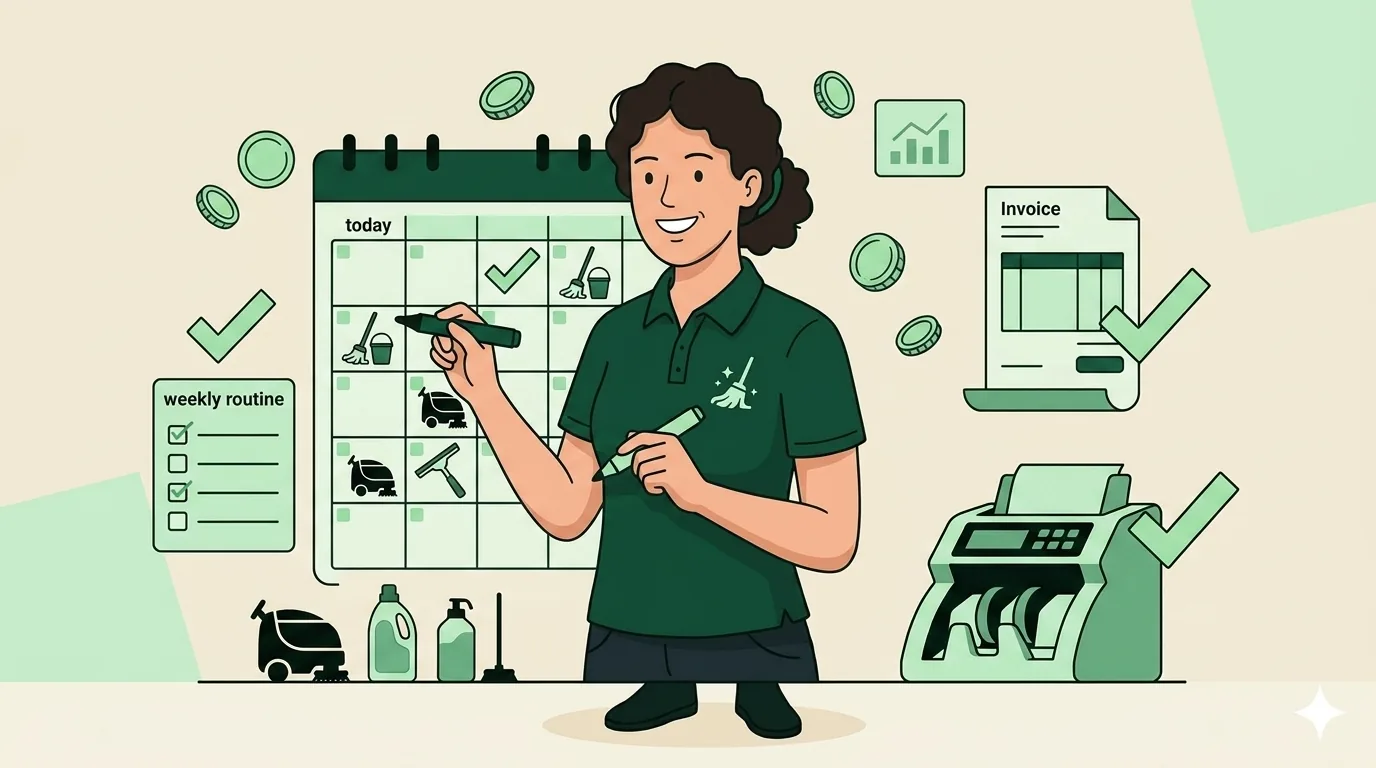
That is the whole system. Two hours a month, one ratio, one reserve account, and December stops being scary.
Frequently Asked Questions
How much working capital does a cleaning business need?
The operator rule of thumb is two to three months of payroll in a separate reserve account. For a six-cleaner residential business, that is roughly $33,000-50,000. Some owners target 3-6 months of total fixed costs instead, a stricter standard worth growing into, but payroll coverage is the floor.
How do I deal with net-30 commercial clients?
Invoice the day the billing period closes, ask for twice-monthly billing at contract signing, state a 1.5% monthly late fee, and run automatic reminders at 3, 7, and 14 days. In practice net-30 often pays in 40-55 days, so hold reserves against roughly six weeks of fronted labor per contract.
What percentage of revenue should I save during peak season?
Skim 5% of every deposit year-round, and raise it to 10-15% during your strongest months until you hit two to three months of payroll in reserve. Automatic weekly transfers to a separate account outperform end-of-month saving, because the money moves before you can spend it.
Why is December slow for cleaning businesses?
Residential clients skip visits around holiday travel and tighten spending in January, so many residential-heavy operators see their softest stretch from mid-December through late January. Commercial contract work holds steadier. Pre-selling January deep cleans and gift certificates in December pulls that revenue forward.
Does faster invoicing really improve cash flow?
Yes, and the math is simple: a $25,000/month business earns about $820 per day, so a five-day average invoicing delay parks roughly $4,100 of earned money outside your account permanently. Same-day automated invoicing recovers it once and keeps it recovered, the cheapest working capital available.

Written by
Rashdi has spent 15+ years building and managing enterprise software, and has worked with US cleaning businesses since 2006. He founded CleanerHQ.