
Move-Out Season Playbook: April-August Lead Surge
Move-out cleaning demand surges April through August: most US leases turn over in summer, families move while school is out, and home sales close in late spring. The operator playbook: price move-outs 50-75% above your standard rate, lock realtor and property-manager partners by March, hold month-end crew capacity, and convert movers into recurring clients at their new home.
 R Rashdi
·
July 2, 2026
·
13 MIN READ
R Rashdi
·
July 2, 2026
·
13 MIN READ

Quick answer
Move-out cleaning demand surges April through August: most US leases turn over in summer, families move while school is out, and home sales close in late spring. The operator playbook: price move-outs 50-75% above your standard rate, lock realtor and property-manager partners by March, hold month-end crew capacity, and convert movers into recurring clients at their new home.
Every move-out cleaning business has the same five months to win the year. From April to August the phone rings with one-time, deadline-driven, premium-priced jobs, and the operators who treated the surge as a system instead of a scramble come out of it with full summer revenue and a fatter recurring book for the fall.
This is that system: why the season happens, how to price it, the partner channels that feed it (with the exact outreach scripts), how to hold same-week capacity without burning your crews or your regulars, and the conversion play most operators skip, turning the person moving out into a recurring client at their new address.

Why move-out demand peaks April through August
No mystery stats needed here, the season is built into how American housing works:
- Leases cluster in summer. Twelve-month leases signed during one summer end the next. Landlords deliberately set lease ends in the warm months because units re-rent faster, which keeps the cycle self-reinforcing.
- Families move when school is out. Parents wait for the last bell in May or June; the goal is being settled before the new school year. That compresses family moves into a 10-12 week window.
- Home sales close in late spring and summer. Listing season starts in March and April; 30-45-day escrows turn those contracts into May-through-August move dates, each one a potential pre-listing clean, a move-out clean, and a move-in clean.
- College towns get two spikes. May (everyone out) and August (everyone in), and student turnovers come in bulk: same floor plans, same condition problems, one property manager holding fifty keys.
- Month-ends inside the season are the peaks within the peak. Leases end on the last day of the month, so the final week of May, June, July, and August is when every property manager in town wants the same three days from you.
The operational consequence: the planning work happens in February and March. Partners signed in June missed half the season; a crew hired in July is being trained during your busiest week.
Pricing move-out cleaning for profit
The full rate breakdown lives in our move-out cleaning prices guide, consumer cost guides put the typical job at $120-$420 (averaging around $360), and operators in higher-cost metros report $500-600 tickets. For the playbook, four pricing rules matter:
- Price 50-75% above your standard rate. That’s the established operator benchmark for move-out work, and it’s earned: the standard is inspection-grade, the deadline is hard, and there’s no next visit to fix a miss. A deposit, a landlord sign-off, or a listing photo shoot is riding on your work.
- Quote by unit type, not by walkthrough. In season you don’t have time to see fifty empty apartments. Build flat rates per floor plan (studio, 1BR, 2BR, 3BR house) with a condition clause: heavy soil, pet contamination, or smoke residue re-quotes on arrival, with photos. How long each unit type takes is knowable, estimate job time accurately once and the flat rate prices itself.
- Take a 50% deposit on every one-time job. This is standard practice now, and during the surge it’s survival: movers are the most cancellation-prone clients in cleaning, closings slip, moving trucks reschedule, and without deposits, cancellations quietly leak 5-10% of revenue.
- Price the rush, don’t absorb it. Same-week is your standard season offer; same-day or next-day carries a stated rush fee (operators commonly add 25-50%). Partners don’t resent a published rush rate, they resent finding out you’re unavailable.

Partner channels: realtors, property managers, apartment complexes
One-off movers find you once. Partners feed you every week of the season, and they’re recruited in late winter, when their own turnover planning starts. Three channels, three pitches, three scripts you can send today.
Realtors and listing agents. What they’re buying: a listing that photographs well and a fast turnaround between closing and possession. Their pain is timing, a deal that closes Friday with possession Monday.
“Hi {name}, I run {company}, a local cleaning crew that works with listing agents. Two things agents use us for: pre-listing deep cleans that make photos pop, and 48-hour turnarounds between closing and possession. We quote flat from the listing’s beds, baths, and square footage, no walkthrough needed, and you get before/after photos to forward to your seller. Can I send over our one-page agent rate sheet?”
One agent who closes two deals a month is worth more than any ad campaign, and agents talk to each other in offices of forty.
Property managers. The volume channel. One PM can control dozens or hundreds of doors, every one a turnover eventually. What they’re buying: reliability, consistent per-unit pricing, and documentation that survives a security-deposit dispute.
“Hi {name}, we handle turnover cleans for rental managers in {area}. Flat per-unit pricing by floor plan, a photo report after every turn (move-out inspection grade, timestamped), and we reserve same-week capacity April through August for when your turns stack up at month-end. If a unit fails your inspection, we re-clean it free within 48 hours. Worth 15 minutes this week?”
Bring a vendor packet to that call: certificate of insurance, W-9, your rate sheet, a sample photo report. PMs hire whoever makes onboarding effortless. The free re-clean guarantee costs you a handful of jobs a season and wins the account.
Apartment complexes and student housing. The bulk play. Leasing offices at large complexes schedule turns in blocks, and in college towns, the entire portfolio turns in the same two weeks. Pitch a per-floor-plan flat rate, a committed number of units per day, and scheduled month-end blocks. The complex gets a guaranteed turn calendar; you get density no residential route can match, ten units in one building beats ten houses across town in drive time alone.
These partner motions sit on top of your regular acquisition engine, the full system is in our guide to getting more cleaning clients.
Same-week capacity without breaking your crews
The season’s defining tension: surge work is won by availability, but your recurring clients keep the business alive in November. Capacity is the playbook’s hard part.
- Protect the recurring base absolutely. Never bump a biweekly regular for a one-time move-out, no matter the ticket. Veteran operators converge on the same math: a recurring client is worth roughly $3,000 in gross profit over a typical two-year relationship, the one-off is one ticket. The 90/10 recurring-to-one-time revenue target doesn’t get suspended for the summer.
- Hold month-end blocks open. Reserve a slice of crew-hours, many operators hold 15-20%, in the last week of each month from April through August, and release unsold holds 48 hours out. Empty-unit work also fits where occupied homes can’t: evenings and weekends are sellable inventory in season.
- Staff up in March, not June. A cleaner hired in March is solo-ready by May (a 30-day SOP training plan gets them there); one hired in July is shadowing during your peak week. Run two-person crews on empties, the work splits cleanly by room, halving clock time on hard-deadline jobs.
- Let the surge book itself. Season leads come in at 9 PM from people sitting in half-packed kitchens. A booking and quote widget on your site gives them an instant price from home details and books the job while you sleep, no phone tag with someone who called three companies. On the dispatch side, smart scheduling ranks slots against drive time and crew load, which is what keeps month-end week from becoming a routing disaster. If this season is the one where you systematize, request early access (14-day trial of the paid plan; card required at checkout), and run the surge through one cleaning business software platform instead of a whiteboard.
- Have an overflow answer. When you’re truly full, refer to a trusted peer and ask the same of them. A referred-out job costs you one ticket; a “sorry, we can’t” to a property manager can cost the account.
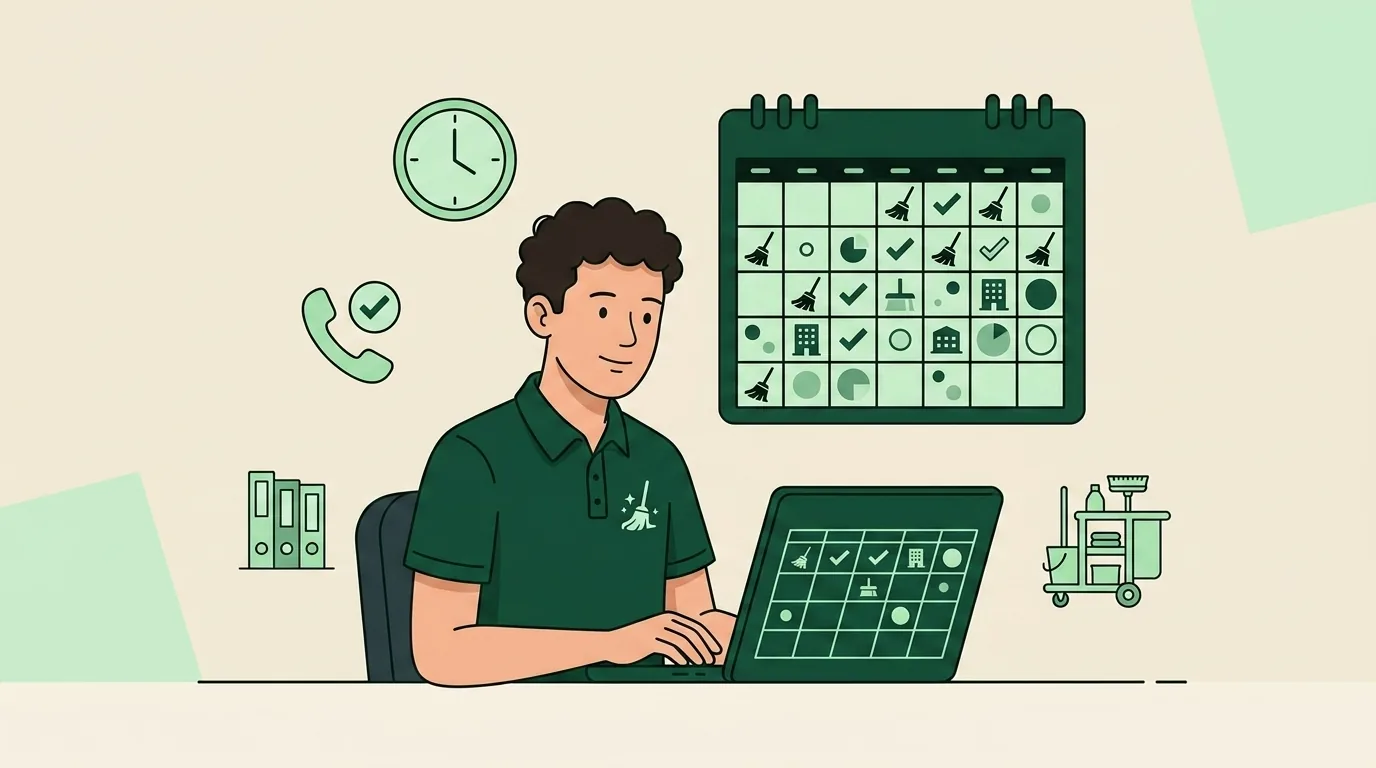
Converting movers into recurring clients at the new home
Here’s the play most move-out cleaning businesses never run. The person whose apartment you just cleaned isn’t disappearing, most are moving across town, into a home they now have to clean themselves. You’re standing in front of a future recurring client at the exact moment they’re exhausted by moving.
The two-touch sequence:
Touch one, at move-out completion. When you send the completion photos, include one line and one offer:
“Congrats on the move, {name}. If your new place is in the area, we do move-in cleans too, empty-house deep clean before the boxes arrive, so you start in a genuinely clean home. Want a quote for the new address?”
The move-in clean is an easy yes: same trusted crew, new house, and it sells itself to anyone who just watched your work earn their deposit back.
Touch two, two weeks after the move-in clean. Now they’ve unpacked, work has resumed, and the new house is already getting away from them:
“Hope you’re settling in, {name}. Most of our move-in clients ask about keeping the place this way, our biweekly service starts at {rate}, and as a recent client you get 50% off the first recurring visit. Want me to hold a day-of-week that fits?”
Discount the first recurring visit, never the move-out, the premium job stays premium, and the discount points at the relationship you actually want.
The math that makes this the highest-leverage section of the playbook: one 10-year, four-city operator’s numbers put a move-out ticket at $500-600 once, while a recurring client at $150-200 per visit returns roughly $3,000 of gross profit over a typical two-year run. If you clean 60 move-outs this season and even one in ten converts, that’s six recurring clients, comparable gross profit to thirty additional move-outs, with zero additional marketing spend. Recurring revenue is the whole exit from the seasonal rollercoaster; the recurring contracts playbook covers the retention side.
Track the conversion rate like a KPI all season. A crew that mentions the move-in offer on every job and a follow-up that actually goes out two weeks later are the difference between “we should do that” and a fall calendar full of biweeklies.

The pre-season checklist (run it in February-March)
- Flat rates set per unit type, with a written condition clause and rush fee
- 50% deposit policy live on every one-time booking
- Agent rate sheet and PM vendor packet (COI, W-9, sample photo report) ready to send
- Ten realtor and ten property-manager outreach messages sent per week through March
- March hires in training so they’re solo by May
- Month-end capacity holds blocked April through August
- Booking widget live so surge leads convert at 9 PM
- Move-in offer script in the completion-message template, two-week follow-up automated
Run the list once and the season stops being weather and starts being a harvest.
The Complete Move-Out Cleaning Checklist
This is the room-by-room scope most landlords and property managers inspect against. Quote from it, work from it, and attach it to your invoice as proof of scope.
Kitchen
- Inside and outside of all cabinets and drawers
- Inside oven, under stove top, drip pans
- Inside refrigerator and freezer (defrosted)
- Dishwasher door edges and filter
- Countertops, backsplash, sink and fixtures descaled
- Range hood and filter degreased
- Floors mopped, edges and corners included
Bathrooms
- Toilet inside, outside, base and behind
- Tub and shower descaled, grout scrubbed
- Vanity, mirror, inside cabinets and drawers
- Exhaust fan cover dusted
- Floors including behind the toilet
Bedrooms and living areas
- Inside closets, shelves and rods wiped
- Baseboards, door frames, doors and handles
- Window sills, tracks and interior glass
- Light fixtures, ceiling fans, switch plates
- Wall spot-cleaning (scuffs, fingerprints)
- Carpets vacuumed, hard floors mopped
Whole home, final pass
- All vents and returns dusted
- Blinds wiped
- Trash removed, garage swept if included
- Photos of every room for your proof-of-work record
Frequently Asked Questions
When is move-out cleaning season?
April through August, with the sharpest demand in the last week of each month, when leases end. The drivers are structural: 12-month leases cluster in summer, families move while school is out, spring home sales close in May-July, and college towns turn over in May and August. Plan partners, hiring, and capacity in February-March.
How much should I charge for move-out cleaning?
Consumer cost guides put typical move-out cleans at $120-$420, averaging around $360, and operators in higher-cost metros report $500-600 tickets. The working rule: 50-75% above your standard cleaning rate, quoted flat by unit type with a condition clause for heavy soil, pets, or smoke. Add a stated 25-50% rush fee for same-day or next-day jobs.
How do I get move-out cleaning contracts with property managers?
Lead with what PMs buy: flat per-unit pricing by floor plan, a timestamped photo report after every turn, reserved month-end capacity April-August, and a free 48-hour re-clean if a unit fails inspection. Bring a vendor packet, certificate of insurance, W-9, rate sheet, sample report. One property manager can control dozens of turnovers a year.
Should I require a deposit for move-out cleanings?
Yes, a 50% deposit on every one-time job is standard practice. Movers are the most cancellation-prone clients in cleaning because closings slip and trucks reschedule; without deposits, cancellations commonly leak 5-10% of revenue. Deposits also filter price-shoppers before you’ve held capacity for them during your busiest weeks.
How long does a move-out clean take?
Plan on 6-8 labor-hours for a standard house, appliance interiors, cabinets, baseboards, and bathrooms at inspection grade take far longer than maintenance cleaning. A two-person crew cuts that to 3-4 clock hours, which matters on hard-deadline turns. Empty units also allow evening and weekend work, expanding your sellable hours in season.
How do I turn move-out clients into recurring customers?
Two touches: offer a move-in clean at their new address when you deliver the completion photos, then follow up two weeks later with a recurring-service offer, 50% off the first recurring visit works well. Even a 1-in-10 conversion rate compounds: a recurring client returns roughly $3,000 in gross profit over a typical two-year relationship versus one $500 move-out ticket.

Written by
Rashdi has spent 15+ years building and managing enterprise software, and has worked with US cleaning businesses since 2006. He founded CleanerHQ.