How to Start a Cleaning Business: The Complete Guide
Pick one niche, register an LLC ($50-$500 in most states), get general liability insurance (roughly $40-$70/month), buy about $500 of starter equipment, price at 2x your loaded labor cost, and win your first 10 clients through Google and referrals. Most owners launch for $685-$3,500 and book a first paying job within two weeks.
 R Rashdi
·
July 2, 2026
·
14 MIN READ
R Rashdi
·
July 2, 2026
·
14 MIN READ
Quick answer
Pick one niche, register an LLC ($50-$500 in most states), get general liability insurance (roughly $40-$70/month), buy about $500 of starter equipment, price at 2x your loaded labor cost, and win your first 10 clients through Google and referrals. Most owners launch for $685-$3,500 and book a first paying job within two weeks.
If you want to know how to start a cleaning business, here is the honest version: it is one of the lowest-cost, fastest-to-revenue businesses you can launch. No degree, no storefront, no $50,000 loan. What kills new cleaning businesses isn’t competition, it’s underpricing, skipped insurance, and running everything from a notes app until the wheels come off.
Once you’re ready to pick your tools, see our ranked comparison of the best cleaning business software for 2026.
This guide walks the whole path: niche, name, legal structure, licenses and insurance, a real startup budget, pricing your first jobs, landing your first 10 clients, the day-one tool stack, and a 90-day launch plan you can follow line by line.
Step 1: Pick your cleaning niche before you pick anything else
Most new owners pick a name first. Wrong order. Your niche decides your equipment list, your insurance, your pricing model, and who you market to. Pick the niche, and the rest of the decisions make themselves.
| Niche | Typical job value | Gross margin (operator benchmarks) | Startup cost | Best for |
|---|---|---|---|---|
| Residential recurring | $120-$250 per clean | 30-50% | $685-$3,500 | Solo founders; fastest break-even |
| Move-in/move-out | $300-$800 per job | Premium one-off rates | $700-$1,500 | Realtor/PM relationships |
| Airbnb/STR turnover | Per-turn flat rates | 50-75% higher hourly than routine work | $700-$1,500 | Dense short-term-rental markets |
| Commercial janitorial | $800-$5,000/month per contract | 20-40% | $8,000-$15,000+ | Owners with cash runway; ~22-month break-even in a standard model |
| Post-construction | $500-$3,000+ per job | Premium rates | High (HEPA equipment mandatory) | Builder/GC relationships |
Margins and break-even figures here are operator benchmarks, practitioner rules of thumb from veteran owners, not lab data. The pattern they agree on: residential recurring is the best solo-founder fit because you can break even in days to weeks, while commercial janitorial is “high volume, low margin” and can take around 22 months to break even in a standard model.
One more rule from the field: aim your service mix at roughly 90% recurring, 10% one-time work. A move-out job pays once. A biweekly client pays 26 times a year. Veteran operators put the lifetime gross profit of a recurring residential client around $3,000 over a typical two-year retention window, recurring value blasts out any one-off job.
Start with one niche. You can add a second once the first one runs without you thinking about it.
Steps 2-3: Name your business and pick a legal structure
Your name needs to pass three tests: a human can spell it after hearing it once, the .com (or a clean variant) is available, and it doesn’t box you in (“Sarah’s Apartment Cleaning” hurts when you land an office contract). Check your state’s business-name database and the USPTO trademark search before you print anything.
On legal structure, you have two realistic options:
- Sole proprietorship. Free or nearly free, zero paperwork, but your personal assets are exposed if a client’s floor gets ruined or someone slips.
- LLC. State filing fees typically run $50-$500 depending on the state, and it separates business liability from your house and savings.
Most cleaning business owners choose the LLC, and for a business built on working inside other people’s homes and offices, the liability separation is worth the filing fee. Either way, get a free EIN from the IRS (takes minutes online, and you’ll need it for a business bank account) and open a separate business checking account on day one. Mixed personal-business finances are the single most common bookkeeping mess new owners create for themselves.
Budget $300-$800 and two to six weeks for the full legal setup: name registration, LLC filing, EIN, bank account, and any local registrations.
Licenses, insurance, and bonding
Here’s the part that surprises most new owners: in most states there is no “cleaning license.” What you typically need is a general business license from your city or county, plus a DBA registration if you operate under a trade name. A handful of specialty services, biohazard work, medical-facility cleaning, carry real regulatory requirements. Our state-by-state guide to cleaning business licenses covers what your state actually requires.
Insurance is not optional, and not just for legal reasons, “licensed, bonded, and insured” is a marketing asset. Commercial clients will ask for a certificate of insurance before you ever see the inside of their building.
| Coverage | What it does | Typical cost (consumer cost guides) |
|---|---|---|
| General liability ($1M/$2M) | Covers property damage and injury claims | ~$40-$70/month for a solo operator |
| Janitorial bond | Covers client theft claims; required by many commercial contracts | ~$100-$300/year |
| Workers’ compensation | Required in most states once you hire W-2 employees | Varies by state and payroll |
As a benchmark, established operators keep insurance and bonding at 1-3% of revenue. Expect a step change when you hire: veteran owners describe an “insurance cliff” where a solo policy around $1,200/year jumps to roughly $7,800-$14,300/year for a three-person team once workers’ comp and higher liability limits kick in. Plan for it; don’t let it ambush you. The full breakdown, coverage levels, premium ranges, what “bonded” actually means on a flyer, is in our guide to cleaning business insurance and bonding.
Startup costs: real numbers
You can launch a solo residential cleaning business for under $1,000 if you’re disciplined. Operator benchmarks put a minimal launch at about $685 and a professional launch, proper equipment, insurance, basic branding, at $2,500-$3,500.
| Item | Minimal launch | Professional launch |
|---|---|---|
| Legal setup (LLC, licenses) | $50-$150 (sole prop + license) | $300-$800 |
| General liability insurance | $40-$70 (first month) | $480-$840 (annual policy) |
| Equipment and supplies | $400-$500 | $800-$1,200 |
| Branding (logo, cards, shirts) | $0-$50 (DIY) | $200-$400 |
| Website + Google Business Profile | $0 (free GBP) | $150-$300 |
| Marketing float | $100 | $500-$800 |
| Total | ~$685 | ~$2,500-$3,500 |
These are typical retail ranges as of late 2026, treat them as estimates and price your own list locally. A starter residential kit stays under $500: a HEPA vacuum ($200-$400), microfiber kit ($60-$100), starter chemicals ($80-$120), and caddy, PPE, and accessories ($90-$140). Skip the floor machine, the branded van, and the wholesale chemical account, those come later. Our equipment and supplies guide for new cleaning businesses has the full buy-now-vs-buy-later list, and we’ve itemized three complete budgets, $1,500 solo, $8,000 crew, $15,000 commercial, in our cleaning business startup costs breakdown.
One warning from the benchmarks: first-year operators often spend 70-90% of revenue on supplies and equipment because they buy retail and over-buy. Established firms run 5-7%. Buy the minimum, then let revenue fund the upgrades.
Pricing your first jobs
Most new owners underquote, not because they can’t do math, but because they fear the no. So here is the math that removes the fear.
Start from your loaded labor cost, not from competitors’ prices. Bureau of Labor Statistics data puts the median wage for cleaning workers around $17/hour. Add payroll taxes, insurance, and supplies, and your true cost per labor hour lands meaningfully higher, say $21-$22 in a worked example. The bottom-up floor rule veteran operators use: price at no less than 2x your loaded labor cost. That keeps labor at or below 50% of revenue, which is the healthy band.
For a solo residential operator, that math typically lands in the $25-$45/hour range, which matches the commonly cited national benchmark for beginner operators. For context on the ceiling: optimized franchise operations in expensive metros effectively realize $65-$90/hour. You won’t start there. You also shouldn’t start at $20.
Quote flat rates, not hourly, wherever you can, clients hate open meters. Typical starter flat rates:
| Job type | Starter range | Experienced range |
|---|---|---|
| Standard recurring clean (2,000 sq ft home) | $140-$180 | $180-$260 |
| Deep clean / first-time clean | 1.5-2x your recurring rate | $340-$500 |
| Move-out clean | $300-$450 | $450-$800 |
| Office/commercial (per sq ft, monthly) | $0.05-$0.10 | $0.10-$0.18 |
Three pricing rules that protect you from day one: charge first-time and deep cleans at 1.5-2x your recurring rate (the first visit always runs long), add 50-75% for move-out and urgent work, and take a 50% deposit on all one-time jobs, standard practice in 2026, because cancellations otherwise leak 5-10% of revenue. When you’re ready to price by square footage, bathrooms, pets, and frequency instead of gut feel, the smart pricing calculator does the bottom-up math for 16 cleaning service types, and our guide on estimating job time accurately keeps your hours honest.
Getting your first 10 clients
You don’t need a marketing budget. You need sequence. Ranked by speed and cost:
- Your existing network (clients 1-3). Text every person you know with a one-line offer and a real price. Do excellent work, then ask each one for two referrals. Mature cleaning firms get 30-50% of new clients from referrals, start the habit at client one.
- Google Business Profile (clients 3-6). Free, and it’s where “house cleaning near me” searches go. Complete every field, add real photos, and ask every early client for a review. Our guide to getting local clients with Google Business Profile is the full playbook.
- Google Local Services Ads (clients 6-10). Operators report lead costs of $25-$70 with direct-Google leads closing around 50%, far better than the ~15% close rates they see from marketplace apps. Set a small weekly budget and answer the phone fast.
- Neighborhood visibility. Door hangers and yard signs in the neighborhoods you already serve. One federal rule: never put flyers inside or on mailboxes, that violates USPS regulations (18 U.S.C. §1725) and carries fines.
- Realtors and property managers. One relationship can feed you move-out jobs every month.
Track where every lead comes from with per-channel coupon codes (FLYER20, GOOGLE20) and by asking “where did you find us?” on every call. As a sanity check, operators benchmark customer acquisition cost around $150 per client, dropping to ~$130 with referrals, if a channel costs you $300 per won client, cut it.
The full channel-by-channel system, with scripts, is in our guide to getting your first cleaning clients fast, with more campaigns in cleaning business marketing strategies.
Tools: the day-one stack
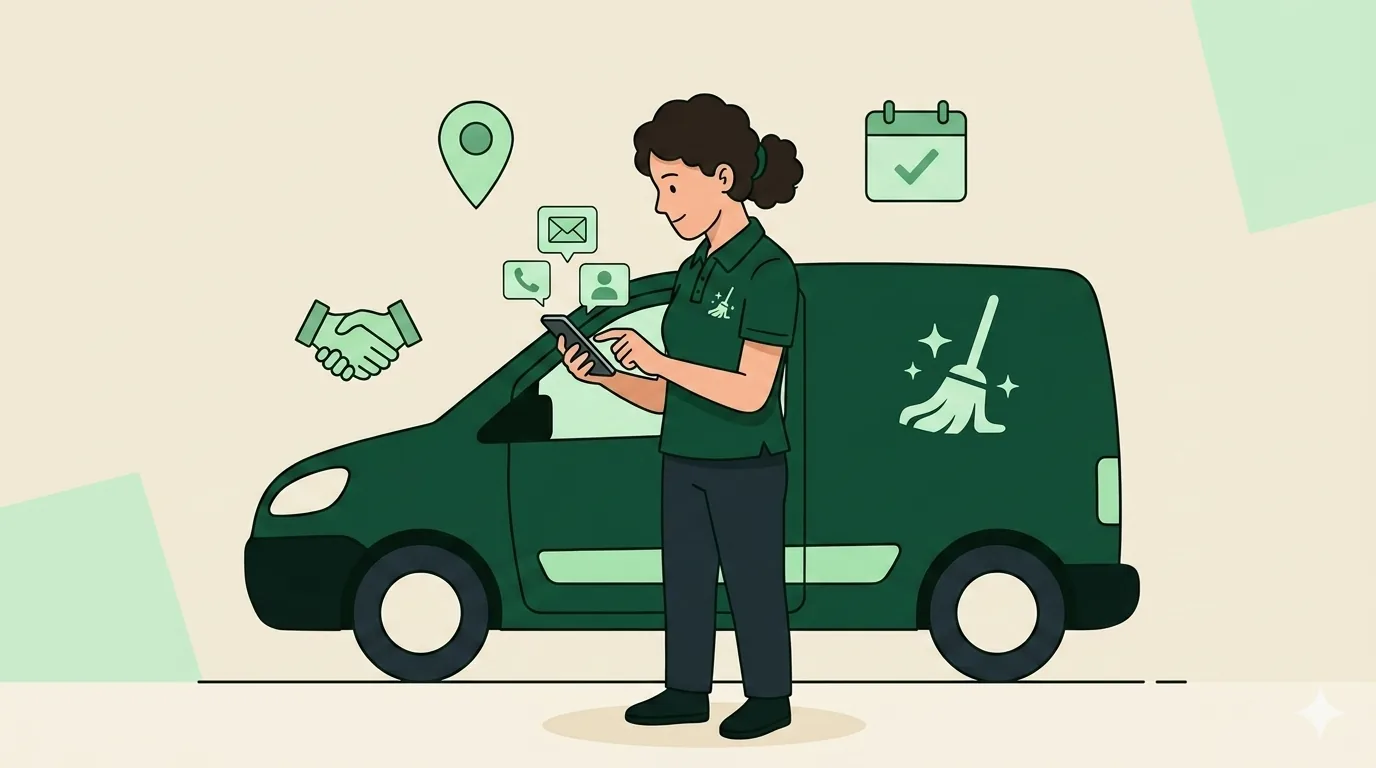
Honest version first: below roughly $8-10K/month in revenue, you can run a cleaning business on a phone calendar, a notes app, and a payment app. Operators benchmark that as the point where field-service software pays for itself. So why start with software on day one? Because the cost of switching later, re-entering clients, rebuilding schedules, migrating invoices mid-growth, is far higher than the cost of starting clean.
Your day-one stack needs to do five things: take bookings, schedule jobs (especially recurring ones), send quotes, invoice automatically, and collect card payments. You can duct-tape that from four free tools, or run it in one system.
This is what CleanerHQ was built for: cleaning-specific pricing calculators, recurring scheduling, quotes that convert to jobs in one click, automatic invoicing with payment reminders at 3, 7, and 14 days, and card payments through your own Stripe account with zero platform markup on processing. Simple per-seat pricing with every feature included, and a free trial that needs a card to start.
Start your launch checklist tonight, try CleanerHQ free and have your booking, quoting, and invoicing running before your first client calls.
For a wider look at what software actually costs as you grow, see our cleaning business software pillar guide.
How to start a cleaning business in 90 days: the launch plan
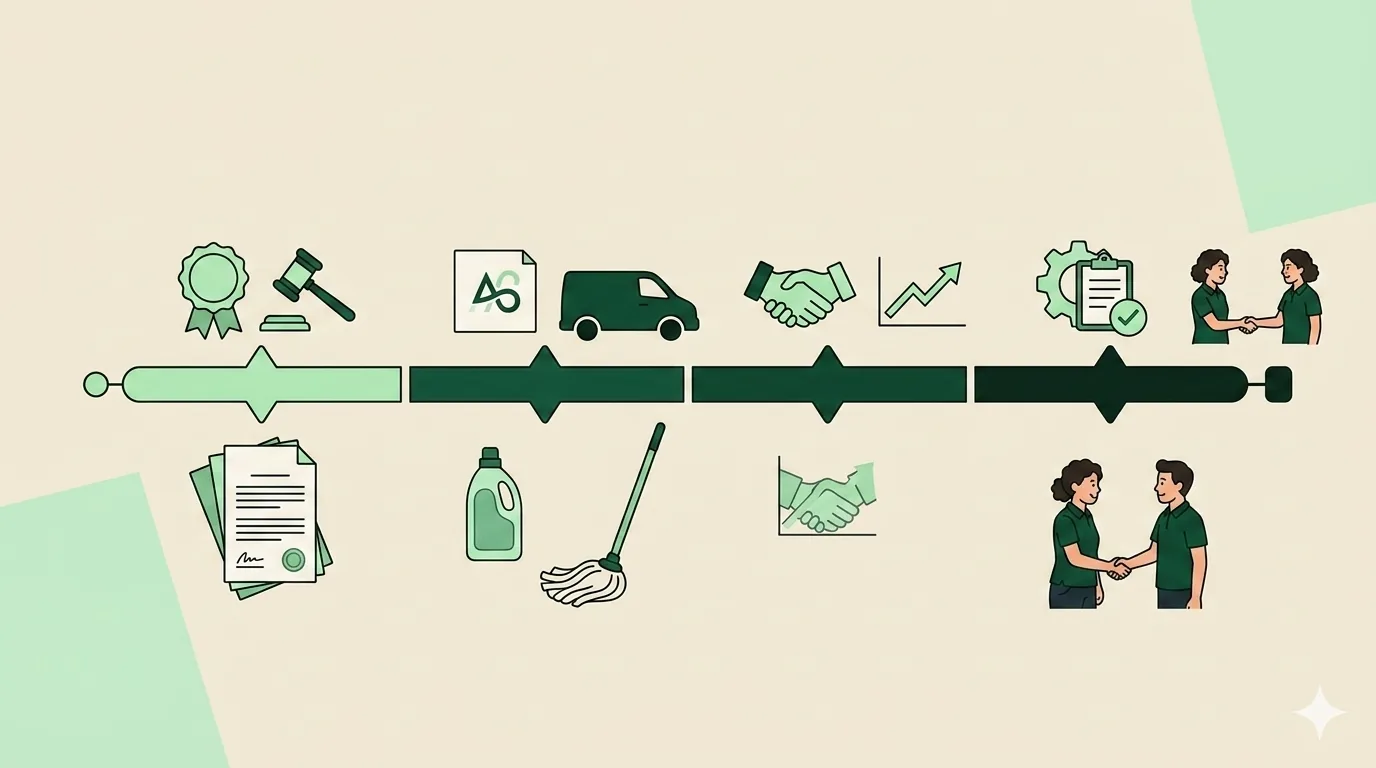
Here is the whole launch, sequenced. Each phase assumes you’re working evenings and weekends until the business can pay you.
Days 1-14: Make it legal, make it insured.
- Choose your niche and confirm 10+ competitors are charging livable rates in your area (if nobody’s charging $150+ per clean, the market is telling you something).
- Register the LLC, get the EIN, open the business bank account.
- Bind general liability insurance; quote a janitorial bond.
- Buy the starter kit (under $500). Nothing else.
Days 15-30: First paying clients.
- Set your price floor at 2x loaded labor cost. Write your three flat rates (recurring, deep, move-out).
- Publish your Google Business Profile with photos.
- Send the offer text to your full contact list. Book your first 3-5 jobs.
- After every job: ask for a review and two referrals, same day.
Days 31-60: Build the engine.
- Turn one-time clients into recurring schedules, offer a biweekly rate that saves them 10-15% versus one-off pricing.
- Launch Local Services Ads with a small budget. Track cost per lead weekly.
- Set up automatic invoicing and card payments so you never chase a check.
- Target: 8-12 recurring clients and reviews in double digits.
Days 61-90: Tighten and decide.
- Raise prices on new clients if your close rate is above ~45%, winning every quote means you’re underpriced (commercial operators benchmark a healthy bid close rate around 30%).
- Cluster jobs geographically; drive time above 15% of paid hours is margin leak.
- Review your profit margins against the benchmarks: labor under 50%, supplies under 10%.
- Decide your month-4 path: stay solo and dense, or start the hiring funnel.
Realistic year-one arc, drawn from operator playbooks: roughly $800-$1,500/month by month two, $2,500-$3,500/month by month four, $5,000-$8,000/month by month eight, and $10,000-$15,000/month with a first hire by month twelve. Plenty of owners go slower. The ones who fail usually skipped the pricing math or the insurance, not the hustle.
Frequently Asked Questions
How much does it cost to start a cleaning business?
Operator benchmarks put a minimal solo residential launch at about $685 and a professional launch at $2,500-$3,500, covering legal setup ($300-$800), first insurance payments (~$40-$70/month for general liability), equipment (under $500), and basic marketing. Commercial launches run $8,000-$15,000+ because of equipment. Most owners recover startup costs within the first one to three months of recurring work.
Do I need a license to start a cleaning business?
In most states there’s no specific “cleaning license”, you need a general business license from your city or county, a DBA if you use a trade name, and an EIN for taxes. Specialty work like biohazard or medical-facility cleaning carries real regulatory requirements. Check your state’s rules before your first commercial bid; many contracts require proof of licensing, bonding, and insurance.
Is a cleaning business profitable?
Yes, when priced correctly. Operator benchmarks put residential gross margins at 30-50% and commercial at 20-40%, with sustainable net margins of 15-20%. The rule that protects profit: price at no less than 2x your loaded labor cost, keeping labor at or below 50% of revenue. Owners who match competitors’ lowball prices instead of pricing bottom-up are the ones who stall.
Can I start a cleaning business with no money?
Close to it. With a sole proprietorship, an existing vehicle, and roughly $200-$300 of supplies, you can legally take residential jobs and fund everything else from revenue. The one thing not to skip is general liability insurance at roughly $40-$70/month, one damaged countertop without coverage can erase months of profit. Use 50% deposits on one-time jobs to keep cash flowing.
How long does it take to get your first cleaning client?
Most new owners booking through their personal network land a first paying job within two weeks of launch. Google Business Profile reviews start compounding within 60-90 days, and operators report Google Local Services Ads delivering leads at $25-$70 each with roughly 50% close rates almost immediately. The 90-day plan in this guide targets 8-12 recurring clients by day 60.
Should I form an LLC for a cleaning business?
Most owners do. An LLC costs $50-$500 in state filing fees and separates your personal assets from business liability, meaningful protection in a business where you work inside clients’ homes with their belongings. A sole proprietorship is free but leaves your savings exposed to claims. Either way, get an EIN and a separate business bank account on day one.

Written by
Rashdi has spent 15+ years building and managing enterprise software, and has worked with US cleaning businesses since 2006. He founded CleanerHQ.